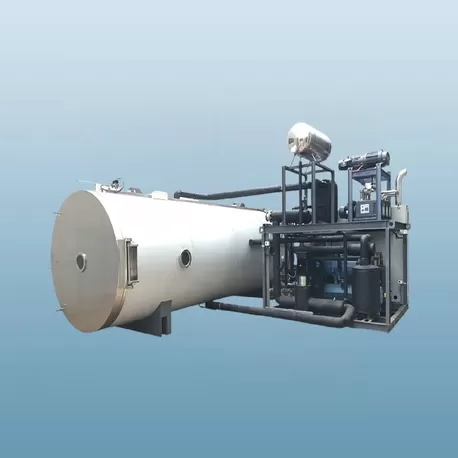
For pharmaceutical companies, biotech labs, and premium food processors, the
choice of a freeze dryer manufacturer determines product stability, batch consistency, and regulatory compliance.
Freeze drying (lyophilization) is not simple dehydration – it requires precise
control of freezing rate, primary drying temperature, and secondary drying
vacuum to preserve biological activity, structure, and shelf life. This article
provides a component-level analysis of what to evaluate when sourcing from a
freeze dryer manufacturer,
covering condenser coil design, shelf heating/cooling rates, vacuum pump sizing,
control system validation, and clean-in-place (CIP) capabilities. Drawing on
data from Nasan's 20 years of industrial drying equipment
manufacturing, we will examine how to match lyophilizer specifications to
products ranging from vaccines and monoclonal antibodies to coffee, fruit, and
probiotics – while avoiding common pitfalls like collapse temperature
exceedance, incomplete sublimation, and high residual moisture.

The engineering competence of a freeze dryer manufacturer directly impacts:
Residual moisture: Pharma products require < 1%
moisture; poorly designed dryers leave 2–3%, reducing shelf life.
Cake appearance and reconstitution: Uneven shelf
temperature leads to meltback or collapsed structure, affecting
dissolution.
Batch uniformity: Vials at the edge of shelves dry faster
than those at the center – a sign of poor vapor flow.
Energy efficiency: Older designs waste 40% of energy on
condenser defrost cycles.
A professional freeze dryer manufacturer like Nasan uses computational fluid dynamics (CFD) to
model vapor flow, selects shelf spacing based on vial geometry, and provides
validated control systems (21 CFR Part 11 compliant). Field data show that
well-engineered lyophilizers achieve residual moisture variation < 0.3%
across all vials, compared to 1.2% for basic units.
2. Core Technical Specifications to Request from a Freeze Dryer
Manufacturer
When evaluating proposals from a freeze dryer manufacturer,
obtain these nine parameters in writing:
Condenser ice capacity (kg per batch): Must be at least
1.5× the water load from the batch. Example: 100 kg of product with 80% moisture
→ 80 kg water → condenser capacity ≥ 120 kg.
Condenser temperature: Typically -50°C to -75°C. Lower is
better for high-solvent loads (e.g., tert-butanol).
Shelf temperature range and ramp rate: -40°C to +60°C; ramp
rate > 1.5°C/min for freezing, > 1.0°C/min for heating.
Shelf temperature uniformity: ≤ ±1°C across all shelves at
steady state (measured with calibrated probes).
Vacuum level and pump-down time: Base pressure < 10 Pa
(0.1 mbar); time to reach 20 Pa < 30 minutes for a 1 m² unit.
Chamber material and finish: 316L stainless steel,
electropolished (Ra < 0.4 µm) for pharma.
Control system: PLC with HMI, data logging, recipe storage
(50+ cycles), and remote access. For pharma: 21 CFR Part 11 compliant audit
trail.
Cleaning systems: CIP (clean-in-place) spray balls and SIP
(sterilize-in-place) capability with steam at 121°C.
Validation documentation: IQ/OQ/PQ protocols, FAT/SAT
reports, and thermal mapping data.
Reputable manufacturers like Nasan provide a
freeze drying cycle development service – they run a small
batch of your product to determine collapse temperature, optimal ramp rates, and
primary drying endpoint (using Pirani vs. capacitance manometer comparison).
3. Freeze Dryer Types Offered by a Manufacturer
A capable freeze dryer manufacturer should offer multiple
configurations to suit different scales and applications.
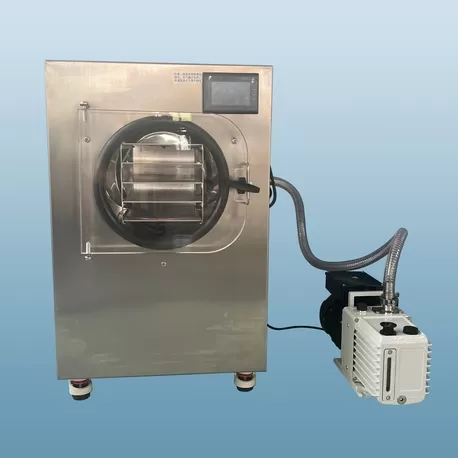
Shelf area: 0.1 – 0.5 m²
Best for: R&D, formulation development, small-batch
pharma (e.g., orphan drugs).
Key features: Single shelf, manual stoppering, small
condenser (6–12 kg ice).
Shelf area: 0.5 – 2.0 m²
Best for: Scale-up studies, clinical trial batches,
high-value nutraceuticals.
Key features: Hydraulic stoppering, automatic
loading/unloading, SIP/CIP ready.
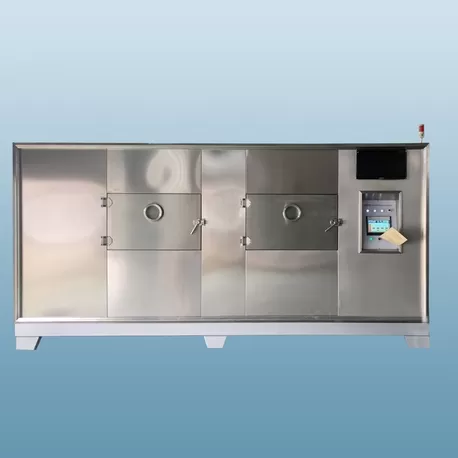
3.3 Production Freeze Dryers (Single or Double Chamber)
Shelf area: 5 – 50 m² per unit
Best for: Industrial pharma (vaccines, biologics), bulk
coffee, instant fruit powders.
Key features: In-line CIP/SIP, automated tray or vial
loading, clean steam condenser defrost.
3.4 Continuous Freeze Dryers
Principle: Tray or belt moves through vacuum locks –
freezing, primary drying, secondary drying zones.
Best for: Very high throughput (> 5 tons/day) – e.g.,
instant coffee, probiotics.
Advantages: Lower labor, consistent product, shorter cycle
time (12–18 hours vs. 24–30 for batch).
Disadvantages: Very high capital cost, complex
validation.
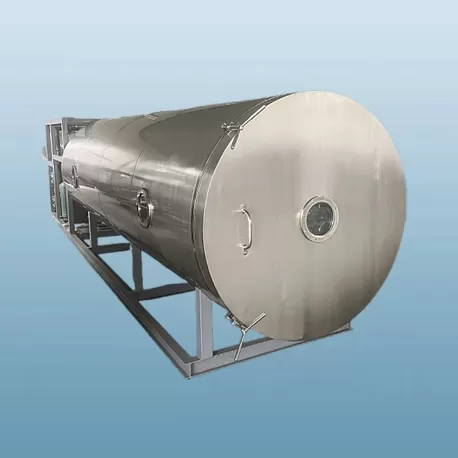
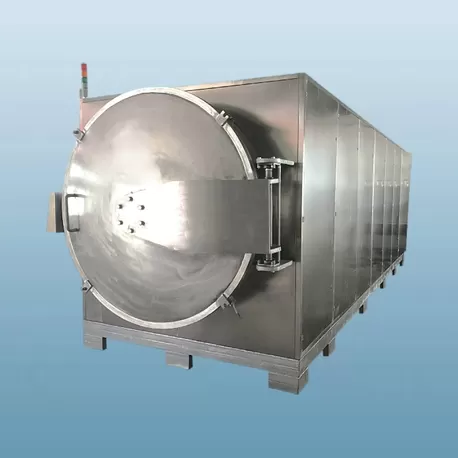
Nasan's industrial freeze
dryers range from 1 m² to 50 m², with options for sterile barrier
isolators and automated loading systems.
4. Industry Pain Points and Engineering Solutions in Lyophilization
Even with good equipment, operators face recurring issues. Below are three
common problems and how a professional freeze dryer
manufacturer addresses them.
Product collapse due to exceeding glass transition temperature
(Tg'): Caused by shelf temperature rising too fast during primary
drying. Solution – a manufacturer provides freeze drying microscopy
(FDM) to determine Tg' and programs a conservative temperature ramp
(e.g., 2°C below Tg'). Nasan includes thermal analysis in their cycle
development service.
Non-uniform sublimation across shelves: Poor vapor flow
causes vials near the door to dry faster than those near the back. Remedy –
adjustable vapor port baffles and shelf spacing optimization. CFD-designed
chambers from Nasan achieve uniformity of ±5% in primary drying time.
Long cycle times due to inadequate condenser sizing: If
condenser ice capacity is too small, the system must pause for defrost
mid-cycle. Solution – specify condenser capacity 2× the water load, and use
hot gas defrost (20 minutes) instead of electric defrost (3
hours).
According to Nasan's field service records, these engineering solutions
reduce batch failure rates from 12% to under 2% for biopharma customers.

5. Energy Efficiency and Operating Cost Comparison
When selecting a freeze dryer manufacturer, ask for the
energy consumption per kg of ice condensed. Typical values:
Single-stage refrigeration (legacy): 1.8–2.5 kWh/kg ice – inefficient.
Two-stage cascade with heat recovery: 0.9–1.3 kWh/kg ice – modern
standard.
With vacuum pump waste heat recovery: 0.7–1.0 kWh/kg ice –
best-in-class.
For a 20 m² production dryer processing 500 kg water per batch, a
high-efficiency unit consumes 500 kWh vs. 1,000 kWh for an old design. At
$0.12/kWh, savings of $60 per batch. Over 200 batches/year → $12,000 annual
energy saving. The payback period for a premium freeze dryer
manufacturer's high-efficiency model is typically 1–2 years.
Nasan dryers include frequency-controlled
vacuum pumps and hot gas defrost with heat recovery,
reducing energy use by 35–45% compared to fixed-speed systems.
6. Validation and Regulatory Compliance
A reputable freeze dryer manufacturer provides documentation
for:
IQ (Installation Qualification): Verifies equipment matches
design specs, utilities are correct.
OQ (Operational Qualification): Tests shelf temperature
uniformity, vacuum leak rate (< 0.01 mbar·L/sec), condenser performance.
PQ (Performance Qualification): Runs three batches with
your product to prove residual moisture, potency, and stability.
Thermal mapping: Temperature distribution across all
shelves (typically 15–30 probes).
21 CFR Part 11 compliance: Electronic records, audit
trails, user access controls for pharma.
Nasan provides FAT (Factory Acceptance Test) at their facility, with
customers invited to witness the test. For regulated industries, Nasan offers
validation package support including templates for SOPs and
validation protocols.
7. Post-Sale Support and Spare Parts Availability
Lyophilizers are complex electromechanical systems. A reliable freeze
dryer manufacturer should offer:
24/7 remote monitoring: Via IoT gateway – alarms for
condenser overpressure, vacuum pump oil change, shelf temperature
deviation.
Preventive maintenance schedules: Every 2,000 operating
hours: replace vacuum pump oil, check condenser coil for ice bridging, calibrate
pressure gauges.
Spare parts availability for 10+ years: Including vacuum
pumps (Edwards, Leybold), valves (VAT, MKS), and temperature sensors
(Pt100).
Operator training: On-site or virtual training on cycle
programming, cleaning validation, and troubleshooting.
Nasan maintains a global spare parts warehouse and offers extended
warranty options (up to 5 years on refrigeration components). Ask for a
list of local service partners when evaluating a freeze dryer manufacturer.
8. Frequently Asked Questions (FAQ) – Freeze Dryer Manufacturer
Selection
Q1: How do I verify a freeze dryer manufacturer's claimed shelf
temperature uniformity?
A1: Request a thermal
mapping report from an independent lab (or ask to witness a test). Place 15–30
calibrated thermocouples across different shelves and corners. Acceptable
uniformity is ±1°C at both -40°C and +40°C. Nasan provides a thermal map for
each unit before shipping.
Q2: What is the typical lead time for a production-scale freeze
dryer?
A2: Standard models (5–20 m²) take 14–20
weeks from order to shipment. Custom units with isolators or automated loading
can take 24–30 weeks. Nasan offers expedited delivery (12 weeks) for
pre-engineered sizes.
Q3: Can the same freeze dryer be used for both pharmaceutical vials
and bulk food products?
A3: Yes, but you must
change shelf configurations (vial nests vs. bulk trays) and perform thorough
cleaning validation. For pharma, a dedicated dryer is recommended to avoid
cross-contamination. Nasan offers interchangeable shelf systems with
quick-release clamps.
Q4: How do I determine the required condenser ice capacity for my
product?
A4: Calculate total water removed: batch
weight × (initial moisture – final moisture) / 100. Then add 20% safety margin.
Example: 200 kg batch of coffee extract (85% moisture → 2% final) → water
removed = 200×0.83 = 166 kg. Condenser capacity ≥ 200 kg. Nasan's engineers
perform this calculation free of charge with your product data.
Q5: What is the difference between a freeze dryer and a vacuum
dryer?
A5: Freeze dryers freeze the product first,
then sublimate ice under vacuum (keeps product below 0°C). Vacuum dryers apply
heat under vacuum without freezing – suitable for heat-stable materials. For
biologics and probiotics, only freeze drying preserves viability. Nasan
manufactures both types; refer to their freeze dryer manufacturer page for a comparison
table.
Q6: What warranty does a reputable freeze dryer manufacturer
offer?
A6: Industry standard is 2 years on parts
and 1 year on labor. Nasan offers 3 years on the refrigeration compressor and
vacuum pump, plus lifetime phone support. Always confirm that the warranty
covers on-site service (not just return-to-base).
9. Partner with an Experienced Freeze Dryer Manufacturer for Long-Term
Reliability
Selecting the right freeze dryer manufacturer is a strategic decision
that affects product quality, regulatory compliance, and operating costs.
Generic dryers from non-specialized manufacturers often lack proper condenser
sizing, shelf uniformity, or validation support, leading to batch rejections and
regulatory findings.
Nasan provides end-to-end support:
Free cycle development using your product sample (up to 5 kg).
Custom engineering to fit your facility's ceiling height and cleanroom
classification.
Installation, IQ/OQ, and operator training.
Remote performance monitoring and predictive maintenance alerts.
Request your free feasibility study today – provide a detailed lyophilization cycle
recommendation, including shelf temperature profile, vacuum setpoints, and
estimated cycle time. Click here
to contact Nasan’s freeze drying specialists or call +86 21 31006665 ext 801(Telephone) / +86 139 1616 2131(Mobile No.) for
immediate assistance. We also offer lease-to-own financing for qualified
businesses.