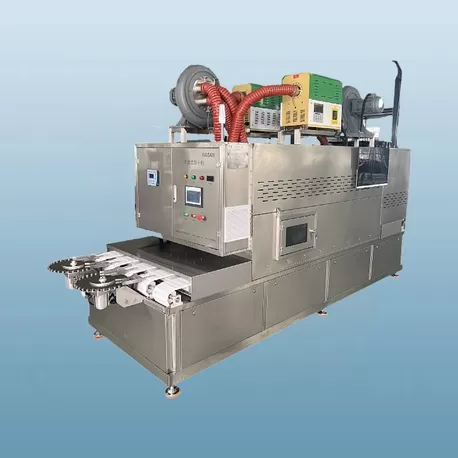
Industrial drying operations across food, chemical, and pharmaceutical
sectors rely on precisely controlled heat and air movement to remove moisture
without damaging product quality. Among various drying technologies, the
hot air dryer remains the
most versatile and widely adopted solution due to its ability to handle diverse
feedstocks – from granules and powders to sheets and pieces. A well-engineered
hot air dryer integrates fan systems, heating elements, air
distribution plenums, and exhaust controls to achieve consistent final moisture
content (typically 2–8% for shelf-stable products). This article examines the
thermodynamic principles, component design, and application-specific
configurations of industrial hot air dryers. As a manufacturer of advanced
drying systems, Nasan has supplied over 500
hot air dryer installations
worldwide, including hybrid models that combine convection with microwave
energy.

1. Fundamental Principles of Hot Air Drying
Drying with heated air involves three simultaneous processes: heat transfer
from air to the wet product, internal moisture migration to the surface, and
evaporation of surface moisture into the air stream. The driving force is the
difference between the vapor pressure at the product surface and the partial
pressure of water in the bulk air. A hot air dryer maximizes
this gradient through:
Air temperature: Typically 40–150°C for food products
(higher for minerals or chemicals). Each 10°C increase doubles the evaporation
rate, but risks case hardening (surface sealing) if too rapid.
Air velocity: 0.5–5 m/s across the product bed. Higher
velocities break the boundary layer, increasing heat transfer coefficient (h)
from 20 to 100 W/m²·K.
Relative humidity (RH): Inlet RH should be below 20% for
effective drying. Recirculating a portion of exhaust air (50–70%) improves
energy efficiency but raises inlet RH – a trade-off controlled by the dryer’s
recirculation damper.
Engineers use psychrometric charts to calculate the required air flow rate
for a given moisture removal load. For example, removing 100 kg of water per
hour requires approximately 5,000–8,000 m³/h of air at 80°C (depending on
ambient conditions). Industrial hot air dryer systems from Nasan include integrated sensors to maintain these parameters
automatically.
The physical design of a hot air dryer varies
dramatically based on product characteristics and throughput. Below are five
common industrial types.
2.1 Tray (Cabinet) Hot Air Dryer
Used for batch processing of delicate or sticky products (herbs, sliced
fruits, pharmaceutical granules). The dryer consists of an insulated cabinet
with multiple trays (10–50 trays, each 0.5–2 m²). Air is heated by steam coils
or electric elements, then distributed horizontally across each tray. Key design
parameters:
Air reversal mechanism: Periodically reverses airflow
direction to equalize drying across the cabinet. Without reversal, trays near
the inlet dry faster.
Tray material: Stainless steel (304 or 316) for
food/pharma; perforated or mesh bottom to allow air passage.
Capacity: 50–1,000 kg per batch. Drying time: 4–24 hours
depending on product thickness.
Nasan’s cabinet hot air dryer includes a programmable logic
controller (PLC) with 10-step ramp/soak profiles, suitable for products
requiring gradual temperature increase.
2.2 Continuous Belt Hot Air Dryer
For high-volume, uniform products (snacks, pet food, washed vegetables). A
perforated stainless steel belt transports the product through a tunnel divided
into 2–6 zones, each with independent temperature and air velocity control. Belt
widths: 0.8–3 meters; length: 6–30 meters. Advantages:
Multi-stage drying: First zone at 90°C for rapid surface
drying; middle zones at 70°C for internal moisture migration; final zone at 50°C
for tempering.
Nozzle arrays: Air impingement nozzles (3–10 mm diameter,
50–100 mm spacing) placed 30–100 mm above the belt. Impingement increases heat
transfer coefficient by 3–5x compared to parallel flow.
Residence time: 15–120 minutes, controlled by belt speed
(0.2–2 m/min).
A continuous hot air dryer can remove 200–2,000 kg of water
per hour, making it suitable for industrial food processing lines.
2.3 Fluidized Bed Hot Air Dryer
Designed for granular, free-flowing materials (powders, crystals, pellets).
Heated air passes upward through a perforated distributor plate, suspending the
particles in a fluid-like state. This maximizes contact area and eliminates dead
zones. Key features:
Pressure drop: Typically 3–8 kPa across the bed. Requires
high-static pressure fans (5–15 kW).
Bed depth: 100–500 mm for batch units; 50–300 mm for
continuous units.
Bypass system: Allows cleaning-in-place (CIP) without
disassembling the dryer.
Fluidized bed hot air dryer systems achieve drying times of
5–30 minutes, much faster than tray dryers. However, they cannot handle sticky
or pasty products without back-mixing with dried material.
2.4 Rotary Hot Air Dryer
Used for minerals, biomass, and animal feed. A slightly inclined rotating
cylinder (2–5° slope, 1–3 m diameter, 5–30 m length) lifts and showers the
product through a hot air stream. Air can be co-current (product and air move
same direction) or counter-current (air opposite to product). Counter-current
provides lower final moisture but risks overheating if product is
heat-sensitive. Rotary hot air dryer units are robust and can
handle large particle sizes (up to 50 mm) and high throughputs (10–100
tonnes/hour).
2.5 Vacuum Hot Air Dryer
For heat-sensitive or oxidizable materials (pharmaceutical intermediates,
vitamins). The dryer operates under reduced pressure (0.1–0.8 bar absolute),
which lowers the boiling point of water. This allows drying at 30–60°C instead
of 80–120°C. The hot air dryer in this configuration uses
recirculated heated air but at lower density – requiring larger fans to maintain
velocity. Nasan offers vacuum-capable dryers with absolute pressure control and
inert gas purging for oxygen-sensitive products.
3. Critical Components and Their Selection
Performance of any hot air dryer depends on
properly sized and matched components:
Heating source: Steam (most economical for >100 kW),
natural gas (direct or indirect), electric (precise control but higher operating
cost). Nasan’s hot air dryer designs use finned tube heat
exchangers with condensate removal traps.
Fan selection: Centrifugal fans (backward-curved blades)
for high static pressure; axial fans for high flow at low pressure. Fan motor
must be rated for the operating temperature (insulation class F or H for
>120°C).
Air filters: Pre-filters (G4) remove coarse dust; HEPA
(H13) for pharmaceutical drying. Filter clogging increases pressure drop –
monitored by differential pressure switches.
Exhaust system: An exhaust fan removes moisture-laden air.
The ratio of recirculated air to fresh air is controlled by a motorized damper.
For every 1 kg of water evaporated, approximately 2,500 kJ of latent heat is
lost in the exhaust – hence recirculation is essential for energy
efficiency.
4. Energy Efficiency and Heat Recovery
Operating a hot air dryer is energy-intensive; typical
consumption ranges from 2.5 to 6.0 MJ per kg of water removed. Without recovery
measures, energy costs can dominate production expenses. Three proven methods to
reduce consumption:
Exhaust air heat exchanger: A plate or run-around coil
preheats incoming fresh air using the hot, humid exhaust. Recovers 30–50% of
sensible heat. Payback period: 1–2 years.
Heat pump integration: A mechanical vapor recompression
(MVR) system captures latent heat from exhaust vapor, condensing it and
returning energy to the air heater. Can reduce energy use by 60–80%, but only
cost-effective for dryers operating >4,000 hours/year.
Solar preheating: For low-temperature drying (<60°C),
solar thermal collectors can preheat fresh air to 30–40°C, cutting natural gas
consumption by 15–25%.
Nasan offers an energy audit service for existing hot air dryer installations, recommending retrofits based on local utility rates.
5. Application-Specific Design Considerations
Different industries impose unique requirements on hot air dryer construction and controls:
Food (fruits, vegetables, herbs): Sanitary design with
smooth welds, no crevices, and easy access for cleaning. Materials: 304
stainless steel. Air filters: G4 pre-filter plus F9 bag filter to prevent oil or
dust contamination. Temperature range: 40–80°C to preserve color and
nutrients.
Chemical (pigments, catalysts): Explosion-proof electrical
components (ATEX or Class II Div 2). Inert gas option (nitrogen) for flammable
solvents. The hot air dryer must have a solvent recovery
condenser on exhaust.
Pharmaceutical (granules, tablets): Validated cleaning
protocols (CIP/SIP). Air handling unit must meet ISO 8 (Class 100,000) cleanroom
standards. Temperature uniformity: ±2°C across the tray or belt. Full
documentation per GAMP 5.

6. Common Operational Problems and Solutions
Even a well-designed hot air dryer can
experience performance degradation. Field data from Nasan’s service records
identify four frequent issues:
Case hardening: The product surface dries too quickly,
sealing moisture inside. Solution: Reduce initial air temperature by 15–20°C and
increase recirculation to raise inlet RH above 30% for the first 30
minutes.
Non-uniform final moisture: Caused by uneven air
distribution. Solution: Install airflow straighteners or replace perforated
plates with higher open area (35–45%). Perform annual thermal mapping with 10–20
thermocouples.
High exhaust humidity (>25% RH): Indicates insufficient
fresh air intake. Solution: Open fresh air damper by 10–20% increments until
exhaust RH drops to 18–22% – a balance between energy and drying rate.
Belt tracking issues (continuous dryers): Belts migrate due
to uneven tension or worn rollers. Solution: Install belt alignment sensors that
trigger automatic correction; schedule monthly tension inspection.
Frequently Asked Questions (FAQ) About Hot Air Dryers
Q1: What is the typical price range for an industrial hot air
dryer?
A1: A small batch tray dryer (100 kg capacity) costs
$8,000–$20,000. A continuous belt dryer (1,000 kg/h moisture removal) ranges
from $80,000 to $250,000. A fluidized bed hot air dryer for
powders is $50,000–$150,000. Nasan provides customized quotations based on
product characteristics and production volume. Energy recovery add-ons add
15–30% to base price but reduce operating costs by 40–60%.
Q2: How do I determine the required drying time for my product in a
hot air dryer?
A2: Drying time depends on critical moisture content,
diffusion coefficient, and air conditions. The most accurate method is a
laboratory tray drying test: dry a thin layer of product at constant temperature
(e.g., 70°C) and 2 m/s air velocity, recording weight loss every 15 minutes.
Plot moisture content vs. time – the constant-rate period ends when surface
water is depleted. Nasan offers free drying trials at our test center for
customers.
Q3: Can a hot air dryer be used for heat-sensitive probiotics or
enzymes?
A3: Yes, but only at low temperatures (≤40°C) with
dehumidified air. Standard hot air dryer units can be modified
with a refrigeration dehumidifier to produce air at 30°C and 15% RH, achieving
8–10% final moisture without thermal degradation. Alternatively, consider a
freeze dryer for maximum viability. Nasan builds low-temperature hybrid dryers
combining air dehumidification with gentle convection.
Q4: What maintenance schedule does a hot air dryer
require?
A4: Daily: Check filter differential pressure, clean
tray/belt residues. Weekly: Inspect fan belts tension, test safety interlocks.
Monthly: Calibrate temperature sensors (using a certified probe), clean heat
exchanger fins. Annually: Replace air filters, lubricate bearings, perform
thermal uniformity test. Nasan supplies a detailed maintenance logbook with
every hot air dryer.
Q5: How does a hot air dryer compare to a microwave
dryer?
A5: Microwave drying penetrates the product, heating
volumetrically – much faster than convection but may cause arcing or non-uniform
heating if product geometry varies. A hot air dryer is slower
but more predictable and suitable for bulk solids. Nasan’s combined hot air-microwave dryer uses 70% hot
air for surface drying and 30% microwave for internal moisture, reducing drying
time by 50% compared to hot air alone.
Q6: What are the exhaust emission limits for a hot air dryer used for
food waste drying?
A6: Drying organic materials (food waste, sludge)
releases volatile organic compounds (VOCs) and odorous gases. In many regions,
exhaust must pass through a thermal oxidizer (750°C for 0.5 seconds) or
biofilter. The hot air dryer manufacturer should provide a
stack test report. Nasan offers integrated thermal oxidizer packages with heat
recovery.
Need a Custom-Engineered Hot Air Dryer for Your Production Line?
Selecting the right hot air dryer requires
matching airflow patterns, heating method, and construction materials to your
product’s physical and thermal properties. Nasan provides turnkey solutions – from lab-scale
dryers for R&D to multi-zone continuous systems with heat recovery. Our
engineering team performs a comprehensive analysis including moisture sorption
isotherms, drying kinetics, and CFD simulation of air distribution.
Send your inquiry today – include product name, initial and
target moisture content, throughput (kg/hour or batch size), and any temperature
sensitivity constraints. We will respond within 24 hours with a preliminary
design, performance guarantee, and fixed price quotation. For urgent projects,
we offer a rapid prototyping service to test your product on our pilot
hot air dryer.
Request a consultation for your hot air
dryer from Nasan – references available from major food processors,
chemical manufacturers, and pharmaceutical companies.