Conventional freeze drying (lyophilization) delivers superior product quality
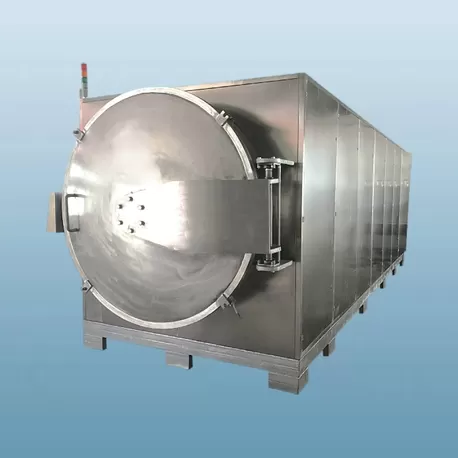
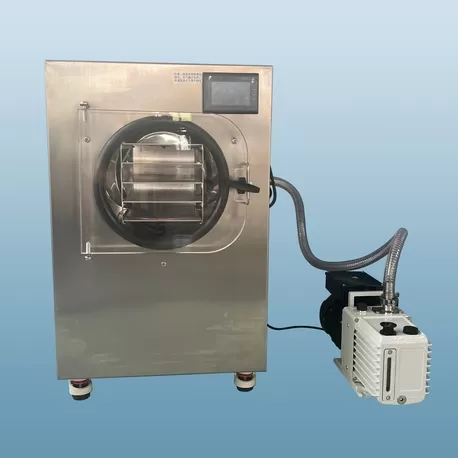
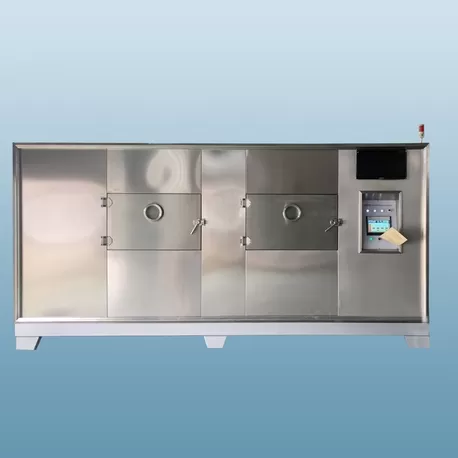
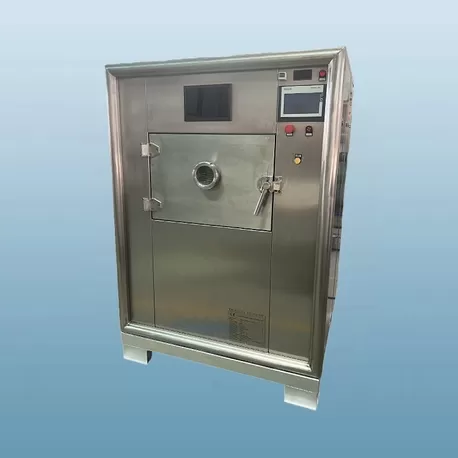
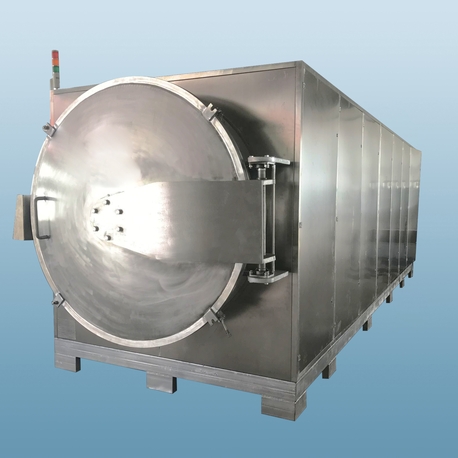
but suffers from long batch cycles and high energy consumption. A microwave freeze drying system combines volumetric heating with low-temperature sublimation,
reducing drying time by 40–70% while preserving bioactivity. Nasan engineers industrial hybrid dryers that integrate microwave applicators with
vacuum chambers, offering a controlled environment for heat-sensitive materials.
This article examines the physics, design challenges, and applications of
microwave-assisted freeze drying for manufacturers of pharmaceuticals,
nutraceuticals, and premium instant foods.

In standard freeze drying, heat is transferred by conduction and radiation
from heated shelves to the frozen product. As sublimation proceeds, the dried
outer layer acts as an insulator, slowing heat penetration – a phenomenon called
“mass transfer limitation.” A microwave freeze dryer solves this by generating heat directly inside the frozen material via
dielectric polarization. Water molecules in the ice phase rotate at microwave
frequencies (typically 915 MHz or 2450 MHz), producing uniform volumetric
heating. This maintains a higher sublimation front velocity without elevating
product temperature above the collapse point.
Key Physical Parameters
Frequency selection: 915 MHz for large industrial chambers
(penetration depth >20 cm in frozen material); 2450 MHz for lab or smaller
batch sizes.
Vacuum level: 10–100 Pa (0.1–1 mbar) to allow ice
sublimation at -40°C to -20°C.
Specific energy input: 1–5 W/g of frozen product,
controlled by magnetron duty cycle or variable power supply.
Temperature monitoring: Fiber-optic probes (non-interfering
with microwave field) placed at product core and edge.
Industry Pain Points Addressed by Microwave Freeze Technology
Process engineers face several limitations with traditional freeze dryers.
Microwave freeze offers targeted solutions.
Extended primary drying time: Conventional cycles for 2 cm
thick product can exceed 48 hours. MFD reduces this to 8–15 hours, increasing
throughput.
Non-uniform residual moisture: Edge vials dry faster than
center vials due to radiant heat asymmetry. Microwave volumetric heating
improves inter-vial uniformity.
Product collapse or cracking: When shelf temperature is
raised too quickly, the dried matrix collapses. MFD’s direct energy transfer
prevents overheating the dried layer.
High energy cost per kilogram: Conventional freeze dryers
have poor energy efficiency (10–20% thermal efficiency). MFD improves to 50–60%
because microwheat heats only the product, not the shelves and chamber
walls.
Scaling up from laboratory microwave freeze dryers to production units requires solving several engineering challenges.
Nasan applies a systematic
approach based on electromagnetic simulation and validation.
1. Uniform Field Distribution
Microwave standing waves create hot and cold spots inside a cavity. Solutions
include:
Rotating turntables or mode stirrers: Mechanical movement
of the product or reflective elements evens out energy distribution.
Multi-feed waveguide systems: Four or six magnetrons
positioned at different cavity walls, each with phase-controlled input.
Variable frequency microwave (VFM): Sweeps across 2400–2500
MHz to average out hotspots – effective for irregularly shaped
products.
2. Preventing Plasma Discharge
Under vacuum, high electric field strengths can ionize residual gas, causing
violet plasma that damages product and cavity. Mitigation strategies:
Keep pressure above 20 Pa (0.2 mbar) during microwave application; use
pressure regulation valves.
Design rounded interior corners and avoid sharp edges that concentrate field
intensity.
Introduce low-pressure inert gas (nitrogen or argon) if working below 10
Pa.
3. Product-Specific Power Protocols
Each material has a dielectric loss factor that changes during drying. Ice
has high loss (heats efficiently), but dried material has low loss (transparent
to microwaves). A control algorithm must:
Monitor reflected power (impedance mismatch) – spikes indicate ice
depletion.
Reduce power input stepwise as the sublimation front recedes.
Switch to conventional conductive heating for final secondary drying
(removing bound water) to avoid arcing.
Industries that benefit most from microwave freeze technology are those with high-value, temperature‑sensitive, or porous
structure‑dependent products.
Pharmaceuticals: Protein therapeutics (monoclonal
antibodies, vaccines), liposomal formulations, and mRNA lipid nanoparticles. MFD
preserves tertiary structure better than spray drying or conventional
lyophilization.
Probiotics and starter cultures: Lactobacillus,
Bifidobacterium strains – survival rates after microwave freeze drying reach
90–95% vs. 70–80% conventional.
Specialty food ingredients: Instant coffee powders with
retained aroma, freeze-dried fruit slices with natural color, and rehydrating
vegetable granules.
Biomaterials and collagen scaffolds: Tissue engineering
matrices require interconnected porosity. MFD produces uniform pore sizes
without surface crust.
Process Validation and Quality Attributes
A successful microwave freeze drying process must demonstrate comparable or better product quality to
conventional methods. Key metrics:
Residual moisture: Karl Fischer titration below 2% for
pharmaceuticals; below 5% for food.
Bioactivity retention: Enzyme activity or cell viability
assays before and after drying.
Glass transition temperature (Tg): Differential scanning
calorimetry (DSC) to ensure the dried product remains in glassy state,
preventing collapse during storage.
Reconstitution time: Seconds to form a clear solution (no
insoluble particles).
Uniformity between batches: Statistical analysis of
residual moisture across different positions in the chamber.
Nasan provides validation
protocols including temperature mapping, power uniformity tests, and scale‑up
documentation for regulated industries. Their hybrid microwave freeze dryers are designed for GMP compliance with clean-in-place (CIP) and
steam-in-place (SIP) options.

Comparison of Microwave Freeze Drying vs. Conventional Freeze Drying
To illustrate process advantages, consider a typical batch of 500 kg frozen
probiotic solution in trays (2 cm thickness).
| Parameter | Conventional freeze dryer | Microwave freeze dryer |
|---|
| Primary drying time | 32–40 hours | 10–14 hours |
| Total cycle (including freezing & secondary drying) | 48–60 hours | 20–28 hours |
| Energy consumption (kWh per kg ice sublimated) | 1.8–2.5 kWh | 0.7–1.1 kWh |
| Residual moisture uniformity (RSD) | ±8–12% | ±3–5% |
| Product temperature during primary drying | Heated from shelf at +10°C to +30°C, gradients exist | Volumetric self-heating, uniform ±2°C |
(Data based on published studies and industrial pilot trials; actual values
depend on product formulation and equipment design.)
Operational Considerations and Maintenance
Running a production microwave freeze system requires specific procedures:
Magnetron lifetime: Industrial magnetrons last 8,000–10,000
hours if operated within rated power. Regular replacement schedules prevent
unexpected downtime.
Waveguide and window cleaning: Condensed volatile compounds
(e.g., terpenes from food) deposit on microwave-transparent vacuum windows,
reducing transmission. Clean monthly with approved solvents.
Vacuum pump maintenance: Water vapor load is high; use
two‑stage rotary vane pumps with gas ballast or dry screw pumps. Change oil at
recommended intervals.
Safety interlocks: Microwave leakage checks every shift
using a calibrated meter – levels below 5 mW/cm² at 5 cm distance.
Frequently Asked Questions (FAQs) on Microwave Freeze Drying
Q1: What products are unsuitable for microwave freeze
drying?
A1: Materials with very low dielectric loss factors (e.g.,
pure crystalline ice is fine, but completely dried cellulose has low loss).
Also, products containing conductive metallic particles (e.g., certain catalysts
or pigments) can cause arcing. Similarly, large batches of non-uniform shape
(e.g., whole fruits) may suffer from uneven heating unless the cavity design
includes rotation.
Q2: Can I retrofit a conventional freeze dryer with microwave
capability?
A2: Retrofitting is rarely practical. Standard freeze dryers
have metal shelves that reflect microwaves, causing field distortion. The
chamber geometry and door seals are not designed for microwave containment. A
dedicated microwave freeze drying system from a specialized manufacturer like Nasan ensures safety and performance.
Q3: How does microwave freeze drying affect the viability of
probiotics?
A3: When properly controlled (low product temperature during
primary drying, final temperature below 35°C), microwave freeze drying achieves
equal or higher viability than conventional methods. The shorter exposure to
vacuum and lower oxidative stress improve survival. In one study, Lactobacillus
rhamnosus showed 93% viability after MFD vs. 82% conventional.
Q4: Is microwave freeze drying scalable to 1000 kg per
batch?
A4: Yes, but with careful engineering. Industrial systems at
915 MHz use multiple magnetrons (e.g., 6 × 25 kW) distributed around the
chamber. Batch sizes up to 2,000 kg have been designed for instant coffee and
pharmaceutical intermediates. The key is to maintain field uniformity – achieved
by rotating shelves or moving the product bed.
Q5: What safety certifications are required for an industrial
microwave freeze dryer?
A5: In the EU, CE marking with EN 61010-2-010 (particular
requirements for microwave heating equipment). In the US, FCC Part 18 for
industrial microwave generators, plus UL 61010-1. Also, pressure vessel
certification (PED or ASME) since the chamber operates under vacuum.
Nasan equipment is built to these standards with documented
conformity.
Ready to Evaluate Microwave Freeze Technology for Your Product?
Transitioning from batch lyophilization to microwave-assisted freeze drying
demands technical assessment of your material's dielectric properties and
desired throughput. Nasan offers feasibility testing
on pilot-scale microwave freeze dryers. Send a sample of your product (minimum 5 kg frozen) along with your
quality specifications – our application lab will provide comparative data on
drying time, residual moisture, and bioactivity retention.
➡️ Submit your inquiry here: https://www.nasandry.com/contact –
Include product type, batch size, and target residual moisture. A process
engineer will respond within 48 hours with a feasibility outline and a proposed
system layout.