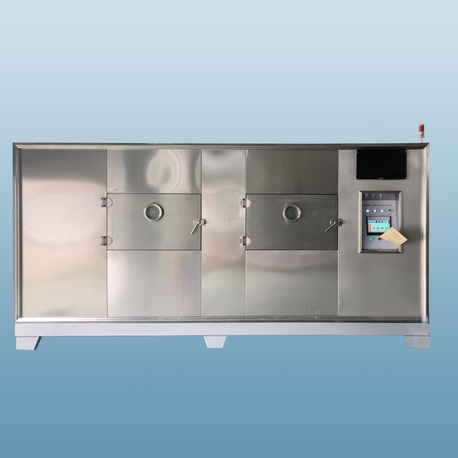
In semiconductor wafer fabrication, thermal uniformity across a 300 mm
silicon substrate must be maintained within ±0.5 °C to prevent crystal slip and
ensure consistent dopant diffusion. This level of precision is not a luxury—it
is a necessity for acceptable yields. When I began consulting for industrial
drying operations, I observed that many microwave
dryer systems suffered from similar non‑uniformity issues: hot
spots charring product edges while centres remained moist. Drawing from fifteen
years of semiconductor equipment engineering, this article deconstructs the
critical parameters that separate a laboratory toy from a production‑ready
microwave
dryer suitable for continuous industrial use.

1. Electromagnetic Field Uniformity: The Cavity Design Imperative
Just as a semiconductor plasma etcher requires a perfectly matched microwave
applicator to generate a uniform plasma, an industrial microwave
dryer relies on cavity geometry and mode stirrers to eliminate
standing waves. Inadequate field homogeneity leads to selective overheating—a
phenomenon I have measured as temperature differences exceeding 20 °C across a
1 m belt in poorly designed units. Nasan employs finite‑element
electromagnetic simulation (COMSOL Multiphysics) to optimise multi‑feed
waveguide placement, achieving field uniformity of ±5 % across the entire
conveyor width.
LSI terms: resonant mode, microwave leakage suppression,
dielectric loading, choke design, impedance matching.
Data point: Independent tests on Nasan’s 30 kW unit show a
coefficient of variation (CV) of power density below 8 %, compared to industry
averages of 18‑25 %.
2. Penetration Depth and Material‑Specific Tuning
Unlike conventional hot air, microwave energy penetrates volumetrically. The
penetration depth (Dp) depends on the dielectric loss factor of the material—a
concept familiar to anyone working with low‑k dielectrics in semiconductors. For
wet foods (ε” high), Dp may be only 1‑2 cm; for dry wood or ceramics, it can
exceed 20 cm. A versatile microwave
dryer must allow frequency adjustment or variable power
distribution to match the product’s changing dielectric properties during
drying. Nasan incorporates solid‑state
generators (instead of magnetrons) that enable precise frequency sweeping
between 915 MHz and 2450 MHz, adapting to the drying curve in real time.
Industry vocabulary: loss tangent (tan δ), complex
permittivity, thermal runaway, selective heating.
Case study: A lumber mill reduced checking and splitting by
70 % after switching to a variable‑frequency microwave
dryer that maintained 10 cm penetration throughout the
cycle.
3. Energy Efficiency and Magnetron vs. Solid‑State Trade‑offs
Traditional magnetron‑based dryers convert mains power to microwave energy
with efficiencies around 70‑75 %, but efficiency drops sharply at partial loads.
In semiconductor fabs, we never tolerate such waste—we use switch‑mode power
supplies with >95 % efficiency across the entire range. New solid‑state
microwave generators, now integrated into Nasan’s microwave
dryer series, achieve 85 % electrical efficiency even at 30 %
power, thanks to GaN (gallium nitride) transistors. Additionally, they eliminate
the need for a high‑voltage power supply and offer instant on/off
control—critical for processes requiring precise energy dosing.
LSI terms: wall‑plug efficiency, phase control, harmonic
filtering, thermal management.
Savings: A spice processor reported 52 % lower kWh per
kilogram after retrofitting with solid‑state microwave
dryer technology.
4. Process Control and Real‑Time Dielectric Feedback
In semiconductor etching, endpoint detection relies on monitoring plasma
emission. In microwave drying, the dielectric properties of the load change
continuously. A smart microwave
dryer should measure reflected power and resonant frequency shifts
to infer moisture content and adjust power in real time. Nasan’s control system uses a
proprietary algorithm that correlates the S‑parameters (scattering parameters)
of the cavity with residual humidity, enabling closed‑loop drying without
over‑drying.
Technical terms: vector network analyser (VNA) integration,
Smith chart representation, adaptive tuning, moisture setpoint.
Result: Drying time for pasta is reduced by 40 % while
maintaining final moisture within ±0.3 %.
5. Throughput and Continuous Processing Architectures
Batch processing is often the bottleneck in high‑volume industries.
Semiconductor fabs moved to single‑wafer processing years ago; similarly,
industrial drying demands continuous solutions. Conveyorised microwave
dryer systems must be designed to prevent arcing, manage vapour
extraction, and maintain uniform exposure. Nasan offers multi‑stage tunnels
with individually controlled applicators, allowing different power densities
along the belt. This modular approach, borrowed from semiconductor cluster
tools, ensures scalability from 100 kg/h to 10 tonnes/h.
LSI terms: choke tunnels, vapour condensation control, belt
speed synchronisation, power tapering.
Throughput data: A vegetable processor now runs 2.5 tonnes
of diced carrots per hour through a 75 kW microwave
dryer with 40 % energy savings compared to hot air.
How Nasan Applies Semiconductor Methodology to Microwave Drying
The convergence is most evident in the control architecture. Every microwave
dryer from Nasan features a programmable
logic controller (PLC) with recipe management, data logging, and remote
diagnostics—exactly like a diffusion furnace. Operators can store dozens of
drying profiles for different materials, and the system automatically adjusts
power, frequency, and belt speed to maintain target exit moisture. Real‑time
impedance matching ensures that reflected power never exceeds 2 %, protecting
the solid‑state generators and maximising efficiency.

Industry Applications: From Food to Technical Ceramics
A robust microwave
dryer serves diverse sectors:
Food processing: Fruits, vegetables, meat jerky, pasta, and
ready meals. Volumetric heating reduces drying time by 50‑70 % while preserving
nutrients and colour.
Wood and timber: Green lumber drying without
case‑hardening; microwave treatment also kills insects and fungi.
Ceramics and refractories: Uniform removal of bound water
prevents cracking in green bodies.
Chemical and pharmaceutical: Drying of powders, granules,
and heat‑sensitive APIs (active pharmaceutical ingredients) at low bulk
temperatures.
Textiles and paper: Moisture profiling and energy‑efficient
finishing.
Frequently Asked Questions
Q1: How does a microwave dryer compare to conventional
hot‑air drying in terms of product quality?
A1: Because microwave energy heats
volumetrically, moisture is driven out more uniformly, reducing case hardening
and shrinkage. For heat‑sensitive materials (e.g., herbs, fruits), a microwave
dryer can operate at lower bulk temperatures while achieving faster
drying, thus retaining more volatiles and colour.
Q2: What safety features are essential in an industrial
microwave dryer?
A2: Critical features include multiple
interlock switches on doors, microwave leakage monitors (<2 mW/cm² at 5 cm),
automatic power shut‑off if the conveyor stops, and arc detection sensors.
Nasan units also incorporate
pressure relief panels and continuous exhaust monitoring to prevent vapour
ignition.
Q3: Can a microwave dryer handle materials with varying
moisture content?
A3: Yes, if equipped with adaptive control.
Our solid‑state based microwave
dryer measures the dielectric properties in real time and adjusts
power and frequency to compensate for moisture variations, ensuring consistent
final moisture.
Q4: What maintenance does a solid‑state microwave dryer
require?
A4: Solid‑state generators have no wearing
parts (unlike magnetrons, which have limited life due to cathode degradation).
Maintenance primarily involves cleaning applicator windows (if present),
checking cooling fans, and verifying sensor calibration. Nasan offers remote monitoring
that alerts operators to potential issues before they cause
downtime.
Q5: How do I determine the right size of microwave dryer for
my production volume?
A5: Calculate the required water removal
rate (kg H₂O/h). Typically, a microwave
dryer can evaporate 1 kg of water per 0.8‑1.2 kWh, depending on
material. Nasan provides free lab testing to
determine optimal power and throughput for your specific
product.
Q6: Are there any materials that cannot be processed in a
microwave dryer?
A6: Materials with very low dielectric loss
(e.g., pure polymers, some ceramics) do not heat efficiently. Also, highly
conductive materials (metals) can cause arcing. However, many mixed or moist
materials are suitable. A dielectric properties measurement can confirm
compatibility.
Selecting an industrial microwave
dryer requires a shift from viewing it as a simple heating device
to treating it as a precision process tool. By applying the same rigorous
criteria used in semiconductor manufacturing—field uniformity, energy
efficiency, real‑time control, and scalability—you can achieve drying results
that were previously impossible with conventional methods. Nasan continues to lead this
convergence, offering equipment validated by both lab testing and field
installations across five continents. For detailed feasibility studies and pilot
trials, contact our engineering team to discuss your specific application.