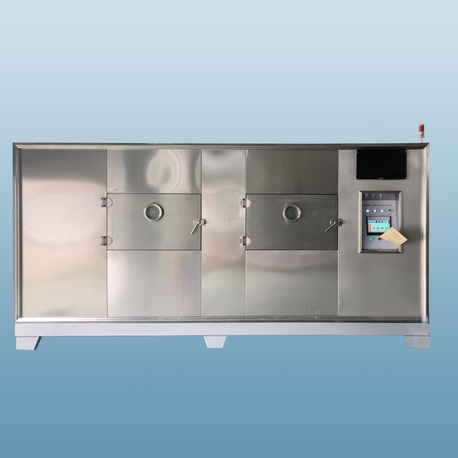
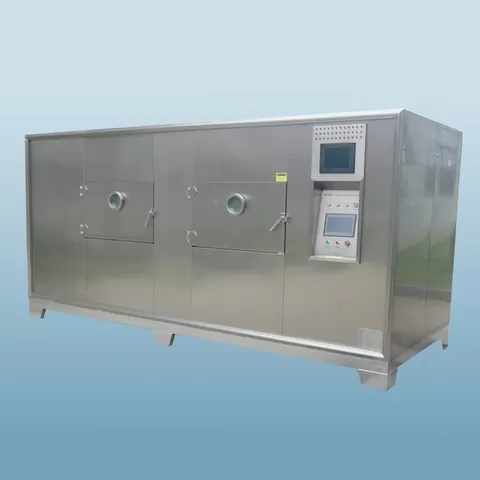
In high-throughput manufacturing environments, moisture removal dictates
production pace, energy consumption, and product integrity. Conventional hot-air
convection or conduction dryers often create thermal gradients, leading to case
hardening, extended processing cycles, and degradation of heat-sensitive
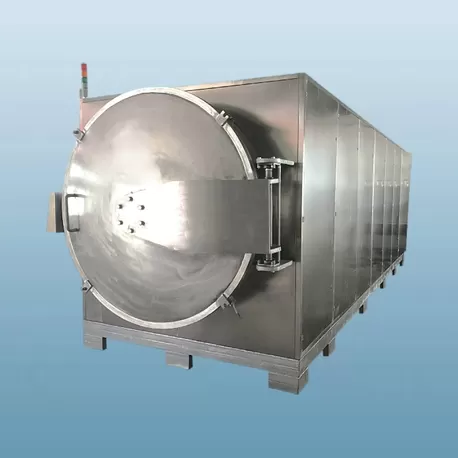
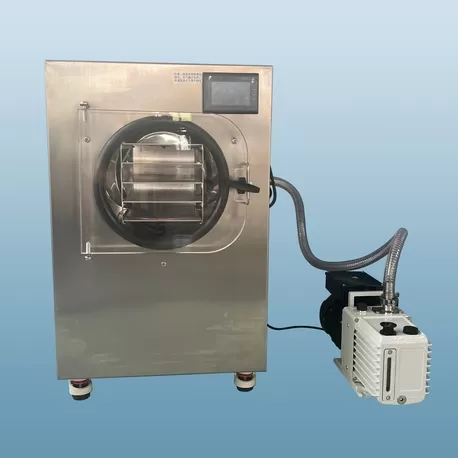
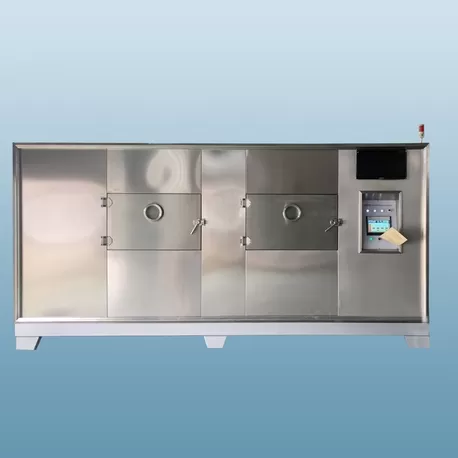
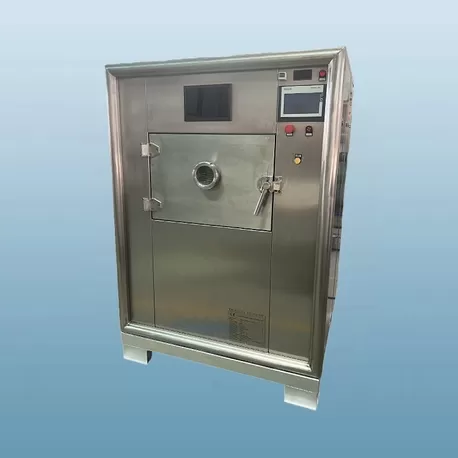
compounds. The microwave drying machine offers a
paradigm shift by directly coupling electromagnetic energy with polar molecules
inside the material. This article presents a detailed engineering analysis of
industrial microwave drying technology, addresses specific production pain
points across sectors, and outlines performance considerations for capital
equipment selection.

Volumetric Heating Mechanism: How a Microwave Drying Machine Operates
Unlike conventional methods that rely on surface heat transfer, a microwave drying machine exploits
dielectric loss mechanisms. When materials containing water or other polar
molecules are exposed to alternating electromagnetic fields in the 915 MHz or
2.45 GHz industrial bands, molecular dipoles attempt to align with the rapidly
reversing field. Friction from this molecular oscillation generates
instantaneous volumetric heat. The absorbed power density follows the
relationship P = 2πf ε₀ εᵣ'' E², where frequency (f), dielectric loss factor
(εᵣ''), and electric field intensity (E) determine the heating rate. This
phenomenon enables moisture to vaporize deep within the product, and the
generated steam migrates outward along the concentration gradient, producing
drying rates that can be three to ten times faster than convective systems.
Frequency Selection and Penetration Depth
Industrial microwave dryers operate primarily at 915 MHz (prevalent in the
Americas and Asia for high-power systems) or 2.45 GHz (global standard for
lower-power and laboratory units). The penetration depth — defined as the
distance where power density drops to 37% of the surface value — is inversely
related to frequency and material moisture content. For wet granular materials,
915 MHz provides deeper energy coupling, suitable for thicker beds or dense
products. At 2.45 GHz, the more compact applicator design fits production lines
with moderate throughput. Engineering teams must match frequency to product
dimensions and dielectric properties to avoid non-uniform heating.
Critical Engineering Subsystems in Continuous Microwave Dryers
An industrial-grade microwave drying machine integrates
several precision components to ensure consistent volumetric energy delivery,
safety, and process repeatability. Each subsystem directly influences the drying
uniformity and uptime.
Magnetron array and power supply: Industrial continuous
systems deploy multiple air- or water-cooled magnetrons (1 kW to 15 kW each)
with phase-controlled power supplies. Redundant magnetron configurations allow
gradual power fading without process interruption.
Multimode or traveling-wave applicator: Resonant cavities
designed with mode stirrers or slotted waveguides distribute electric field
intensity, reducing standing wave patterns. For high uniformity, advanced
systems implement phased antenna arrays with real-time field mapping.
Conveyor and material handling: PTFE-coated belts, ceramic
rollers, or non-metallic chains prevent arcing and withstand temperatures up to
200°C. Variable-frequency drives regulate residence time to match target final
moisture content.
Closed-loop process control: PLC/HMI platforms integrate IR
surface thermometers, humidity sensors in exhaust ducts, and near-infrared
moisture analyzers. PID algorithms adjust total magnetron power, belt speed, and
air extraction rates automatically.
Choke and shielding assemblies: Quarter-wavelength choke
tunnels at both ends of the drying tunnel contain microwave leakage below 1
mW/cm² (FDA/CDRH standards). Interlocked safety switches and redundant
monitoring provide operator protection.
These engineering features transform the microwave dryer from a simple
heating chamber into a precise dehydration platform suitable for 24/7 industrial
schedules.
Industry-Specific Dehydration Challenges and Microwave Solutions
Each sector faces distinct drying pain points — from oxidation in spice
drying to agglomeration in fine chemicals. The following analysis maps
industrial dilemmas to microwave-specific countermeasures.
Food Processing: Retention of Volatile Oils and Color
In drying herbs (basil, oregano), fruits (cranberries, mangoes), and
vegetables, conventional hot air drives off volatile terpenes and causes
caramelization of sugars. A microwave drying machine operating at 40–60°C bulk
temperature preserves up to 95% of essential oil content because the surrounding
air remains cool while water molecules are activated internally. For snack
seasonings, Nasan has engineered belt-type systems
that combine vacuum-assisted extraction to further lower boiling points,
preventing nutrient degradation. Additionally, microwave pasteurization occurs
simultaneously — pathogens are inactivated by both thermal and non-thermal
effects, eliminating separate sanitization steps.
Pharmaceutical Manufacturing: Heat-Sensitive API Drying
Wet granulation for tablet compression requires removing solvents (water,
ethanol, or acetone) without altering polymorphic forms of active pharmaceutical
ingredients (APIs). Traditional tray dryers expose granules to elevated
temperatures for 12–24 hours, risking degradation. Microwave volumetric heating
reduces drying time to 2–4 hours while maintaining uniform residual solvent
levels below ICH limits. The closed-system design of a microwave drying machine
also allows solvent recovery via condensation, aligning with cGMP and
containment requirements.
Chemical Powders: Preventing Surface Crust and Agglomeration
Drying catalysts, ceramic precursors, or pigment pastes often results in a
hardened outer layer that traps internal moisture — the classic case-hardening
effect. Because energy is generated inside each particle, a microwave drying
machine creates simultaneous evaporation throughout the bed. The resulting steam
flow breaks particle bridges, producing free-flowing powders without post-drying
milling. For hygroscopic materials, nitrogen-purged applicators avoid
reabsorption.
Wood and Biomass: Stress Relief and Insect Elimination
Kiln drying of timber can cause surface checks and residual growth stress.
Microwave treatment elevates internal temperature rapidly, equalizing moisture
content from core to surface. Moreover, the rapid dielectric heating kills
wood-boring insects and larvae at all life stages — a non-chemical phytosanitary
method compliant with ISPM 15.
Addressing Common Operational Concerns with Microwave Drying
Despite clear advantages, production managers raise valid concerns regarding
uniformity, load sensitivity, and integration with existing lines. Each
challenge has an established engineering solution.
Hot and cold spots: Modern applicators use rotating
reflectors, moving antennae, or multiple feed ports with variable phase
shifters. Field uniformity can be modeled via finite-element simulation (COMSOL
or CST) before fabrication. Post-installation, fiber-optic temperature probes at
multiple bed positions validate uniformity.
Material geometry and load size: Dielectric properties
change during drying. Adaptive power control based on real-time humidity exit
temperature compensates for load variations. Conveyor systems with load cells
adjust power per unit mass.
Integration with existing drying lines: Microwave modules
can be retrofitted as boosters before conventional dryers — removing 30–50% of
moisture in the first minutes, then finishing with low-temperature air. This
hybrid approach reduces overall energy use and footprint.
Potential for arcing: Any metallic inclusions or sharp
conductive objects (nuts, bolts, metal fragments) can create arcs. Magnetic
separators upstream and non-metallic conveyor belts eliminate risk. Industrial
microwave drying machines also include arc detection and automatic power
shutdown.
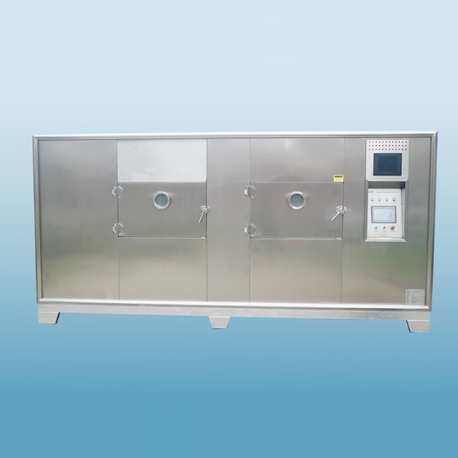
Engineering Parameters for Industrial Microwave Dryer Specification
When evaluating a microwave drying machine, buyers must
analyze the following performance metrics against production targets. Nasan
provides custom engineering datasheets, but general guidelines help initial
selection.
Output power range: 6 kW to 200 kW (modular scales). For
throughput estimation, expect approximately 0.8–1.2 kg water removal per kWh,
depending on material dielectric properties.
Residence time variability: Belt speeds from 0.1 to 5
m/min, allowing moisture reduction from 60% down to 8% in a single pass for many
products.
Applicator length and tunnel cross-section: Standard
tunnels from 3 m to 20 m, with heights from 50 mm to 300 mm, optimized for bulk
density.
Uniformity index: Measured by coefficient of variation
(CV%) of final moisture across belt width — top systems achieve CV < 3%.
Safety compliance: Industrial units must meet ISO 14000,
CE, and local radiation leakage norms. Verify third-party test reports.
Data acquisition: OPC-UA or Modbus TCP interfaces for IIoT
integration, batch traceability, and predictive maintenance analytics.
Reliability and Engineering Support from Nasan
Nasan has engineered microwave drying
platforms for more than 350 industrial lines worldwide, focusing on continuous
systems for hygroscopic powders, food ingredients, and recycled materials. Each
microwave drying machine undergoes factory acceptance testing
(FAT) with the client’s actual product samples to confirm drying kinetics and
uniformity. Nasan provides turnkey installation, process
optimization training, and remote diagnostics via secure IoT gateways. For B2B
buyers requiring validated systems for regulated industries (pharma, food
safety), Nasan’s documentation packages include IQ/OQ protocols
and sanitary designs with polished stainless-steel interiors. The engineering
team also performs dielectric property measurements (open-ended coaxial probe
method) to scale up from laboratory results to full production capacity,
eliminating trial-and-error investments.
Frequently Asked Questions (FAQ) – Microwave Drying Machine
Q1: Which materials are not suitable for a microwave drying
machine?
A1: Materials with extremely low dielectric loss factors
(e.g., pure PTFE, many ceramic oxides below 100°C) do not couple efficiently
with microwaves and would require susceptor additives. Highly conductive bulk
metals or sealed metal containers cause arcing and are strictly prohibited.
Also, very dense, thick blocks with low porosity may develop internal steam
pressure beyond structural limits — pre-drying size reduction is
recommended.
Q2: Can a microwave drying machine handle continuous
operation with varying moisture input?
A2: Yes. Industrial controllers with feed-forward algorithms
adjust microwave power based on incoming moisture sensors (NIR or capacitance).
Closed-loop tuning maintains exit moisture setpoint despite fluctuations. Many
systems also include adaptive power profiling across zones: higher power density
in the entry zone for bulk water removal, lower density in final zones for
finish drying without overheating.
Q3: What safety certifications are required for industrial
microwave drying equipment?
A3: In North America, equipment must comply with FDA 21 CFR
1030.10 (radiation safety) and typically UL 61010-1 or CSA. European markets
require CE marking, including EN 55011 for EMC and EN 61010-1. Additionally, ISO
12100 risk assessment and NFPA 70 (electrical safety) for systems operating with
flammable solvents are mandatory. Responsible manufacturers provide third-party
leakage test reports at installation.
Q4: How does product throughput compare between a microwave
dryer and a fluidized bed dryer?
A4: For the same footprint, a microwave drying machine
typically achieves 2–4 times higher evaporation rates for medium-moisture
products (initial moisture 40–70%). However, fluidized bed dryers are more
economical for very coarse, free-flowing granules that tolerate high air
velocity. The optimal choice depends on material friability and heat
sensitivity. Many hybrid solutions exist: microwave-assisted fluidized beds
combining volumetric heat with convective mass transfer.
Q5: Can I test my product on a microwave drying machine
before purchasing industrial-scale equipment?
A5: Absolutely. Nasan offers laboratory-scale microwave
drying systems (2–6 kW) with variable frequency and data logging. Clients can
ship 5–50 kg of product for process characterization: drying curves, uniformity
mapping, and quality analysis. The results are used to generate linear scale-up
models to full production throughput, ensuring a secure capital
investment.
Optimize Your Production with Precision Microwave Drying Engineering
Selecting an industrial microwave drying machine requires careful
evaluation of material dielectric behavior, desired throughput, and integration
constraints. The engineering depth of volumetric heating, combined with modern
control systems, solves long-standing drying bottlenecks in food, chemical, and
pharmaceutical lines. Nasan’s application engineers provide
tailored feasibility studies, on-site trials, and full lifecycle support — from
concept to commissioning.
For detailed technical specifications, a customized quotation, or to arrange
a product test using your material, contact the Nasan engineering team directly. Share your target moisture reduction, production
capacity, and product characteristics to receive a process proposal and 3D
layout drawing.
→ Send an inquiry to Nasan industrial drying specialists to discuss
your microwave drying project.