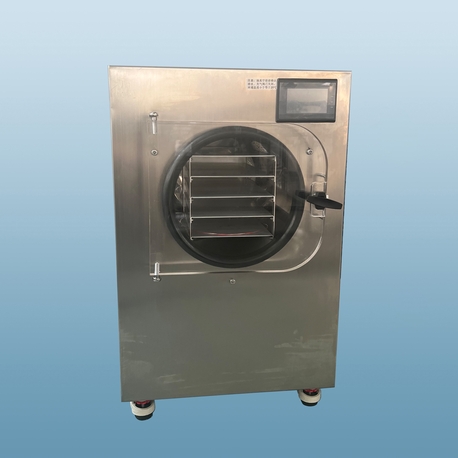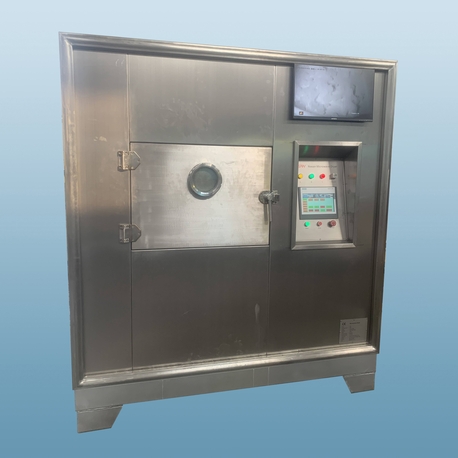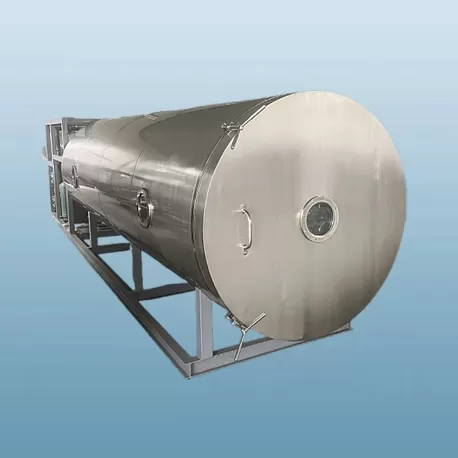


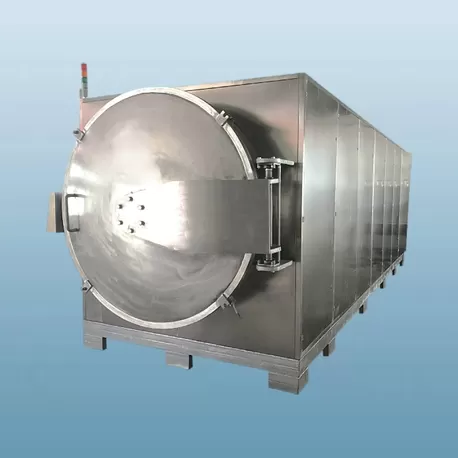
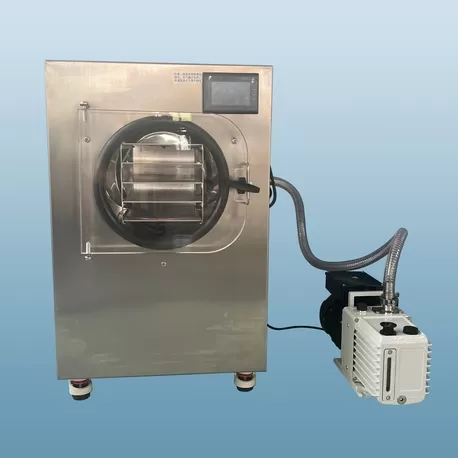
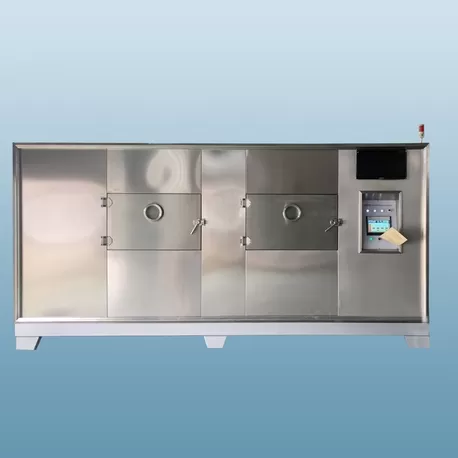
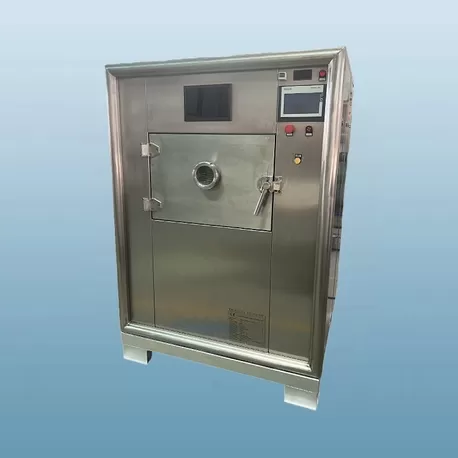
Freeze drying (lyophilization) preserves food, pharmaceuticals, and biological samples by removing water via sublimation. A freeze dehydrator machine must maintain precise vacuum and temperature control to avoid product collapse. Unlike conventional hot-air drying, freeze drying retains structure, flavor, and over 95% of nutrients. Nasan has engineered lyophilization systems for instant coffee, fruit slices, probiotics, and vaccine stabilizers across 30 countries. This guide details nine measurable criteria for procurement engineers.

1. Sublimation Rate and Ice Capacity
The core performance metric of any freeze dehydrator machine is how much water it removes per hour. Key specifications:
Ice condenser capacity: Measured in kg of ice before defrost. For batch lyophilizers, 50–500 kg is typical. Too small causes premature defrost cycles.
Sublimation rate: kg water removed per hour per square meter of shelf area. Target ≥1.2 kg/h·m² for fruit; ≥0.8 kg/h·m² for pharmaceutical vials.
Final residual moisture: ≤2% for long-term stability; ≤0.5% for sensitive biologics.
Industrial lyophilizers from Nasan include dual condensers for continuous operation – one defrosts while the other collects ice, increasing uptime by 40%.
2. Shelf Temperature Uniformity and Ramp Rate
Non-uniform shelves cause partial drying. For a freeze dehydrator machine, demand:
Shelf-to-shelf variance: ≤±1.0°C across all shelves at -40°C to +60°C range.
Ramp rate: Cooling from +20°C to -40°C in ≤45 minutes; heating from -40°C to +40°C in ≤60 minutes.
Temperature sensors: PT100 Class A probes on each shelf, not just the fluid inlet.
Nasan's shelf design uses silicone oil circulation with individual flow control valves. We provide a 24-point temperature map during FAT.
3. Vacuum System Performance and Leak Rate
Vacuum level determines sublimation efficiency. Specifications for a freeze dehydrator machine:
Ultimate vacuum: ≤1 Pa (0.0075 Torr) for most products; ≤0.1 Pa for high-value pharmaceuticals.
Leak rate: ≤0.01 Pa·m³/sec (equivalent to 0.01 mbar·L/sec) per ISO 14644.
Pump combination: Rotary vane + roots blower for fast pump-down (from atmospheric to 10 Pa in ≤20 minutes).
Vacuum gauge type: Pirani and cold cathode dual sensors for accuracy across range.
Nasan conducts helium leak tests on every chamber before shipment, providing a certificate of leak integrity.
4. Control System and Lyophilization Cycle Programming
A modern freeze dehydrator machine must support complex recipes. Look for:
PLC-based HMI (Siemens or Allen-Bradley) with touchscreen.
At least 200 recipe slots, each with 20+ steps (freezing, primary drying, secondary drying).
Real-time pressure rise test to determine end of primary drying (automatic).
Data logging: CSV export for 21 CFR Part 11 compliance (pharma grade).
Remote access via VPN for diagnostic support.
Nasan’s control software includes a “recipe optimizer” that uses historical data to reduce cycle time by 15–25% without compromising quality.
5. Energy Efficiency: Refrigeration and Heat Recovery
Freeze drying is energy-intensive. Evaluate your freeze dehydrator machine for:
Specific energy consumption: kWh per kg of water removed. Target ≤1.8 kWh/kg for food; ≤2.2 kWh/kg for pharma.
Refrigerant type: R507A or R404A (phased out) vs. low-GWP options like R449A or R744 (CO₂).
Heat recovery from condenser: Hot gas defrost using waste heat reduces electrical defrost energy by 70%.
Nasan offers an optional heat pump-assisted lyophilizer that reuses rejected heat to warm shelves, cutting total energy use by 35%.
6. Material Compatibility and Cleanability
Pharmaceutical and food applications require hygienic design. A freeze dehydrator machine should have:
Chamber interior: 316L stainless steel, electropolished to Ra ≤0.4μm.
Corners: radius ≥25mm to prevent product accumulation.
SIP (Steam-in-Place): Ability to withstand 121°C steam for 30 minutes.
CIP spray balls: Coverage of all internal surfaces.
Nasan’s freeze dryers are designed with no internal threads or sharp edges, meeting EHEDG guidelines.
7. Common Industry Pain Points and Solutions
Based on 180+ installations, Nasan has identified recurring issues with freeze dehydrator machine performance:
Problem: Product collapse (loss of porous structure). Root cause: Shelf temperature above collapse temperature during primary drying. Solution: Use in-line product thermocouples and control shelf temperature at 5°C below collapse point.
Problem: Long cycle time (>48 hours for fruit). Root cause: Insufficient condenser surface area. Solution: Increase condenser coil density or add a second condenser. Nasan’s dual condenser design cuts cycle time by 30%.
Problem: Batch-to-batch moisture variation. Root cause: Inconsistent pre-freezing rate. Solution: Controlled freezing with ramp rate of -1°C/min. Nasan’s control includes programmable freezing profiles.
8. Scale-Up from Pilot to Production
Laboratory freeze dryers do not linearly scale to production. When purchasing a production freeze dehydrator machine, require:
Heat transfer coefficient (Kv) data from pilot unit.
Validation using the same vial/tray geometry and fill depth.
A scale-up factor calculation: Kv production = 0.8 × Kv pilot for shelf drying.
Nasan offers a “scale-up guarantee”: We run your product on our pilot machine (2m² shelf area) and then on a full-scale unit (20–100m²). If drying time differs by more than 15%, we adjust the design at no cost.
9. Why Nasan Is a Preferred Freeze Dehydrator Machine Manufacturer
With 15 years in lyophilization engineering, Nasan builds freeze dehydrator machine systems that combine reliability with low lifecycle cost. Our differentiators:
Modular chamber construction: Shelf areas from 5m² to 200m², expandable by adding modules.
In-situ cleaning validation: We provide residue swab test kits and protocols.
Global service network: 24/7 remote monitoring and 48-hour on-site response.
Performance bond: Contractual guarantees for sublimation rate, energy consumption, and final moisture content.
Nasan’s freeze dryers are used by Nestlé, Pfizer, and Unilever for high-value products.
Frequently Asked Questions (FAQ)
Q1: What is the difference between a freeze dehydrator machine and a
conventional hot-air dehydrator?
A1: Freeze drying removes water by
sublimation (solid to vapor) under vacuum, preserving structure and nutrients.
Hot-air drying uses evaporation, which causes shrinkage and nutrient loss.
Freeze-dried products rehydrate faster and retain original shape.
Q2: How do I calculate the required ice condenser capacity for my
batch?
A2: Multiply the batch’s water content (kg) by 1.2 (safety
factor). Example: 200 kg of strawberries (90% water = 180 kg water) requires 216
kg ice capacity. Nasan provides a sizing spreadsheet on request.
Q3: Can a freeze dehydrator machine handle both food and
pharmaceutical products?
A3: Yes, but pharmaceutical applications
require 316L stainless steel, SIP capability, and 21 CFR Part 11 software.
Food-grade uses 304 stainless and simpler controls. Nasan offers interchangeable
hygienic designs for multi-use facilities.
Q4: What is the typical lead time for a custom freeze
dryer?
A4: Standard units (5–20m² shelf area): 14–16 weeks. Large
custom systems (50–200m²): 24–30 weeks. Nasan offers 10-week expedited delivery
for smaller pilot units.
Q5: How often must vacuum pump oil be changed?
A5: For
rotary vane pumps: every 2,000 operating hours or 6 months. Nasan’s oil-free
scroll pump option eliminates oil changes, reducing maintenance cost by
80%.
Request a Freeze Drying Feasibility Test or Quotation
Selecting the right freeze dehydrator machine requires product-specific data. Nasan offers complimentary freeze drying trials at our R&D center. Send 2–5 kg of your product (fruit, coffee, probiotics, or biological material). We will provide a report showing: drying curve, final moisture, water activity, color difference, and energy consumption per batch.
Contact Nasan’s lyophilization
division:
Website: https://www.nasandry.com/
Email:
info@nasandry.com
Phone: +86 21 31006665 ext 801(Telephone)/+86 139 1616 2131(Mobile No)
Include your product type, batch size (kg per cycle), desired residual moisture, and current drying method. Nasan will respond with a customized proposal, including a process flow diagram and ROI calculation, within 5 business days.