


Dehydrating fruit at scale demands more than a heated chamber. An industrial fruit dryer must balance energy efficiency, product quality, and throughput consistency. Drying mango, apple, banana, or berry slices requires precise air management to avoid case hardening or uneven moisture removal. Nasan has supplied over 500 drying systems to food processors in Asia, Europe, and the Americas. This guide presents seven measurable criteria for procurement and plant engineers.

1. Drying Technology Comparison: Convection, Belt, or Heat Pump
The core of any industrial fruit dryer is its heat and airflow method. Three dominant designs exist:
Convection tray dryers: Heated air (50–85°C) passes over static trays. Simple but labor-intensive. Best for small batches or delicate fruits (berries, herbs).
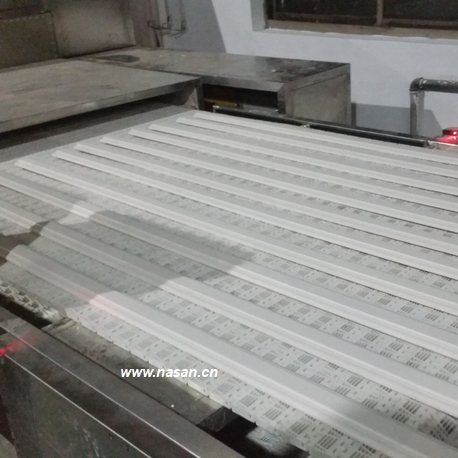
Continuous belt dryers: Stainless steel mesh belts move fruit through multiple temperature zones. High throughput (2–10 tons per hour). Suitable for sliced apples, bananas, mangoes.
Heat pump dryers: Closed-loop refrigerant system recovers latent heat from exhaust air. Energy consumption 40–60% lower than electric resistance. Excellent for heat-sensitive fruits (kiwi, papaya).
Industrial drying equipment from Nasan includes hybrid designs: heat pump pre-drying followed by belt finishing. One mango processor reduced energy cost by 48% with this configuration.
2. Temperature Uniformity Across the Drying Chamber
Non-uniform temperature leads to over-dried edges and under-dried centers. When evaluating an industrial fruit dryer, request a thermal mapping report:
At least 12 thermocouple positions across the belt width and length.
Maximum variance: ±2°C for fruit drying (compared to ±5°C for general drying).
Air velocity uniformity: 1.5–2.5 m/s across the product bed, measured with a hot-wire anemometer.
Nasan designs include adjustable air dams and perforated plates to correct airflow distribution. We provide a certified uniformity test during commissioning.
3. Energy Efficiency Metrics: Specific Moisture Extraction Rate (SMER)
Energy cost is the largest operational expense. A professional industrial fruit dryer should achieve:
SMER (kg water removed per kWh): Target 2.5–3.5 for heat pump dryers; 1.2–1.8 for electric resistance; 2.0–2.8 for gas-fired convection.
Heat recovery efficiency: Cross-flow plate exchangers reclaim 50–70% of exhaust heat. Rotary wheel regenerators achieve up to 85%.
Insulation: Minimum 75mm polyurethane foam (thermal conductivity ≤0.022 W/m·K).
Nasan's heat pump dryers feature inverter-driven compressors and variable-speed fans. A dried mango line in Thailand reported SMER 3.2, cutting annual electricity bill by $34,000.
4. Product Quality Parameters: Color, Rehydration, and Nutrient Retention
Buyers reject fruit with browning or poor texture. Specify these quality metrics for your industrial fruit dryer:
Color difference (ΔE): ≤5 compared to fresh fruit (measured with a spectrophotometer).
Rehydration ratio: ≥1:4 (dry to rehydrated weight) after 15 minutes in 40°C water.
Vitamin C retention: ≥70% after drying. Achievable with low-temperature (<65°C) heat pump drying.
Final moisture content: ≤15% for long-term storage; ≤2% for powdering.
Nasan offers in-line NIR moisture sensors that adjust belt speed automatically, maintaining ±1% moisture consistency.
5. Hygiene and CIP (Clean-in-Place) Design
Fruit drying lines require frequent cleaning to prevent microbial growth. An industrial fruit dryer should include:
Stainless steel 304 or 316 interior with rounded corners (no sharp angles).
Removable belt sections for manual washing or automated spray nozzles.
Sloped floors to drain condensation and wash water.
Access doors with sanitary gaskets (FDA-compliant silicone).
Commercial fruit drying systems from Nasan are designed with CIP connections. A berry processor reduced cleaning downtime from 4 hours to 45 minutes using our automated spray system.
6. Control System and Data Logging for HACCP Compliance
Food safety regulations require process traceability. Select a industrial fruit dryer with:
PLC-based HMI (Siemens or Allen-Bradley) with recipe storage for 100+ fruit types.
Real-time recording of temperature, humidity, belt speed, and energy consumption.
USB/ethernet export for HACCP audit reports.
Alarm for out-of-spec conditions (e.g., temperature drift >2°C for 5 minutes).
Nasan's control platform includes a cloud dashboard for remote monitoring across multiple sites. One dried apple exporter uses it to certify batch compliance for European buyers.
7. Throughput Validation and Scale-Up Guarantees
Laboratory tests do not always scale linearly. When purchasing an industrial fruit dryer, demand:
A pilot test using your fruit (minimum 200 kg) on a production-equivalent belt width.
A signed throughput guarantee: kg of fresh fruit input per hour at specified final moisture.
Drying curve data showing time to reach target moisture at different temperatures.
Nasan operates a 5-meter pilot dryer at our facility. Clients bring their fruit for full-scale simulation before ordering. We provide a performance bond with liquidated damages if throughput is not met.
Common Industry Pain Points and Nasan's Solutions
Problem: Case hardening (dry surface traps internal moisture). Solution: Multi-stage drying with increasing temperature and intermittent cooling periods. Nasan's controller automates this profile.
Problem: High energy consumption with electric heaters. Solution: Heat pump or waste heat recovery from other processes. Nasan offers solar-assisted hybrid dryers.
Problem: Mold growth during slow drying. Solution: Reduce drying time with high-velocity impingement jets. Nasan's nozzle design cuts drying time by 30% for sliced mango.
Why Nasan is Trusted by Global Fruit Processors
With 18 years in thermal processing, Nasan designs industrial fruit dryer systems that prioritize product integrity and low operating cost. Our differentiators:
Modular construction: Belt widths from 0.6m to 3.2m, lengths up to 40m. Expandable in the field.
Low-temperature drying: Heat pump models operate at 35–65°C, preserving volatile aromas.
Global service network: 48-hour on-site response for critical breakdowns, plus remote diagnostics.
Spare parts consignment: We stock belts, fans, and sensors at regional warehouses for immediate shipment.
Frequently Asked Questions (FAQ)
Q1: What is the typical payback period for a heat pump industrial
fruit dryer compared to electric resistance?
A1: Based on 8
hours/day operation, electricity cost $0.12/kWh, payback is 12–18 months. For
16-hour operation, payback drops to 8–12 months. Nasan provides a site-specific
ROI calculator.
Q2: Can the same dryer handle both high-sugar fruits (dates, figs)
and low-acid fruits (apples, pears)?
A2: Yes, but requires
adjustable airflow and temperature profiles. High-sugar fruits need lower
temperatures (55–60°C) to prevent caramelization. Nasan’s recipe control stores
separate parameters for up to 200 products.
Q3: How do I prevent sulfur dioxide treatment if I want a natural
dried fruit product?
A3: Use a combination of blanching (85°C water
for 2 minutes) followed by heat pump drying at 60°C. This inactivates polyphenol
oxidase, reducing browning. Nasan’s pre-treatment module includes steam
blanching.
Q4: What is the maximum capacity for a single industrial fruit
dryer?
A4: A continuous belt dryer with 3.2m width and 30m length
can process up to 12 tons of fresh fruit per hour (e.g., apple slices). Nasan
offers multiple lines in parallel for higher throughput.
Q5: How often should air filters be replaced in a fruit
dryer?
A5: Pre-filters (G4 grade) every 3 months. HEPA or F9 fine
filters every 12 months or when pressure drop exceeds 250 Pa. Nasan’s control
system tracks filter life and sends alerts.
Request a Drying Test or Quotation from Nasan
Choosing the right industrial fruit dryer affects product quality and operating cost for years. Nasan offers free drying trials at our test center using your fruit samples. We provide a report showing final moisture, color difference, and energy consumption per kg of water removed.
Contact Nasan’s food processing
division:
Website: https://www.nasandry.com/
Email:
info@nasandry.com
Phone: +86 21 31006665 ext 801(Telephone)/+86 139 1616 2131(Mobile No)
Send your fruit type, desired final moisture, and target throughput (kg/hour). Nasan will reply with a customized proposal, including a 3D layout drawing and performance guarantee, within 5 business days.

