Conventional hot air drying relies on conductive and convective heat
transfer, which creates temperature gradients and often leads to case hardening
or degradation of thermolabile compounds. Vacuum
microwave drying (VMD) offers a paradigm shift by combining the
rapid, volumetric heating of microwave radiation with the low-temperature
boiling point environment of a vacuum. This article provides a rigorous
technical examination of the principles, equipment configurations, and
industrial applications of this advanced dehydration technology.
Understanding the physics behind VMD is essential for process optimization.
Unlike conventional methods that transfer heat from the surface inward,
microwave energy penetrates the material and interacts with polar
molecules—primarily water—causing them to oscillate and generate heat
internally.
Synergy of Microwave Penetration and Vacuum Pressure
Volumetric Heating: Microwaves at 2450 MHz typically
penetrate 20-40 mm into wet materials, heating the entire cross-section nearly
simultaneously. This reverses the moisture gradient, pushing liquid from the
core to the surface where it evaporates.
Reduced Boiling Point: By maintaining an absolute pressure
of 10 to 50 mbar within the chamber, the boiling point of water drops to
25-40°C. This allows for rapid evaporation without exposing the product to
thermal stress.
Mass Transfer Acceleration: The internal pressure generated
by vaporization creates a "puffing" effect, opening capillary channels and
accelerating moisture migration. This makes vacuum
microwave drying particularly effective for dense materials where
diffusion is normally the rate-limiting step.
Industrial Applications and Material Suitability
While VMD is not universally required for all products, it delivers
substantial quality advantages for specific categories where conventional drying
compromises value.
Pharmaceutical and Biotech Intermediates
Active pharmaceutical ingredients (APIs) often contain bound solvents or
water of crystallization. Nasan has engineered
vacuum microwave systems that maintain precise temperature control (±1°C) to
preserve polymorphic forms and prevent degradation. The absence of oxygen in the
vacuum environment also inhibits oxidation of sensitive compounds.
High-Value Food and Botanical Extracts
For ginseng, fruit purees, and instant coffee, VMD preserves volatile
aromatic compounds that are typically stripped away during spray drying or lost
in freeze drying due to long cycle times. The rapid dehydration locks in color
pigments and antioxidants, yielding a premium product with superior
reconstitution properties.
Equipment Design and Critical Components
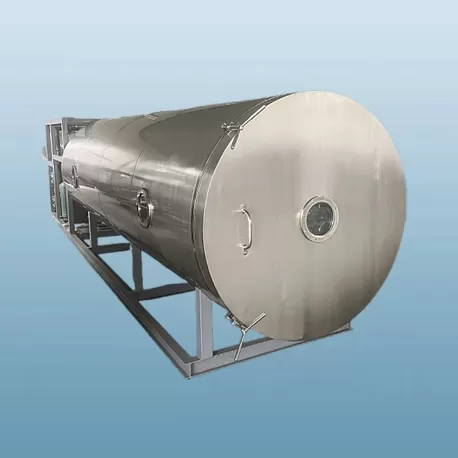
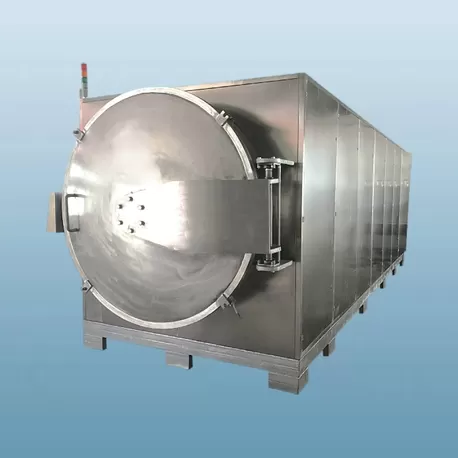
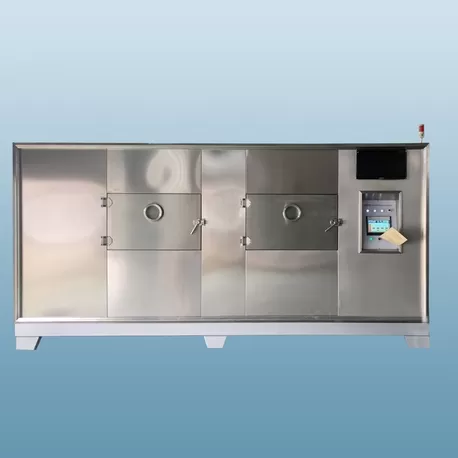
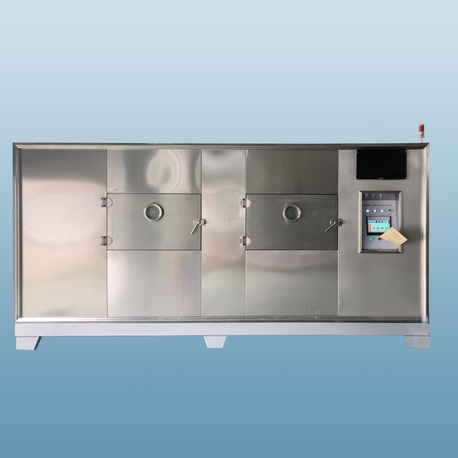
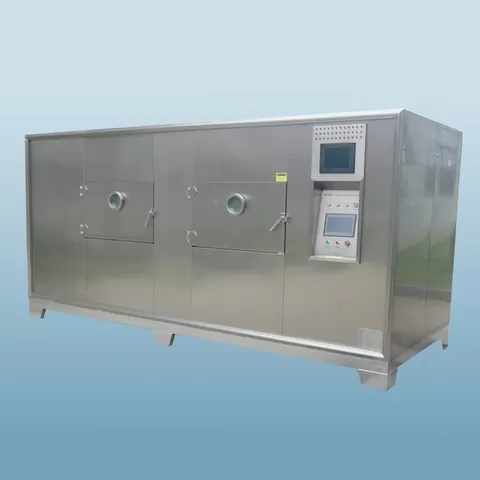
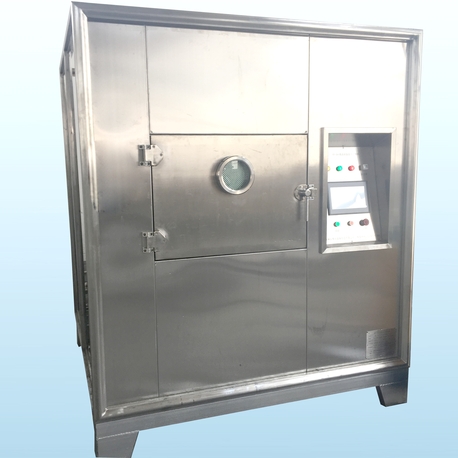
An industrial vacuum
microwave drying system is a sophisticated assembly of microwave
generators, a vacuum-rated vessel, and material handling systems.
Microwave Application and Uniformity
A common technical challenge is achieving uniform field distribution to
prevent arcing or hot spots. Modern systems employ:
Rotating waveguides (mode stirrers): These continuously
change the microwave reflection pattern inside the cavity.
Multiple magnetron sources: Using 6 to 12 individual 1.5 kW
magnetrons, each with phase control, ensures even energy deposition across the
product bed.
Tunable cavities: Adjustable geometry to match the
dielectric properties of the load as drying progresses.
Vacuum System Integration
The vacuum pump must handle not only non-condensable gases but also large
volumes of water vapor. Industrial setups typically use a combination of a roots
blower and a liquid-ring pump, with an intermediate condenser to capture vapor
before it reaches the pump oil. This protects the pump and recovers solvents if
required.
Comparative Analysis: VMD vs. Freeze Drying vs. Convection
Process engineers must weigh capital expenditure against product quality and
throughput. Below is a data-oriented comparison based on typical operational
metrics.
Drying Time and Throughput
Freeze drying of a 20 mm thick food slab can take 24-48 hours due to the slow
sublimation front. Conventional hot air drying at 70°C might take 8-12 hours but
risks surface hardening. Nasan vacuum microwave
dryers typically complete the same task in 2-4 hours, with a dry matter
temperature never exceeding 40°C.
Energy Economics
While microwave generation is electricity-intensive, the drastic reduction in
drying time leads to lower total energy consumption per kilogram of water
removed. VMD systems achieve an energy efficiency of 0.8 to 1.2 kWh/kg of water,
compared to 1.5-2.5 kWh/kg for freeze dryers and 1.0-1.5 kWh/kg for
well-optimized heat pump dryers.
Process Control and Monitoring
Successful implementation of vacuum
microwave drying requires real-time feedback loops. Fiber-optic
temperature probes are embedded in the product bed, as conventional
thermocouples are affected by the microwave field. Pressure rise tests are
conducted periodically: the vacuum valve closes, and the rate of pressure
increase indicates the continuing vapor release rate, allowing the PLC to
modulate microwave power to match the falling drying rate curve.
Addressing Industry Challenges
Adoption of VMD has been hindered by concerns over scaling and batch
consistency. However, advancements in solid-state microwave generators now allow
for precise power modulation, eliminating the On/Off cycling of older magnetrons
that caused non-uniformity. Furthermore, continuous rotary vacuum microwave
designs are now available for high-capacity processing of granular materials,
addressing the scale-up challenge.
Frequently Asked Questions (FAQ)
Q1: What is the maximum temperature reached inside a vacuum microwave
dryer?
A1: The product temperature is controlled by the boiling
point at the set vacuum level. At 30 mbar absolute pressure, water boils near
25°C. As moisture decreases, the product temperature may rise slightly but can
be capped by reducing microwave power. Typically, process temperatures are
maintained between 30°C and 50°C.
Q2: Can vacuum microwave drying handle liquid or slurry
materials?
A2: Yes, but specific equipment configurations are
required. Rotary vacuum microwave dryers with heated paddles can process viscous
liquids and pastes. For low-viscosity liquids, a foaming or pre-concentration
step is often needed to prevent the material from being splashed or entrained in
the vacuum airflow.
Q3: How does the capital cost of a vacuum microwave system compare to
a freeze dryer of similar capacity?
A3: Generally, a VMD system has
a lower capital cost than an equivalent industrial freeze dryer, primarily
because it does not require the extensive refrigeration and condenser systems
needed for sublimation. However, it is more expensive than a standard hot air
dryer. The return on investment is realized through higher product quality and
faster cycle times.
Q4: Is it possible to retrofit vacuum microwave technology into an
existing vacuum dryer?
A4: Retrofitting is technically challenging
but possible. It requires installing microwave feedthroughs (quartz or ceramic
windows) into the vessel wall, shielding all internal metal components to
prevent arcing, and adding mode stirrers. Nasan offers engineering
consultations for such modifications, but a purpose-built unit is recommended
for optimal performance and safety.
Q5: What safety features are integrated into industrial vacuum
microwave dryers?
A5: Key safety systems include: stub tuners or
circulators to protect magnetrons from reflected power, gas sensors to detect
solvent vapors and prevent explosive mixtures, burst discs on the vacuum vessel
for overpressure protection, and interlock systems that immediately cut
microwave power if the vacuum is lost or if the door is opened.
Q6: Which materials are not suitable for vacuum microwave
drying?
A6: Materials with very low dielectric loss factors (i.e.,
they do not absorb microwaves) will not heat efficiently. This includes pure
oils, many dry powders, and metals. Additionally, materials that are highly
conductive or contain ionic salts can cause arcing. A dielectric property
analysis should be conducted before scaling up.