

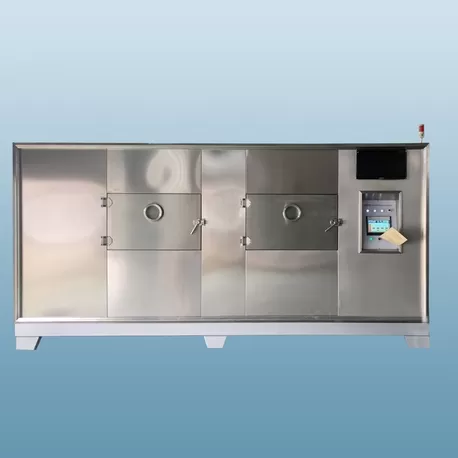
Conventional freeze drying (lyophilization) relies on conductive heat transfer through a frozen product layer, leading to long processing times (24–48 hours for many biopharmaceuticals) and non-uniform drying. Microwave freeze drying applies volumetric electromagnetic energy directly to the frozen matrix, dramatically accelerating sublimation while preserving the porous structure. This article examines the physics of dielectric heating under vacuum, equipment configurations for continuous operation, and validation protocols for sensitive products. Drawing on data from Nasan pilot studies, we provide engineering guidelines for implementing this hybrid technology.

1. Principles of Microwave Freeze Drying: Sublimation Under Controlled Vacuum
Freeze drying requires maintaining product temperature below the eutectic point while supplying latent heat of sublimation (approximately 2838 kJ/kg for ice). In conventional shelf-lyophilizers, heat transfers from a heated shelf through the container bottom and frozen layer. The dried layer (already porous) acts as a thermal insulator, causing a receding ice front and prolonged secondary drying. Microwave freeze drying eliminates this gradient: microwave energy at 915 MHz or 2.45 GHz penetrates the frozen region and is absorbed primarily by ice crystals (dielectric loss factor εr'' ≈ 3–5 at -20°C, depending on purity). Key advantages:
Uniform power deposition: Volumetric heating maintains a flat temperature profile across the product, avoiding collapse or meltback.
Reduced drying time: Sublimation rates increase from 0.5–1.0 kg H₂O/m²·h (conventional) to 2.5–4.0 kg/m²·h in microwave-assisted systems.
Energy efficiency: Microwave energy converts directly to sublimation heat without intermediate heating of shelves or air, cutting specific energy consumption by 30-50%.
However, microwave freeze drying requires precise control of pressure (typically 10–50 Pa) to avoid corona discharge and arcing. Vacuum-compatible microwave applicators with pressurised waveguides and ceramic windows are standard. Nasan integrates mode stirrers and real-time power mapping to maintain field uniformity across multi-tray loads.
2. Technical Challenges and Engineered Solutions
2.1 Thermal Runaway and Ice Melting
Liquid water has a much higher dielectric loss (εr'' ≈ 40 at 2.45 GHz) than ice. If any region melts prematurely, microwave energy concentrates there, accelerating melting and causing product collapse. Mitigation strategies:
Use pulsed microwave power (e.g., 5 seconds on, 10 seconds off) to allow thermal diffusion.
Monitor product temperature via fiber-optic probes inserted into the frozen matrix, with closed-loop power control.
Maintain vacuum below the triple point pressure (611 Pa) – typical operation at 30 Pa ensures ice sublimation directly to vapor.
2.2 Plasma Formation and Arcing
At low pressures (1–100 Pa), the mean free path of electrons increases, raising the risk of gas breakdown and plasma. This is exacerbated by sharp metal edges or residual organic vapors. Solutions: apply a static magnetic field (B ≈ 0.01 T) to confine electrons, use rounded electrode geometry, and ensure that chamber pressure does not fall below 10 Pa during microwave operation. Nasan's vacuum chamber design incorporates a proprietary anti-arcing ring and automated pressure-ramping sequences.
2.3 Non-Uniform Drying Across Trays or Vials
In batch systems, edge vials may receive different field intensity than center vials. Solutions: rotate trays (planetary motion) or use a 915 MHz frequency with longer wavelength (≈33 cm in vacuum) to reduce field variation. Microwave freeze drying systems from Nasan include a dynamic impedance matching network that adjusts to changing dielectric properties as ice sublimates.
3. Industrial Applications and Process Performance Data
3.1 Biopharmaceuticals – Monoclonal Antibodies and Vaccines
Conventional lyophilization of protein formulations often suffers from long secondary drying (removal of bound water), which can denature sensitive molecules. Microwave freeze drying reduces total cycle time from 40 hours to 16 hours for a 2 mL vial fill. Residual moisture below 0.5% is achieved without exceeding 30°C product temperature. Fourier-transform infrared (FTIR) analysis shows no change in secondary structure compared to control. Throughput: 50,000 vials per batch in a 10 m² chamber.
3.2 Food Ingredients – Probiotics and Coffee Extracts
Freeze-dried probiotics require survival rates >90%. Conventional drying exposes cells to prolonged temperature gradients. Microwave freeze drying at 915 MHz with 0.3 W/g specific power reduces drying time from 30 hours to 12 hours. Viability of Lactobacillus rhamnosus improved from 86% to 94% in Nasan trials. For instant coffee, the process yields a more porous structure, reducing dissolution time from 15 seconds to 6 seconds.
3.3 Advanced Materials – Aerogels and Ceramic Precursors
Silica aerogels produced via freeze drying of hydrogels typically require supercritical CO₂ drying to avoid shrinkage. Microwave freeze drying under vacuum preserves the nanostructure with only 8% linear shrinkage (vs. 35% for conventional freeze drying). The volumetric heating prevents re-wetting of the gel surface.
4. Equipment Architecture for Microwave Freeze Drying
An industrial microwave freeze drying system comprises:
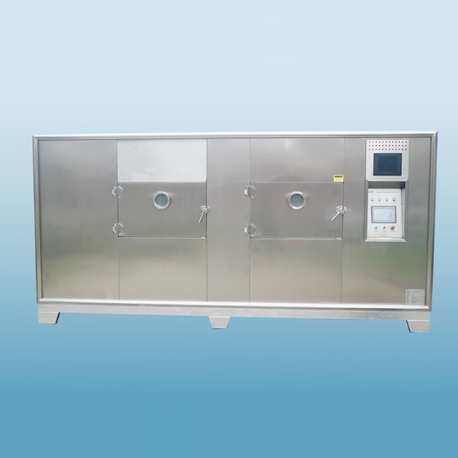
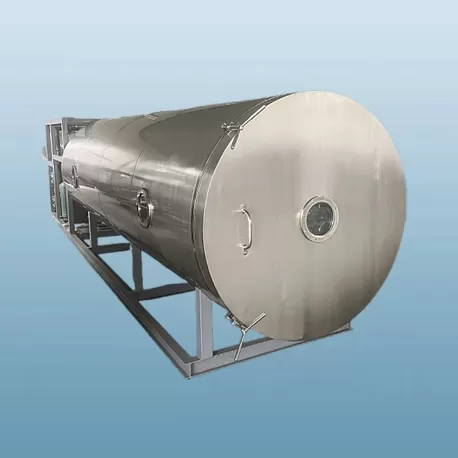
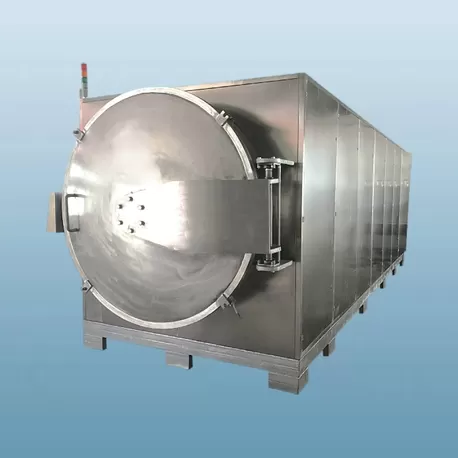
Vacuum chamber: Stainless steel (304L or 316L) with internal dimensions up to 2.5 m width, 6 m length. Wall thickness 15 mm to withstand full vacuum. Includes a water-cooled condenser (−50°C to −70°C) for vapor capture.
Microwave sources: 915 MHz magnetrons (each 25–75 kW) with circulators and dummy loads to protect against reflected power. Total installed power 100–500 kW.
Applicator: Overmoded rectangular cavity with mode stirrers rotating at 10–30 RPM. Waveguide windows made of high-purity alumina ceramic (99.6%) to maintain vacuum integrity.
Temperature monitoring: 12-channel fiber-optic system (range −60°C to +80°C, accuracy ±0.5°C).
Control system: PLC with recipe management, pressure control via butterfly valve, and safety interlocks that disable microwave power if pressure rises above 100 Pa or leakage detected.
For continuous processing, Nasan offers a rotary vacuum microwave dryer with a helical screw conveyor inside a cylindrical cavity, suitable for granular materials (e.g., enzymes or plant extracts). Throughput up to 500 kg/h.
5. Comparative Energy and Cost Analysis
A benchmark for a 500 kg batch of frozen coffee extract (initial solids 30%, final 96%):
Conventional freeze dryer (shelf-heated): Total cycle 28 hours, energy consumption 4.8 kWh/kg water removed. Annual electricity (250 batches): 600,000 kWh.
Microwave freeze drying (Nasan system): Cycle 11 hours, energy 2.9 kWh/kg water removed. Annual: 362,500 kWh. Savings of 237,500 kWh/year. At $0.10/kWh, operating cost reduction $23,750/year. Additionally, labor and maintenance savings due to shorter cycles increase ROI to < 2 years.
Product quality advantages (higher porosity, less collapse) allow premium pricing – a 10% higher sale value for pharmaceutical intermediates. Nasan provides a detailed lifecycle cost calculator for specific products.

6. Future Directions: Hybrid Microwave-Infrared and Continuous Microwave Freeze Drying
Emerging designs combine microwave heating with infrared lamps to supply energy during the initial freezing step (pre-freezing on a chilled belt). The frozen product then enters a microwave vacuum section. Another innovation: using variable frequency microwave (5.8–6.2 GHz) to selectively target bound water in secondary drying, reducing residual moisture to <0.1% without overheating. These advances will make microwave freeze drying the standard for high-value hygroscopic products.
Frequently Asked Questions (FAQ)
Q1: Can microwave freeze drying handle high-sugar or high-fat formulations?
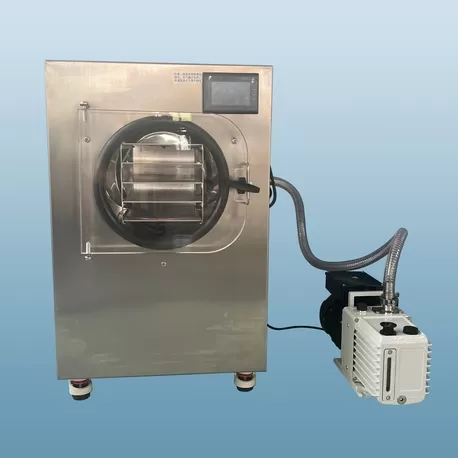
A1: Yes, but care is required. Sugars (e.g., sucrose) depress the glass transition temperature (Tg'), increasing collapse risk. Use lower power density (0.2–0.4 W/g) and ramp pressure slowly. Fats have low dielectric loss; they act as inert fillers. The ice fraction still absorbs microwave energy efficiently. Pre-formulation testing with a lab-scale Nasan microwave freeze dryer is recommended.
Q2: How does microwave freeze drying compare to conventional freeze drying for heat-sensitive biologics?
A2: Conventional freeze drying often exposes the product to temperature gradients that can cause aggregation (e.g., monoclonal antibodies). Microwave freeze drying maintains nearly isothermal conditions (within ±2°C across the batch). In a study with IgG1 antibody, aggregation measured by SEC-HPLC was 0.8% for microwave vs. 2.3% for conventional, and potency recovered 98% vs. 92%.
Q3: Is microwave freeze drying suitable for large-scale production (1000+ kg batch)?
A3: Yes. Industrial microwave freeze dryers from Nasan are available up to 30 m² shelf equivalent. For 1000 kg of frozen material (approx. 20 m³), a 500 kW 915 MHz system with a 6 m long chamber processes a batch in 18–22 hours. Multiple chambers can be operated in parallel.
Q4: What validation protocols are required for pharmaceutical microwave freeze drying?
A4: Follow ICH Q8 and ASTM E2500. Key tests: (i) Temperature uniformity mapping using 16 fiber-optic sensors across the load. (ii) Residual moisture by Karl Fischer (target <1%). (iii) X-ray diffraction to confirm no polymorphic transitions. (iv) Microwave leakage measurement (<5 mW/cm² at 5 cm). Nasan provides qualification documentation packages including DQ, IQ, OQ, and PQ protocols.
Q5: What maintenance is specific to microwave freeze dryers?
A5: Beyond standard vacuum pump and condenser maintenance, inspect the ceramic waveguide window for cracks or deposits monthly. Magnetrons in 915 MHz systems have a typical lifespan of 12,000 hours. Clean mode stirrers and chamber interior with isopropyl alcohol to prevent arcing from product residues. Nasan offers remote diagnostics and predictive maintenance algorithms.
Q6: Can we retrofit an existing conventional freeze dryer with microwave capability?
A6: Retrofits are possible but require significant modifications: installation of microwave waveguides and feed ports, replacement of metal shelves with microwave-transparent supports (e.g., PTFE-coated aluminum), and upgrade of control system to manage microwave power. Typically more cost-effective to procure a dedicated microwave freeze drying unit. Nasan provides a feasibility assessment and trade-off analysis.
Ready to accelerate your freeze drying process? Submit your product specifications (formulation, fill volume, target residual moisture) to Nasan for a free feasibility study and a customized microwave freeze drying proposal. We offer pilot trials and turnkey industrial systems with performance guarantees.
© 2026 Nasan – Advanced Microwave Freeze Drying Solutions