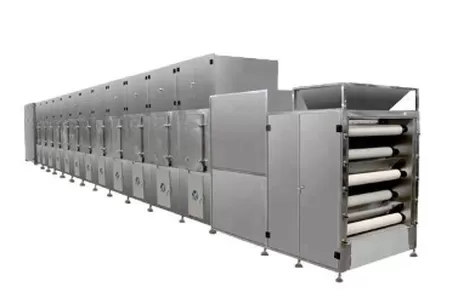
Lyophilization represents the gold standard for stabilizing heat-sensitive
biologicals, pharmaceuticals, and high-value nutritional matrices. Traditional
freeze drying relies on conductive or radiative heat transfer from
temperature-controlled shelves through a growing layer of dried product. Because
the porous dry layer exhibits exceptionally low thermal conductivity, heat
transfer rates decay rapidly as sublimation proceeds, extending process cycles
from 24 to more than 72 hours. Integrating volumetric electromagnetic heating
into low-pressure environments redefines these thermodynamic constraints.
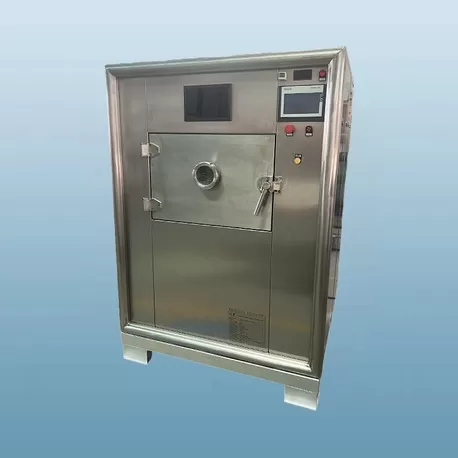
Implementing a microwave freeze process introduces direct
energy coupling into the frozen core of the product. Rather than depending on
heat conduction through an insulating outer cake, microwave fields penetrate the
material, supplying the latent heat of sublimation directly where frozen water
resides. This fundamental change in energy delivery decouples sublimation
kinetics from cake thickness, dramatically reducing cycle durations while
preserving structural, biochemical, and enzymatic integrity.
Thermodynamics of Sublimation: Conductive Lyophilization vs. Dielectric
Volumetric Heating
In conventional freeze drying, the heat required for ice sublimation ($q =
\dot{m} \Delta H_s \approx 2838 \text{ kJ/kg}$) must travel across several
physical boundaries: the shelf surface, the container base, the frozen layer,
and eventually the dried product layer. As drying progresses, the sublimation
front recedes toward the bottom of the container. The porous dried matrix above
this front acts as a thermal insulator with thermal conductivity values
typically between 0.015 and 0.035 W/(m·K) under vacuum. To accelerate
sublimation without exceeding the collapse temperature ($T_c$) or glass
transition temperature ($T_g'$) of the formulation, conventional systems must
maintain modest shelf temperatures, extending primary drying over multiple
days.
Volumetric energy deposition shifts this balance. When electromagnetic energy
in the radiofrequency or microwave spectrum penetrates the drying chamber, the
dissipated power per unit volume ($P_v$) is governed by the dielectric
properties of the matrix:
Pv = 2 π f ε0 ε″r E2
f: Applied frequency (typically 2450 MHz or 915 MHz for
industrial operations).
ε0: Permittivity of free space ($8.854 \times
10^{-12} \text{ F/m}$).
ε″r: Dielectric loss factor of the processed
material.
E: Local electric field root-mean-square strength within
the target.
Because the microwave energy interacts directly with the dielectric dipoles
of the frozen core, heat is generated uniformly throughout the ice mass.
Sublimation occurs without requiring a temperature gradient across the dried
boundary layer. Vapor generated at the sublimation interface diffuses outward
through the open pores via Knudsen diffusion and hydrodynamic flow driven by the
vapor pressure differential between the frozen interface and the condenser
chamber.
Dielectric Behavior and Ionization Thresholds in Low-Pressure
Environments
Industrial deployment of dielectric fields under vacuum conditions requires
precise management of material properties and electromagnetic parameters. The
dielectric loss factor ($\varepsilon''$) of hexagonal ice ($I_h$) at microwave
frequencies is substantially lower than that of liquid water, yet sufficiently
high to absorb energy efficiently when exposed to appropriate field intensities.
As shown in the comparative baseline below, the dielectric properties shift
dramatically across states:
Liquid Water (20°C, 2450 MHz): $\varepsilon' \approx 80$,
$\varepsilon'' \approx 12$
Ice (-20°C, 2450 MHz): $\varepsilon' \approx 3.2$,
$\varepsilon'' \approx 0.003$
Dried Porous Matrix (-20°C to 20°C): $\varepsilon' \approx
1.2 - 1.8$, $\varepsilon'' < 0.001$
The stark difference between the loss factor of ice and liquid water
establishes a self-regulating thermal dynamic during proper processing: ice
absorbs energy, while the already-dried outer matrix remains largely transparent
to the field. If localized melting occurs, however, the loss factor jumps by
several orders of magnitude, precipitating thermal runaway. Equipment engineers
must therefore modulate power delivery with extreme precision to maintain the
product temperature strictly below its eutectic point ($T_{eu}$) or collapse
threshold ($T_c$).
A secondary engineering consideration involves plasma discharge. Under
reduced pressures (between 10 Pa and 100 Pa, common in freeze drying), the mean
free path of gas molecules increases. According to Paschen's Law, the breakdown
voltage of gases decreases significantly within this pressure regime. High
electric field gradients ($E$) can ionize residual gases and water vapor,
generating a low-temperature plasma that scorches organic matrices and destroys
field uniformity. Modern systems mitigate this by operating with lower electric
field strengths distributed across wider resonant cavities, using solid-state
generators, or operating within specialized pressure windows where breakdown
potentials are maximized.
Translating dielectric sublimation from laboratory prototypes to continuous
industrial throughput demands rigorous vacuum, thermal, and radiofrequency
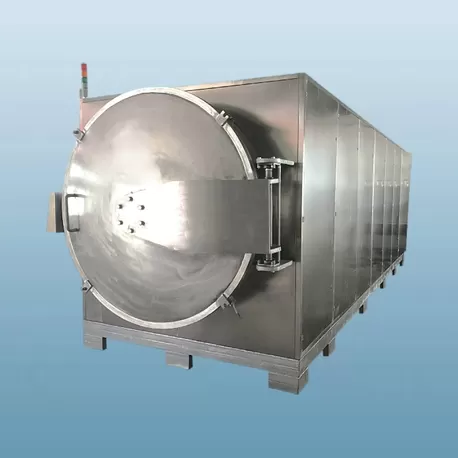
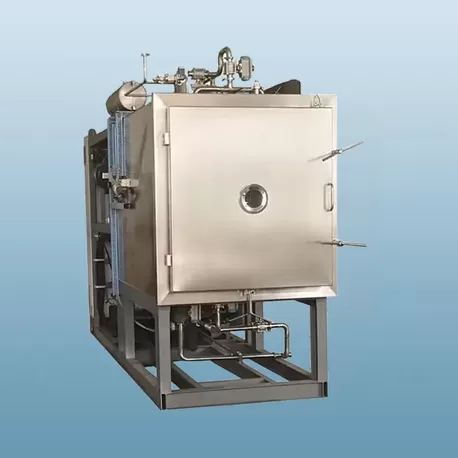
engineering. Industrial implementations designed by Nasan combine industrial
microwave cavities with high-capacity vacuum condensation modules to maintain
steady mass-transfer equilibrium.
Resonant Cavity Design and Field Homogenization
Uniformity represents the primary hurdle in processing bulk or vial-based
biologicals. Multimode cavities often suffer from standing wave nodes, leading
to localized hot spots and cold spots. Industrial systems counter this
heterogeneity through several integrated mechanisms:
Phase-Shifting Solid-State Generators: Replacing
traditional magnetrons with solid-state power amplifiers (SSPAs) allows dynamic
frequency hopping (within the 2.4–2.5 GHz ISM band) and phase adjustment,
continuously redistributing field patterns within the chamber.
Mode Stirrers and Rotary Platforms: Mechanically altering
the boundary conditions inside the chamber distributes time-averaged field
density evenly across product containers.
Array Waveguide Feeds: Introducing microwave energy through
multiple phased ports prevents high field concentrations at single entry points,
suppressing the onset of ionization discharges.
Vapor Removal Dynamics and Condenser Sizing
Because the sublimation rate in a microwave freeze system is 4 to 10 times
higher than in a conventional lyophilizer, the vapor generation rate increases
proportionately. If the ice condenser and duct geometry are undersized, product
chamber pressure rises rapidly, causing choking flow at the isolation valve and
raising the saturation temperature above $T_c$. Vacuum systems must maintain
laminar and transition flow pathways with wide ducting, high-conductance
butterfly valves, and cryogenic condenser surfaces capable of handling sustained
deposition rates exceeding tens of kilograms of ice per hour per square meter of
surface area.
System designers at Nasan incorporate high-conductance vapor pathways
alongside continuous-defrost condenser systems, ensuring that operational vacuum
levels remain stable between 0.1 mbar and 0.8 mbar throughout the high-energy
primary sublimation phase.
Process Kinetics: Comparing Drying Stages and Energy Transfer
Drying profiles in a dielectric environment differ substantially from
conventional shelf-heated cycles across all three processing stages.
Freezing Phase
Thermal protocol during initial freezing governs the pore structure of the
dry cake. Controlled ice nucleation creates large, interconnected ice crystals
that yield lower mass transfer resistance during subsequent drying. In systems
operating under volumetric heating, uniform crystal size distribution is
critical to ensure homogeneous dielectric properties throughout the frozen
mass.
Primary Drying Phase
In standard lyophilization, primary drying accounts for 80% to 90% of the
entire processing timeline due to the heat transfer bottlenecks through the
shelf interface and the dried layer. During microwave-driven processing, power
is adjusted based on real-time dielectric feedback. As the volume of ice
diminishes, total absorbed power drops proportionally, preventing
post-sublimation overheating. The primary drying duration shrinks from tens of
hours to several hours.
Secondary Drying Phase
Secondary drying removes unfrozen, bound water molecules adsorbed to the
internal surfaces of the matrix. While conventional cycles slowly ramp shelf
temperatures up to 30°C–40°C to overcome desorption energy barriers ($40 - 50
\text{ kJ/mol}$ of bound water), microwave energy directly excites these polar
water dipoles. Desorption rates increase without requiring sustained exposure of
sensitive matrices to high convective or conductive surface temperatures.
Target Applications and Industry Compatibility
Accelerated sublimation via dielectric energy input offers distinct economic
and quality advantages for specific categories of high-value, heat-sensitive
compounds.
Live Biotherapeutic Products and Probiotics
Probiotic strains, bacterial vaccines, and live viral vectors suffer
viability loss when exposed to prolonged thermal stress or extended dehydration
times. Accelerating the transition through the semi-hydrated state preserves
cell membrane integrity and metabolic recovery rates post-reconstitution,
yielding higher colony-forming unit (CFU) counts.
Thermolabile Enzymes and Monoclonal Antibodies
Proteins prone to denaturation, aggregation, or conformational degradation
benefit from shortened residence times within the lyophilization chamber.
Removing the need for elevated shelf temperatures during secondary drying
preserves native secondary and tertiary tertiary structures.
Nutraceuticals, Functional Botanicals, and Diagnostic Reagents
High-value plant extracts, active bio-compounds, and pre-mixed diagnostic
assays (such as PCR reagents and lateral flow enzyme mixes) demand rapid
processing to retain reactivity and aromatic or structural stability. Continuous
or semi-continuous microwave freeze processing equipment
provides an alternative to massive multi-shelf batch infrastructure,
streamlining manufacturing plants into continuous production flows.
Process Analytical Technology and Dynamic Control Systems
Precise control over volumetric heating within vacuum environments relies on
non-invasive, high-speed instrumentation architectures. Traditional thermocouple
probes placed inside product vials introduce metallic conductors into strong
electromagnetic fields, which can induce localized arcing, field distortion, and
erroneous temperature readings.
Modern process control integrates advanced Process Analytical Technology
(PAT) tools:
Fiber-Optic Fluoroptic Probes: Non-metallic, immune to RF
and microwave interference, providing direct measurement of frozen core and cake
temperatures.
Infrared Thermal Imaging: Surface-scanning sensors mapped
to transparent viewing ports to detect localized thermal anomalies across the
drying bed in real time.
Mass Spectrometry and Pressure Rise Analysis (MKS/Pirani
Differential): Continuous monitoring of gas composition within the
chamber allows exact identification of the primary drying endpoint by detecting
drops in water vapor partial pressure.
Reflected Power Monitoring: Real-time automated measurement
of forward versus reflected microwave power provides instantaneous feedback on
remaining ice volume, enabling closed-loop generator modulation.
Frequently Asked Questions
How does microwave freeze drying prevent matrix collapse without
conventional shelf contact?
Energy transfer does not depend on conduction from heated shelves through the
bottom of the container. Instead, microwave radiation penetrates directly into
the frozen core, converting into thermal energy right at the ice crystal site.
This maintains the sublimation front temperature below the critical structural
collapse point ($T_c$) while eliminating the thermal resistance of the
thickening dry layer above it.
How is plasma discharge avoided during low-pressure operation?
Plasma formation occurs when the localized electric field strength exceeds
the breakdown voltage of residual gases at operating vacuum levels (governed by
Paschen's Law). Modern industrial dryers prevent ionization by using lower field
strengths spread across multiple phased solid-state ports, avoiding sharp metal
geometries inside the chamber, and maintaining vacuum levels outside the minimum
breakdown voltage valley.
How do dielectric properties change as sublimation progresses?
At the start of drying, the system is dominated by the dielectric properties
of hexagonal ice ($\varepsilon'' \approx 0.003$). As ice sublimates, the dry
matrix left behind has an even lower dielectric loss factor ($\varepsilon'' <
0.001$). Consequently, the dry product becomes virtually transparent to the
electromagnetic field, which automatically focuses power absorption into the
remaining frozen sections and prevents scorching of dried cake.
Can microwave-assisted sublimation be integrated into continuous industrial
production lines?
Yes. Because dielectric heating shortens primary drying from days to hours,
materials can move continuously or semi-continuously along vacuum-lock rotary
tables, vibrating beds, or modular belt assemblies. This shifts manufacturing
away from massive, energy-intensive stationary batch lyophilizers toward
compact, inline processing modules.
Which frequencies are standard for industrial-scale dielectric freeze
systems?
Industrial systems utilize the internationally allocated Industrial,
Scientific, and Medical (ISM) frequencies. The most prevalent are 2450 MHz for
small-to-medium systems requiring high energy density and shorter penetration
depths, and 915 MHz for larger bulk layers requiring deeper penetration across
thicker product beds.
How does the energy efficiency profile compare to conventional
lyophilization?
Although generating microwave power involves conversion losses (typically
65–70% efficiency for magnetrons and up to 60–65% for solid-state sources), the
overall energy consumption of the plant drops significantly. Shortening the
complete cycle duration by 70% to 80% drastically reduces the runtime of heavy
vacuum pumps, circulation chillers, and condenser refrigeration compressors.
Industrial Equipment Engineering and Process Optimization
Transitioning to volumetric drying requires balanced design between
electromagnetic field delivery, vacuum conductance, and thermal refrigeration
systems. Nasan engineers and manufactures industrial drying infrastructure built
to rigorous operational standards, matching solid-state microwave architectures
with heavy-duty condenser systems tailored to specific client formulations.
For custom engineering evaluations, cycle time simulations, or pilot testing
protocols on specific biologicals, extracts, or active ingredients, contact our
technical team. Submit your formulation parameters and capacity targets to
receive a comprehensive equipment sizing and system integration proposal.