Conventional freeze drying (lyophilization) relies on conductive heat
transfer through shelves, creating a slow, energy-intensive process with notable
temperature gradients. A microwave freeze
dryer substitutes this mechanism by delivering electromagnetic
energy directly to the frozen product. Water molecules in the ice phase absorb
microwave radiation, converting it to latent heat of sublimation without warming
the surrounding matrix. This article quantifies the thermodynamic advantages,
equipment architectures, and control strategies for industrial
microwave-assisted freeze drying. Drawing from validation trials on probiotics,
vaccine excipients, and premium coffee extracts, we demonstrate how a correctly
specified microwave freeze
dryer reduces primary drying time by 70% while preserving viability
and structure. Nasan engineers full-scale microwave freeze drying systems with magnetron arrays and
real-time pressure-moisture feedback, closing the gap between lab research and
production lyophilization.
1. Physical Mechanism: Volumetric Heating of Ice Under Vacuum
In a microwave freeze
dryer, the product is first frozen to below its eutectic or glass
transition temperature (typically -40 to -30°C). Chamber pressure is reduced
below the triple point of water (usually 10–50 Pa). Microwaves at 2450 MHz (or
915 MHz for larger loads) couple with the dielectric loss of ice. Ice has a
relatively high loss factor at subzero temperatures, absorbing energy and
directly converting it to sublimation enthalpy (2835 kJ/kg). Key advantages over
conventional shelf freeze drying:
No thermal gradient: Ice sublimates simultaneously
throughout the product, eliminating collapse caused by warm-bottom effect.
Shorter primary drying phase: Typical 48-hour cycle for a
20mm thick product reduces to 8–12 hours at equivalent chamber pressure.
Lower residual moisture variability: Endpoint moisture
standard deviation drops from ±1.5% to ±0.3% due to uniform energy
delivery.
This mechanism is often termed “microwave-assisted freeze drying” or “MWFD”.
However, care must be taken to avoid local melting (runaway) when ice is
depleted unevenly. Professional systems employ power modulation and in-situ
temperature monitoring via fiber-optic probes.
2. Frequency Selection and Applicator Design for Frozen Loads
Unlike conventional microwave drying of wet materials, a microwave freeze
dryer operates at low pressure, affecting plasma ignition
thresholds. Two frequency bands dominate:
2.1 2450 MHz (Standard for batch pharmaceutical dryers)
Penetration depth in frozen pure ice at -30°C: approximately 70 mm. For most
vials, trays, or bulk frozen slabs, 2450 MHz provides sufficient coupling. Many
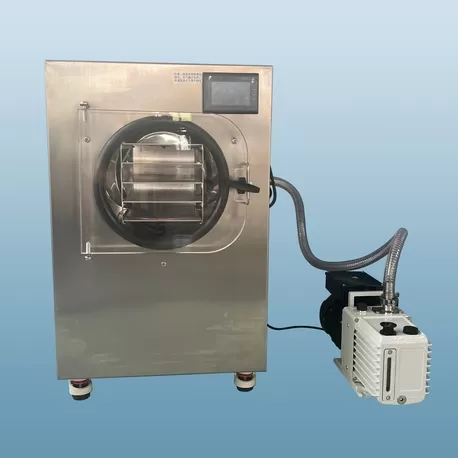
lab-scale microwave
freeze dryers operate at 2.45 GHz with up to 6 kW power. Mode
stirrers and rotating turntables are mandatory to avoid arcing and hot
spots.
2.2 915 MHz (High-power industrial systems)
Penetration depth >150 mm, suitable for thick frozen blocks (e.g., 100 mm
fruit puree slabs). Requires larger waveguides and magnetrons (25 kW to 100 kW).
Nasan offers 915 MHz
industrial units designed for continuous freeze drying of food ingredients.
Special attention is needed for the dielectric properties of frozen
formulations: solutes (sugars, salts) dramatically increase loss factor.
Pre-freezing protocol (slow vs. rapid freezing) also affects ice crystal size,
which modifies microwave absorption. A thorough analysis using a vector network
analyzer (VNA) on frozen samples is recommended before specifying a microwave
freeze dryer.
3. Equipment Architecture: Batch, Semi-Continuous and Continuous
Configurations
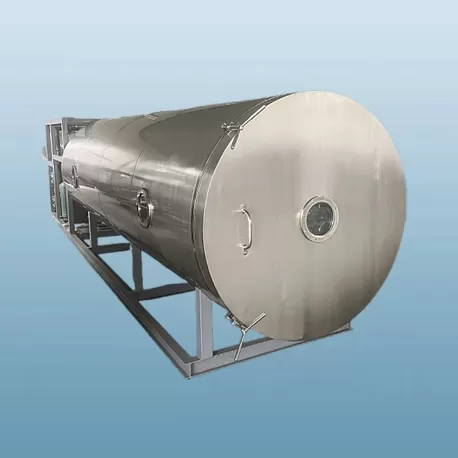
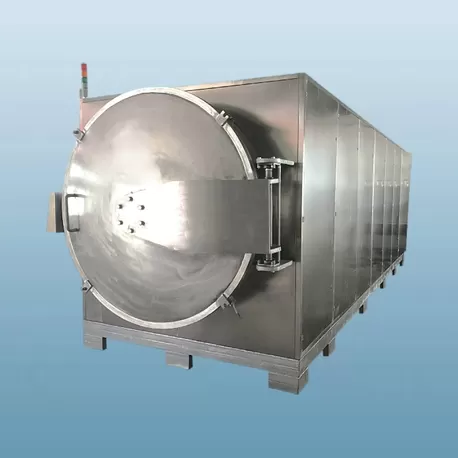
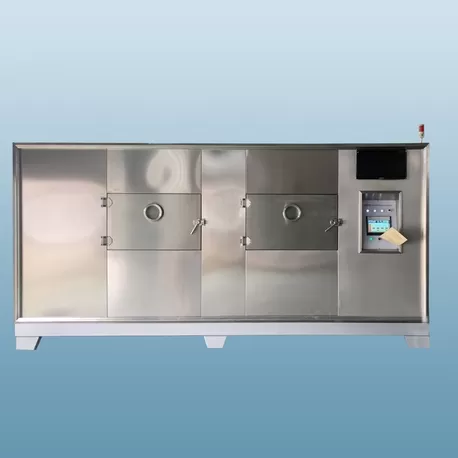
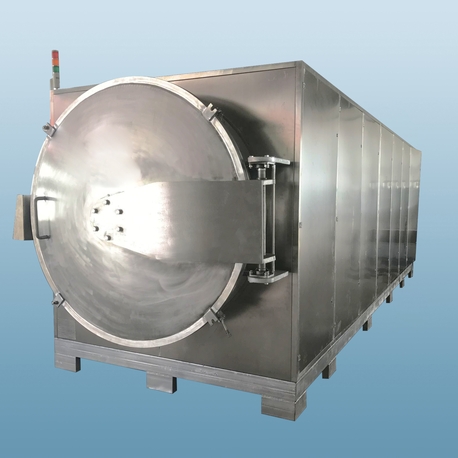
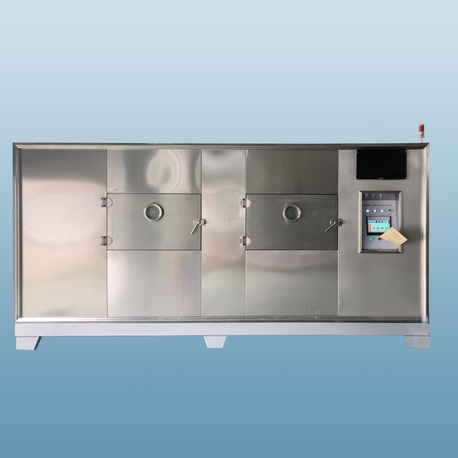
Three main industrial layouts for a microwave freeze
dryer exist, each optimized for throughput and product form:
Batch vacuum chambers with rotating racks: 50–200 kg load
capacity. Product loaded in trays or vials. Microwave power applied through a
waveguide window (ceramic or quartz). Used for high-value pharmaceuticals,
probiotics, and biological materials. Batch sizes from 10 to 1000 L.
Semi-continuous rotary microwave freeze dryers: A slowly
rotating drum (0.5–2 rpm) contains frozen granules or pellets. Microwave power
introduced via rotating launcher. This design improves uniformity and is suited
for freeze-dried coffee, fruit pieces, and enzymes. Throughput 100–500
kg/h.
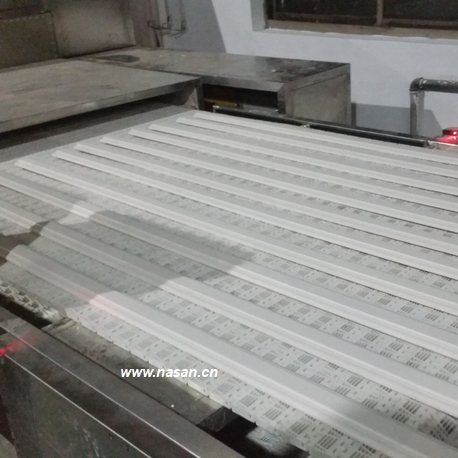
Continuous belt microwave freeze dryers: Frozen product bed
(20–40 mm thick) moves on a PTFE belt through multiple microwave applicator
zones under vacuum locks at inlet and outlet. Still experimental for most foods,
but operational for high-value chemicals. Industrial continuous microwave
freeze drying lines are custom-engineered per
application.
Each architecture requires precise vacuum control (typically 10–100 Pa) and
cold traps (-60°C to -80°C) to capture sublimated water vapor. For
heat-sensitive biologics, additional infrared temperature mapping is
integrated.
4. Process Control: Avoiding Plasma Ignition and Thermal Runaway
The greatest operational risk in a microwave freeze
dryer is plasma discharge: when chamber pressure falls below 20 Pa
and local electric field exceeds 2 kV/cm, gas ionization occurs, damaging
product and equipment. Mitigation strategies include:
Pulsed microwave operation: 10–100 ms pulses at low duty
cycle (10–30%) to maintain field strength below breakdown threshold.
Inert gas backfill (nitrogen or argon) to raise breakdown
voltage, albeit slightly increasing operating cost.
Field optimization via numerical modeling (CST or COMSOL) to avoid high E-field nodes.
Furthermore, as ice sublimates, the dry region’s loss factor decreases
sharply. If not compensated, the remaining ice absorbs even more power,
potentially leading to melting (collapse). Closed-loop control using an
end-point detection system (pressure rise test or tunable diode laser absorption
spectroscopy) is standard on professional microwave freeze dryers.
Nasan integrates a
proprietary fuzzy-logic controller that modulates magnetron current based on
real-time product temperature (fiber-optic) and exhaust vapor concentration,
maintaining sublimation front stability throughout the primary drying phase.
5. Energy Balance and Comparisons with Conventional Lyophilization
A conventional tray freeze dryer consumes approximately 1.8–2.5 kWh per kg of
ice sublimated, due to losses through the shelf compressor and radiative heat
transfer. In contrast, a well-optimized microwave freeze
dryer achieves 0.9–1.2 kWh/kg for the same water removal,
representing 40–50% energy reduction. The improvement stems from direct energy
coupling without intermediate thermal mass.
For a product requiring 20% final moisture (e.g., sliced strawberries), total
cycle time shrinks from 36 hours to 11 hours, improving equipment utilization by
a factor of 3. This translates to lower capital expenditure per annual
throughput. However, secondary drying (removing bound water from the amorphous
matrix) still requires moderate heat input; microwave power alone may overheat
the dry layer. Hybrid solutions apply low microwave power combined with heated
shelf for secondary drying.
6. Application Deep-Dive: Heat-Sensitive Biologics, Foods, and Advanced
Materials
Three validated use cases where a microwave freeze
dryer provides clear advantage:
Pharmaceuticals – Lyophilized mRNA lipid nanoparticles
(LNPs): Conventional freeze drying caused particle aggregation due to
slow ice front movement. A 6 kW 2450 MHz microwave freeze dryer reduced primary
drying from 56 hours to 14 hours, with particle size distribution retained (PDI
<0.15). Residual water <0.8% without cake collapse.
Food – Freeze-dried yogurt starter cultures (Lactobacillus
bulgaricus): Viability after conventional FD was 73%. Microwave
freeze drying at 35°C shelf equivalent (product temperature -25°C during
sublimation) yielded 91% viability, with drying time 9 hours vs. 28 hours. The
higher survival is attributed to reduced thermal stress and shorter exposure to
vacuum.
Technical ceramics – Freeze-drying of alumina-toughened zirconia
green bodies: Conventional freeze drying causes cracking due to
differential sublimation rates. Microwave freeze drying produced crack-free
parts with uniform porosity (open porosity 58±2%). Drying cycle reduced from 72h
to 18h.
7. Design Considerations for Scale-Up: Power Density and Chamber
Geometry
When moving from lab to industrial microwave freeze
dryer, three parameters must be re-evaluated:
Specific power (W/g of ice): Optimal range 0.5–1.2 W/g.
Lower power prolongs cycle time; higher power risks plasma or melting.
Chamber aspect ratio: For 2450 MHz, chamber diameter should
not exceed 0.8 m unless using multiple feed ports.
Condenser design: Microwave transparent cold coils
(glass-coated) are preferred to avoid arcing. Defrost cycles must be automated
for continuous operation.
Nasan provides
kiln-scale microwave freeze dryers with modular magnetron arrays, validated
through heat transfer modeling and vacuum integrity tests. Each unit includes a
Class I, Division 2 electrical enclosure for solvent-compatible
applications.
8. Frequently Asked Questions – Microwave Freeze Dryer
Q1: Can a microwave freeze dryer process liquid formulations
directly?
A1: No, the product must be pre-frozen to below its glass
transition temperature. A separate static or dynamic freezer (e.g., plate
freezer, immersion freezer) is required before loading into the microwave freeze
dryer. Some integrated systems combine a freezing tunnel with microwave
applicator, but this remains rare. For best results, freeze in a shape that
matches the applicator field (thin slabs or uniform pellets).
Q2: How to prevent product collapse when using microwave energy
during primary drying?
A2: Collapse occurs if the product
temperature exceeds the collapse temperature (Tc) of the maximally
freeze-concentrated matrix. Control strategies: (a) Apply microwave power in
short pulses (e.g., 5 sec on, 20 sec off) and monitor product temperature via
fiber-optic probes inserted into representative vials; (b) Keep chamber pressure
low enough to maintain sublimation at -30°C to -20°C product temperature; (c)
Use a temperature-controlled microwave
freeze dryer that automatically reduces power when any sensor
exceeds Tc.
Q3: What are the maintenance requirements for a microwave freeze
dryer?
A3: Regular tasks: (1) Inspect waveguide ceramic windows for
cracks or product film (clean with isopropanol weekly); (2) Test magnetrons
every 2000 hours – replace when output drops >20%; (3) Check vacuum seals and
cold trap defrost efficiency; (4) Calibrate pressure sensors and fiber-optic
thermometers quarterly. Nasan offers predictive
maintenance with vibration analysis on vacuum pumps.
Q4: Is a microwave freeze dryer suitable for organic solvents (e.g.,
tert-butyl alcohol/water mixtures)?
A4: Yes, but with
explosion-proof modifications. Many freeze-drying applications use tert-butanol
to improve sublimation rates. The microwave frequency must be chosen to match
the solvent’s dielectric properties – most alcohols have lower loss factors than
water, requiring higher power. Additionally, the system must be equipped with
solvent-compatible seals, inert gas purge, and certified electrical components
for Zone 2 hazardous areas. Solvent-resistant microwave freeze
dryers are available for pharmaceutical R&D.
Q5: How does microwave freeze drying compare to conventional freeze
drying for mannitol-based formulations?
A5: Mannitol is often used
as a bulking agent. Conventional lyophilization can produce two polymorphs
(alpha and beta). Microwave freeze drying tends to favor the beta polymorph due
to rapid sublimation, which may affect reconstitution time. However, cake
appearance remains elegant and mechanical strength is comparable. Process
development should include XRPD analysis to confirm polymorph outcome.
Q6: What is the typical return on investment (ROI) for switching from
conventional to microwave freeze drying?
A6: Based on 2000 kg/year
of high-value pharmaceutical intermediate (value $5000/kg), reduced cycle time
from 48h to 16h increases annual throughput from 20 batches to 60 batches using
the same freeze dryer footprint. Additional savings: 45% lower energy cost, 80%
reduction in cleaning downtime (due to sterile design). Payback period typically
12–18 months for continuous operation. For food-grade products with lower
margins, ROI extends to 30 months, still competitive.
Technical Evaluation and Engineering Inquiry
Selecting a microwave freeze
dryer requires careful analysis of product dielectric loss, frozen
state stability, and throughput targets. A mismatched system leads to
non-uniform sublimation, plasma damage, or residual moisture deviations.
Nasan provides a full
qualification workflow: dielectric measurement on frozen samples at your
facility, pilot-scale freeze-drying trials with 5–50 kg batches, finite element
modeling of electromagnetic field uniformity, and validation of sterility for
pharmaceutical applications. Our platforms range from 3 kW lab units to 150 kW
industrial continuous systems.
To receive a process feasibility study and budgetary quotation, submit an
inquiry with the following information: product description, water content
(initial/target), batch size, desired cycle time, and any specific regulatory
requirements (cGMP, FDA). Our engineers will respond with a simulation report
and a recommended system layout within 10 working days.
➤ Submit an Inquiry: Request
Microwave Freeze Dryer Design & Validation →