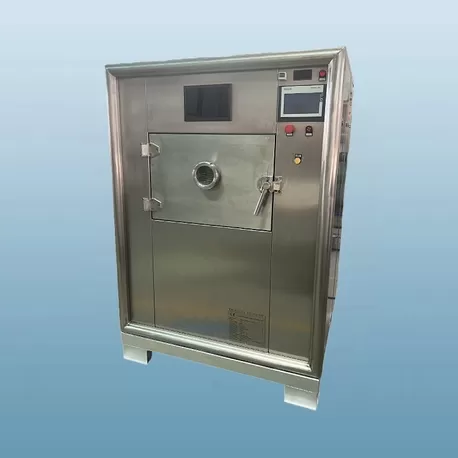
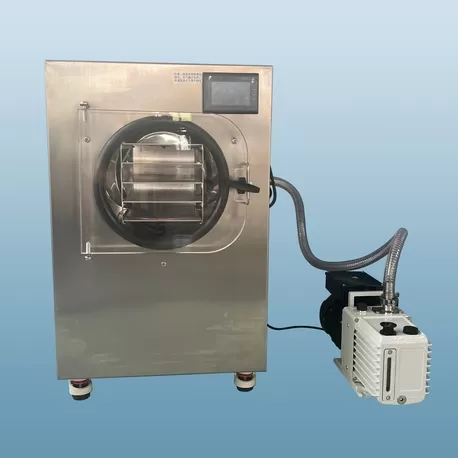
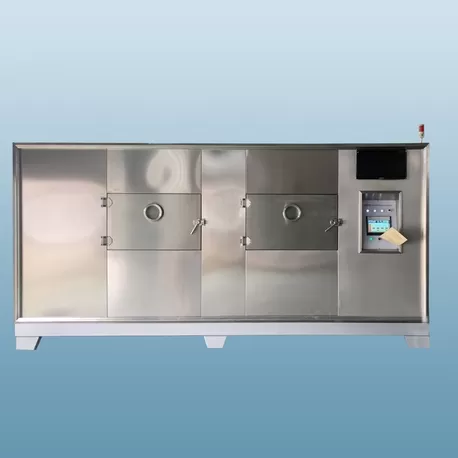
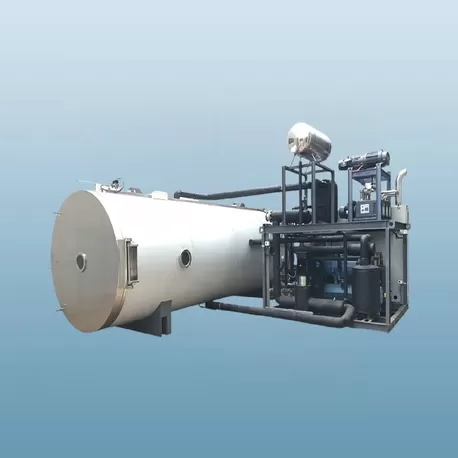
Selecting an industrial freeze drying machine involves far more than chamber size and price. The equipment must balance heat
transfer, vapor flow, and refrigeration capacity to achieve target product
temperature and residual moisture levels. According to the Parenteral Drug
Association (PDA) Technical Report 79, suboptimal lyophilizer design can
increase cycle time by 30‑50%, directly impacting manufacturing throughput. This
article provides a technical deep dive into freeze drying machine specifications—from shelf thermal fluid selection to condenser ice capacity—and
references implementation by Nasan, a manufacturer with over
two decades of experience supplying validated systems to pharmaceutical and food
industries.
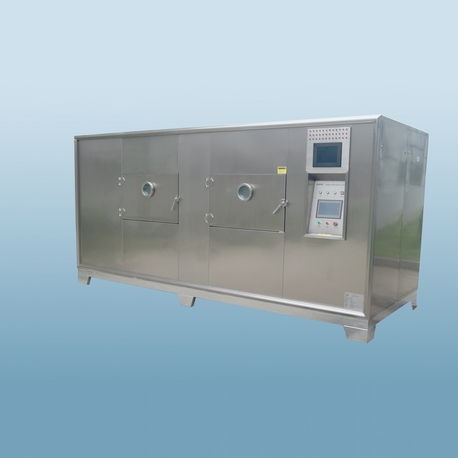
1. Core Components and Their Sizing Criteria
A freeze drying
machine consists of three interdependent subsystems: the
refrigeration unit, the vacuum chamber with heated/cooled shelves, and the
condenser. Each must be sized to handle the thermal load of the product’s
eutectic or glass transition temperature (Tg'). For example, a pharmaceutical
lyophilizer processing 10,000 vials (20 mm diameter) requires shelf area around
15‑20 m² and condenser ice capacity of 400‑600 kg. Nasan’s industrial models
feature dual refrigeration stages (cascade system) achieving shelf temperatures
as low as -55°C with uniformity ±1°C across all shelves, verified by thermal
mapping per ICH Q7.
Sizing parameters to evaluate
Shelf area: Usable area minus edge margin (typically 10‑15
mm from shelf edge).
Condenser temperature: Must be at least 15‑20°C below
product temperature to maintain driving force (e.g., -70°C for a product at
-30°C).
Ice condenser rate: Expressed in kg/24h; for industrial
units, 200‑1000 kg/24h is common.
2. Heat Transfer Fluids and Shelf Temperature Uniformity
Shelf temperature control directly influences sublimation rate and product
quality. Most modern freeze drying
machines use silicone oil as the heat transfer medium due to its
stability across a wide temperature range (-60°C to +120°C). The fluid must have
low viscosity at low temperatures to maintain flow. Nasan’s shelf design
incorporates micro‑channels (instead of simple drilled passages) to ensure ΔT
< 1.5°C across a 2 m² shelf at steady state. This uniformity prevents
edge‑effect drying where vials near the edges dry faster than center vials, a
common cause of batch rejection.
3. Vacuum System: Pumpdown Time and Leak Tightness
The vacuum system must achieve and maintain pressure below 100 mTorr (13 Pa)
during primary drying. Two‑stage rotary vane pumps combined with Roots blowers
are standard. However, for solvent‑based products (e.g., tert‑butyl alcohol),
hydrocarbon‑free pumps (dry pumps) are necessary to avoid oil back‑streaming. A
critical specification is leak rate: according to ISO 18453, industrial freeze
drying machines should have a leak rate below 5×10⁻³ mbar·L/s. Nasan performs
helium leak testing on every chamber and validates that pumpdown time from
atmosphere to 100 mTorr is under 30 minutes, even for large chambers.
4. Condenser Design and Defrost Systems
The condenser captures water vapor removed during drying. Coil type (vertical
or horizontal) and material (stainless steel 316L) affect ice adhesion and
defrost efficiency. Ice build‑up reduces condenser surface area and efficiency;
therefore, ice capacity must exceed the total water removed in a batch. For a
500 kg ice load, a coil surface area of 80‑100 m² is typical. Defrost methods
include hot gas bypass, electric heating, or water spray. Nasan’s units
incorporate a hot‑gas defrost that completes within 45 minutes, minimizing
turnaround time between batches.
5. Clean‑in‑Place (CIP) and Steam‑in‑Place (SIP) Integration
For aseptic pharmaceutical applications, the freeze drying machine must accommodate CIP and SIP without disassembly. This requires spray nozzles
positioned to cover all internal surfaces (chamber walls, shelves, condenser)
and drainage that is fully sloped to avoid pooling. SIP typically involves steam
at 121°C for 30 minutes, which places demands on gasket materials (silicone or
EPDM) and instrumentation. Nasan’s CIP/SIP systems are validated for endotoxin
reduction (3‑log reduction) and include automated control sequences that comply
with cGMP Annex 15.
6. Cycle Development and Scale‑Up Considerations
A pilot‑scale freeze
drying machine (1‑5 m²) is essential for developing cycles that
transfer successfully to production units. Key scale‑up parameters include
chamber pressure (same), shelf temperature profile (same), but ramp rates may
differ due to thermal mass. Nason provides a scale‑up service where pilot runs
are performed on their laboratory units, and the validated cycle is transferred
to their production machines with documented equivalency in product temperature
and drying time. This reduces risk during technology transfer.
7. Energy Efficiency and Life‑Cycle Cost
Industrial lyophilization is energy‑intensive; refrigeration and vacuum
systems account for 80% of power consumption. Variable frequency drives (VFDs)
on compressors and vacuum pumps can reduce energy use by 20‑30%. Additionally,
heat recovery from the refrigeration system (e.g., preheating CIP water)
improves overall efficiency. Nasan’s Eco‑Lyte series incorporates these
features, achieving a specific energy consumption of 1.8 kWh per kg of ice
removed, compared to industry average of 2.5 kWh/kg. Life‑cycle cost analysis
should factor in not only electricity but also maintenance (oil changes, seal
replacements) and validation costs.

8. Control Systems and Data Integrity
Modern freeze drying
machines are equipped with PLC/SCADA systems that comply with FDA
21 CFR Part 11. They log over 50 process parameters (product temperature,
pressure, shelf temperature, ice mass) at intervals as frequent as 1 second.
Nasan’s control system includes a model‑based monitoring tool that compares
actual drying behavior to a mathematical model, alerting operators if deviations
(e.g., choke flow) occur. This real‑time process analytical technology (PAT)
enables quality‑by‑design (QbD) and supports batch release without extensive
offline testing.
Q1: How do I determine the required shelf area for my production
volume?
A1: Calculate based on fill volume per vial and batch size.
For a 10,000‑vial batch of 5 mL fill (10 mm liquid height), typical shelf load
is 7‑10 kg/m². Add 20% margin for future scale‑up. Nasan provides a sizing
calculator based on your vial dimensions and target cycle time.
Q2: What is the difference between eutectic and glass transition
temperatures in freeze drying?
A2: Eutectic temperature (Teu)
applies to crystalline products; if product temperature exceeds Teu during
primary drying, melting occurs. Glass transition temperature (Tg') applies to
amorphous products; exceeding Tg' causes collapse (loss of structure). Both must
be measured by DSC (differential scanning calorimetry) and used to set maximum
allowable product temperature.
Q3: Can I use a freeze drying machine for solvents other than
water?
A3: Yes, but the condenser must be capable of reaching
temperatures below the solvent’s freezing point, and the vacuum pump must be
solvent‑resistant. For tert‑butyl alcohol (freezing point 25°C), a condenser at
-50°C is sufficient. However, explosion‑proof ratings (ATEX) may be required if
flammable solvents are used.
Q4: How often should a freeze drying machine be
validated?
A4: Initial validation (IQ/OQ/PQ) is performed at
installation. Re‑validation is typically required annually, or after major
changes (e.g., replacement of vacuum pump, chamber modification). Routine
calibration of temperature sensors and leak testing should be performed every
6‑12 months.
Q5: What causes longer than expected drying times?
A5:
Common causes include: insufficient chamber pressure (too high or too low), low
shelf temperature (heat transfer limitation), high condenser temperature
(reduced driving force), or product resistance (if cake structure is too dense).
A design of experiments (DoE) approach can identify the optimal setpoints.
Q6: Are there freeze drying machines for continuous
processing?
A6: Yes, continuous or semi‑continuous lyophilizers
(e.g., tunnel‑type) are emerging for high‑volume products. They involve multiple
chambers at different pressures, allowing continuous loading and unloading.
Nasan offers pilot‑scale continuous units for feasibility testing.