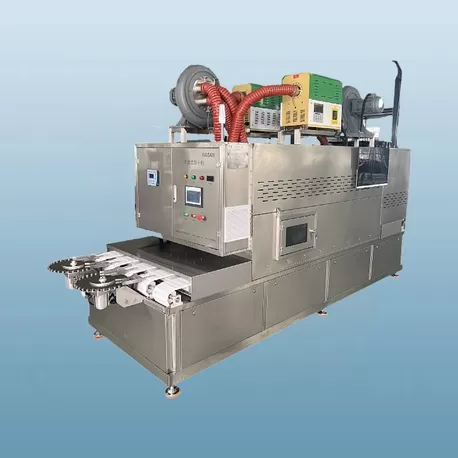
Industrial dehydration is a complex engineering challenge that involves the
simultaneous transfer of heat and mass. At the foundation of this process is the
hot air
dryer, a system designed to utilize heated air as both the energy
carrier and the moisture transport medium. In high-volume production
environments, the efficiency of this equipment determines not only the
throughput but also the final quality and stability of the product. Nasan focuses on the precision
engineering required to manage these variables, ensuring that thermal processing
meets the rigorous demands of modern manufacturing.

The Thermodynamics of Convective Drying
Convective drying relies on the principle of evaporation through the
introduction of thermal energy. When a hot air
dryer operates, it creates a partial pressure gradient between the
moisture on the surface of the material and the surrounding air. This gradient
is the driving force for mass transfer. As the air temperature increases, its
relative humidity decreases, thereby increasing its capacity to absorb water
vapor.
The process is typically divided into two distinct phases: the constant rate
period and the falling rate period. During the constant rate period, the surface
of the material is saturated with water, and the evaporation rate is governed by
external factors such as air velocity and temperature. As the surface dries, the
process enters the falling rate period, where internal moisture migration
(diffusion) becomes the limiting factor. Engineering a system that can adapt to
these different phases is a fundamental requirement for achieving uniform
results without damaging the material structure.
Structural Components and Industrial Materials
A high-performance hot air
dryer must be constructed to withstand continuous thermal cycling
and, in many cases, corrosive environments. The choice of materials is decisive
for the longevity of the system.
Internal Chambers: Utilizing high-grade stainless steel
(SUS304 or SUS316L) is standard in food and pharmaceutical applications to
prevent contamination and resist oxidation.
Insulation Layers: To maximize thermal efficiency,
double-walled construction with high-density mineral wool or ceramic fiber
insulation is employed. This minimizes radiant heat loss and ensures a stable
internal environment.
Heat Exchangers: In indirect-fired systems, the heat
exchanger must provide a large surface area for efficient energy transfer while
maintaining a complete seal between combustion gases and process air.
Air Filtration: Pre-filters and HEPA filters are often
integrated into the intake to ensure that the air used for drying is free from
particulates, which is a key factor in maintaining product purity.
By emphasizing these structural details, Nasan builds equipment that
remains reliable over years of intensive operation, minimizing the need for
unplanned interventions.
Airflow Patterns and Distribution Engineering
The way air moves through the drying chamber determines the uniformity of the
final moisture content. Inconsistent airflow leads to "cold spots" where the
product may remain damp, or "hot spots" where the material might burn or
degrade. There are three primary airflow configurations used in industrial
settings:
Cross-Flow and Through-Flow Systems
In cross-flow systems, the air moves horizontally across the product beds.
This is common in tray-based systems. Through-flow systems, however, force the
air vertically through a perforated bed of material. Through-flow is generally
more efficient as it provides a higher contact area between the air and the
product, accelerating the heat transfer coefficient.
Parallel and Counter-Current Flow
For continuous conveyor systems, the direction of the air relative to the
product movement is a major design consideration. Parallel flow, where both the
product and the air move in the same direction, is gentler and suited for
heat-sensitive materials. Counter-current flow, where the air and product move
in opposite directions, provides a higher temperature gradient at the outlet,
which is effective for reaching very low final moisture levels.
Optimizing Product Quality in Industrial Processing
A common hurdle in thermal drying is "case hardening," a phenomenon where the
exterior of a material dries and forms a hard shell before the internal moisture
can escape. This often leads to internal spoilage or structural defects. To
solve this, a hot air
dryer must be equipped with sophisticated humidity controls. By
maintaining a specific humidity level in the air during the early stages of
drying, the surface remains porous, allowing for a steady migration of moisture
from the core to the surface.
Precise temperature modulation is also a requirement. Using PID control
loops, the system can adjust the heat input based on real-time feedback from
sensors. This prevents the thermal degradation of sensitive compounds, such as
vitamins in food products or active ingredients in chemical catalysts.
Hybrid Integration: Synergizing Hot Air with Microwave Technology
While convective drying is effective for surface moisture, it is often slow
when dealing with thick or dense materials. This is where hybrid technology
provides a significant advantage. By combining a hot air
dryer with microwave energy, manufacturers can achieve volumetric
heating.
In this configuration, the hot air handles the surface evaporation and
maintains the chamber temperature, while the microwave energy penetrates the
material to excite water molecules internally. This internal pressure drives
moisture to the surface much faster than conventional conduction or convection
alone. Nasan specializes in these combined systems, offering a solution that reduces
processing times and improves the structural integrity of the dried product.
Managing Moisture Gradients in Complex Materials
Hygroscopic materials—those that readily absorb moisture from the
atmosphere—present a unique challenge. In these cases, the drying process must
be followed by a controlled cooling phase to prevent re-absorption. The
hot air
dryer can be configured with a cooling zone where ambient or
chilled air is circulated. This stabilizes the product before it is
packaged.
Understanding the equilibrium moisture content (EMC) is a requirement for
these applications. The EMC is the point at which the material neither gains nor
loses moisture to the environment. Modern drying systems use specialized
software to calculate the optimal dwell time and temperature profile to reach
the desired EMC, ensuring that the product remains stable during storage and
transport.
Maintenance and Operational Reliability
To ensure a long service life, the mechanical components of the drying system
must be part of a rigorous maintenance schedule. Centrifugal fans, which are the
heart of the air distribution system, require periodic balancing to prevent
vibration-induced wear. Burner assemblies must be cleaned to maintain the
correct fuel-to-air ratio, which is a primary factor in thermal efficiency.
Designers are increasingly focusing on "Clean-in-Place" (CIP) features,
particularly in the food and biotech sectors. Smooth internal welds, rounded
corners, and accessible ductwork allow for thorough sanitation without the need
for extensive manual labor. This reduces downtime and ensures that the system
meets the highest hygiene standards.
The Future of Industrial Dehydration
The evolution of drying technology is moving toward greater automation and
data integration. Sensors now monitor everything from inlet humidity to exhaust
air temperature, allowing for a closed-loop system that adapts to variations in
the raw material. This level of control is a fundamental part of the transition
to smart manufacturing, where the equipment can self-correct to maintain peak
performance.
As industries look for more efficient ways to process bulk solids, powders,
and pastes, the role of the hot air
dryer remains central. Through better airflow dynamics, material
selection, and the integration of hybrid heating technologies, the current
generation of drying equipment provides the precision and reliability needed for
complex industrial workflows.
Frequently Asked Questions
Q1: What materials are best suited for hot air drying?
A1: This method is highly versatile and used for grains, fruits, vegetables,
chemical powders, pharmaceutical granules, and minerals. It is particularly
effective for any non-sensitive material that requires bulk moisture removal
through convection.
Q2: How does air velocity affect the drying process?
A2: Higher air velocity increases the heat transfer coefficient and speeds up
surface evaporation during the constant rate period. However, once the process
reaches the falling rate period, increasing air velocity has diminishing returns
as internal diffusion becomes the limiting factor.
Q3: Can a hot air dryer be used for heat-sensitive
products?
A3: Yes, by utilizing precise PID controls and indirect heating, the air
temperature can be kept at a low, consistent level. Some systems also use
vacuum-assisted hot air drying to lower the boiling point of water, allowing for
drying at much lower temperatures.
Q4: Why is humidity control important in a drying
system?
A4: Controlling the humidity of the drying air prevents the surface of the
material from drying too quickly. This avoids case hardening and internal
cracking, ensuring that moisture can migrate from the core to the surface
uniformly.
Q5: What is the benefit of a hybrid microwave and hot air
system?
A5: Hybrid systems use microwaves to heat the product from the inside out
while hot air removes moisture from the surface. This significantly reduces
drying times, improves energy efficiency, and often results in better product
texture and color compared to using hot air alone.
Request a Technical Consultation
If your manufacturing process requires a sophisticated drying solution, our
technical team is available to help. We offer comprehensive analysis of your
material properties and production requirements to design a system that
maximizes throughput and product quality. Contact us today to discuss your
project specifications and receive a formal inquiry response.