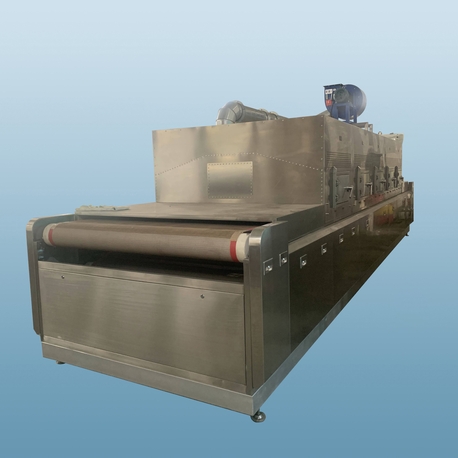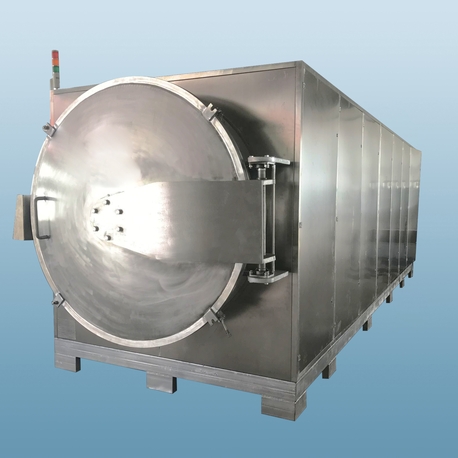



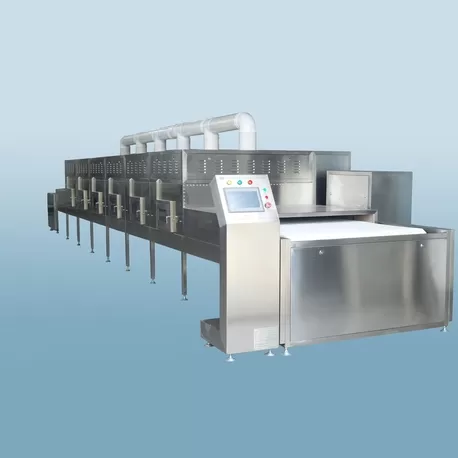
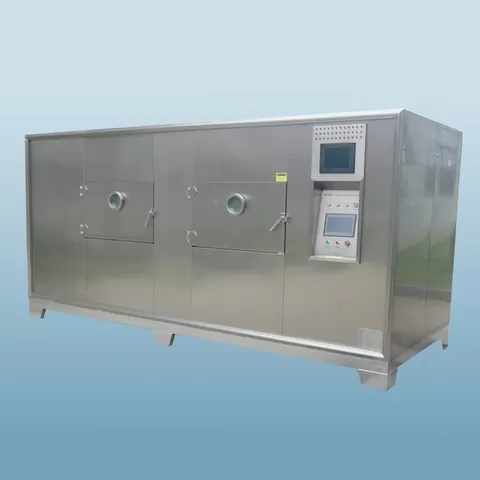
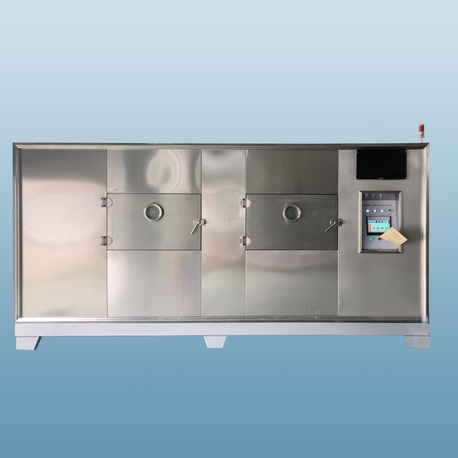
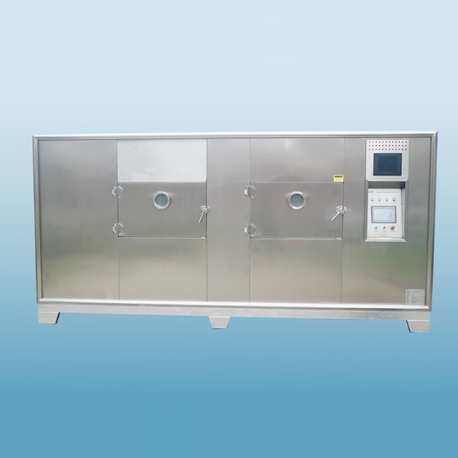
For commercial fruit processors — from dried mango slices to apple chips and berry powders — the choice of an industrial fruit drying machine directly determines product quality, energy cost, and throughput capacity. Unlike batch dehydrators used in small operations, industrial-scale systems must remove tons of water per day while preventing case hardening, enzymatic browning, and nutrient degradation. This article examines the leading drying technologies (convection, heat pump, microwave, and hybrid), key specification parameters, common failure modes, and energy optimization strategies — drawing from installations by Nasan across dried fruit processing lines worldwide.

1. Core Technologies for Industrial Fruit Drying Machines
Selecting the right industrial fruit drying machine requires understanding the strengths and limitations of each drying principle.
1.1 Convection (Hot Air) Belt Dryers
The most common configuration for high-volume processing (2–20 tons/day). Fruit pieces (e.g., diced apples, banana slices) are spread on a perforated stainless steel belt, while heated air (50–85°C) passes through the bed from below or above. Multi-stage units allow different temperature zones: higher initial temperatures for surface drying, lower final temperatures to avoid scorching. Advantages include low capital cost and simple operation. However, convection drying can cause case hardening (dry outer layer trapping internal moisture) and requires long dwell times (4–12 hours), leading to higher energy consumption (3.5–5.0 kWh per kg water removed).
1.2 Heat Pump Drying Systems
Heat pump industrial fruit drying machine units recycle exhaust heat by condensing moisture from the air and reheating the dehumidified air stream. Operating temperatures range from 30–65°C, ideal for heat-sensitive fruits (berries, cherries, citrus peels). Energy efficiency is exceptional: 1.0–1.5 kWh per kg water removed (coefficient of performance COP 3–5). The closed-loop design also prevents external contamination. Disadvantages include higher upfront cost and slower drying rates compared to direct gas heating.
1.3 Microwave and Hybrid Drying
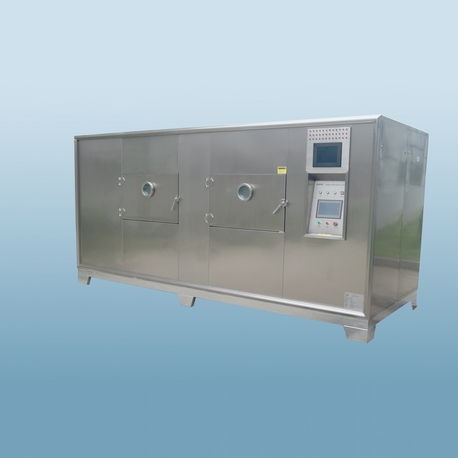
Microwave drying (2450 MHz or 915 MHz) volumetrically heats water molecules inside the fruit, creating internal steam pressure that accelerates moisture escape. A microwave dehydrator can reduce drying time from hours to minutes, with minimal surface temperature rise — preserving volatile aromas and color. For fruits with high sugar content (dates, figs), microwave alone can cause scorching, so hybrid systems combine microwave with hot air or vacuum. Nasan’s hybrid industrial fruit drying machine units achieve 0.8–1.2 kWh per kg water, while producing dried fruit with superior rehydration ratios.
1.4 Freeze Drying (Lyophilization)
For premium products (freeze-dried strawberries, durian, exotic fruits), freeze drying preserves shape, color, and >95% of nutrients. However, operating costs are high (8–12 kWh per kg water) and batch cycles run 24–48 hours. This technology is reserved for high-value ingredients used in cereals, space food, or pharmaceutical applications.
2. Key Specification Parameters for Industrial Fruit Drying Machines
When evaluating an industrial fruit drying machine, buyers must consider these engineering metrics:
Moisture extraction rate (MER): kg water removed per hour per square meter of belt area. Typical MER for convection: 2–5 kg/m²/h; for heat pump: 1.5–3 kg/m²/h; for microwave: 8–15 kg/m²/h.
Final moisture uniformity: For diced fruit, target ±1% across the belt width. Poor uniformity leads to microbial growth in under-dried pieces and brittle texture in over-dried ones.
Maximum air velocity (for convection): 1.5–3 m/s through the bed. Higher velocities increase drying rate but risk blowing small pieces off the belt.
Temperature gradient control: Fruits with high sugar content require gradual temperature increase to avoid caramelization. Programmable zone controllers are necessary for multi-stage drying.
Sanitation design: All product-contact surfaces must be 304 or 316 stainless steel, with CIP (clean-in-place) spray balls and sloped floors for drainage.
Nasan provides a detailed sizing worksheet based on initial moisture content (typically 80–90% for fresh fruit), target final moisture (15–20% for semi-dried, 3–5% for crispy), and desired throughput (kg/h wet basis).
3. Industry Pain Points and Engineered Solutions
Even a high-quality industrial fruit drying machine can produce defects if not optimized for specific fruit varieties. Below are four common problems and corrective measures.
Pain point: Case hardening (dry crust with wet interior) in mango or papaya
Cause: Too high initial air temperature ( >70°C) or excessive airflow. Solution: Use a three-stage profile: 55°C for first 2 hours (to remove surface moisture slowly), then 65°C for 4 hours, finally 75°C for 2 hours. Install humidity sensors to maintain 40–50% RH in the first stage — higher humidity reduces surface evaporation rate, allowing internal moisture to migrate.Pain point: Non-enzymatic browning (darkening) in apple or pear slices
Cause: Oxidation or heat-induced Maillard reaction. Solution: Pre-treat slices in 1% citric acid + 0.5% ascorbic acid solution for 2 minutes before drying. Use a microwave dehydrator or heat pump dryer operating below 65°C. For convection dryers, reduce oxygen exposure by using a nitrogen purge in the drying chamber (for high-value products).Pain point: Clumping and sticking of dried fruit pieces
Cause: High sugar content (dates, figs, raisins) becomes tacky at intermediate moisture levels (25–35%). Solution: Apply a light dusting of rice flour or starch before drying. Use a vibrating belt or rotary drum dryer instead of a flat belt. For heat pump dryers, oscillate the belt direction every 30 minutes to break clumps.Pain point: Uneven drying across the belt width
Cause: Air distribution imbalance or thicker product layer at edges. Solution: Install adjustable baffles in the air plenum. Use a laser scanner to measure bed depth and automatically adjust belt speed or air flow. For microwave systems, overlapping multiple magnetron feeds (as in Nasan’s designs) ensures field uniformity within ±5%.
4. Energy Efficiency and Operating Cost Analysis
Energy represents 60–70% of the total operating cost for an industrial fruit drying machine. Here is a comparison of specific energy consumption (SEC) for different technologies drying mango from 85% to 15% moisture (wet basis):
Direct gas-fired convection: 4.2 kWh/kg water removed (including fan electricity). Gas cost at $0.05/kWh equivalent = $0.21/kg water.
Heat pump (closed-loop): 1.3 kWh/kg water. Electricity at $0.12/kWh = $0.16/kg water — lower cost despite higher electricity price due to efficiency.
Microwave (915 MHz): 1.1 kWh/kg water. Electricity cost $0.13/kg water — fastest drying, best quality retention.
Hybrid microwave + heat pump: 0.9 kWh/kg water. Best efficiency but highest capital cost.
Additionally, waste heat recovery can further reduce SEC by 15–20%. For example, exhausting warm air from a convection dryer can preheat incoming fresh air via a plate heat exchanger. Nasan offers modular heat recovery units that retrofit to existing dryers, with payback periods of 12–18 months.
5. Automation and Quality Control Systems
Modern industrial fruit drying machine lines incorporate Industry 4.0 features for consistent quality:
Near-infrared (NIR) moisture sensors: Mounted at the dryer exit, they measure moisture in real time (accuracy ±0.5%). Closed-loop PID adjusts belt speed or temperature to maintain target.
Machine vision for color sorting: Cameras detect browning or scorched pieces and activate pneumatic ejectors downstream.
Data logging and traceability: Each batch is recorded with time-temperature-moisture profiles, essential for food safety certifications (BRC, IFS, SQF).
Predictive maintenance: Vibration sensors on fans and motors, plus bearing temperature monitoring, alert operators before failure.
For small to medium processors, Nasan provides PLC-based control with remote access, allowing technical support to adjust parameters without site visits.
6. Frequently Asked Questions (FAQs)
Q1: What is the typical capacity range for an industrial fruit drying machine?
A1: Single units range from 50 kg/h wet fruit input (small-scale) up to 5,000 kg/h (large continuous lines). For example, a 5 m wide belt dryer with 30 m length can process 2 tons of wet apple slices per hour, producing 300 kg of dried product (assuming 85% moisture reduction). Nasan offers modular designs that scale by adding belt sections or parallel tunnels.
Q2: How do I prevent aflatoxin growth during fruit drying?
A2: Aflatoxin (from Aspergillus fungi) develops when drying is too slow, particularly in tropical climates. Reduce risk by: (1) achieving final moisture below 12% within 24 hours of harvest, (2) using a pre-dryer to quickly reduce surface moisture to 30% within 2 hours, (3) maintaining airflow velocity above 1.5 m/s to remove boundary layer humidity, (4) adding UV-C lamps in the drying chamber (kills surface spores). For dried figs and dates, hot water blanching (80°C for 30 seconds) before drying is highly effective.
Q3: Can the same industrial fruit drying machine handle different fruit types?
A3: Yes, but with adjustments. Convection and heat pump dryers require different belt speeds and temperature profiles for each fruit. Microwave dryers can be programmed with recipes, but the load density and bed depth must be optimized. A flexible design includes modular belts that can be swapped (fine mesh for berries, open mesh for larger pieces) and multi-zone temperature control. Nasan’s universal fruit dryer line allows changeover within 30 minutes.
Q4: What sanitation procedures are required for industrial fruit drying machines?
A4: Daily cleaning: Remove residual fruit pieces using brushes and compressed air. Weekly: Wash belts and interior surfaces with hot water (70°C) and food-grade detergent, followed by a sanitizing rinse (50 ppm chlorine). Monthly: Disassemble belt tracking rollers and clean bearing housings. For organic certification, use only hydrogen peroxide or peracetic acid sanitizers. Nasan’s CIP system automates the weekly wash cycle, reducing downtime to 2 hours.
Q5: How long does an industrial fruit drying machine typically last?
A5: With proper maintenance (lubrication, belt replacement every 3–5 years, fan bearing changes every 2 years), a stainless steel dryer lasts 15–20 years. Microwave magnetrons need replacement every 5,000–8,000 hours (about 2–3 years in 24/7 operation). Heat pump compressors have a 10–12 year lifespan. Nasan offers extended service contracts covering parts and labor, including annual performance verification.
Ready to Optimize Your Fruit Drying Operations?
Whether you process tropical fruits, berries, or tree fruits, Nasan provides custom-engineered industrial fruit drying machine solutions — from lab-scale test units to full production lines with integrated pretreatment, drying, and packaging. Our services include free moisture analysis of your fruit samples, process simulation, turnkey installation, and operator training.
Send us 10 kg of your fresh fruit (any variety) and your target final moisture. We will run a comparative trial on convection, heat pump, and microwave technologies, then provide a detailed report with recommended equipment specifications, energy cost projections, and ROI analysis.
Submit your industrial fruit drying machine inquiry to Nasan engineering or use the online form for a prompt technical consultation.