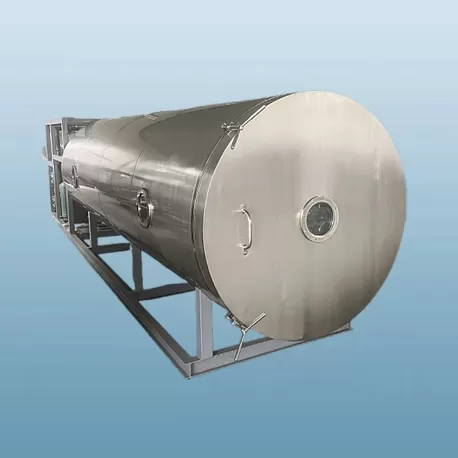
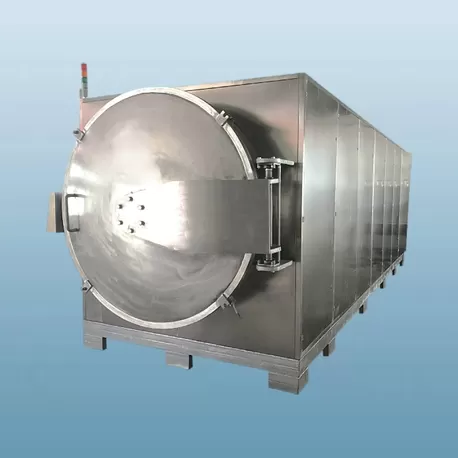
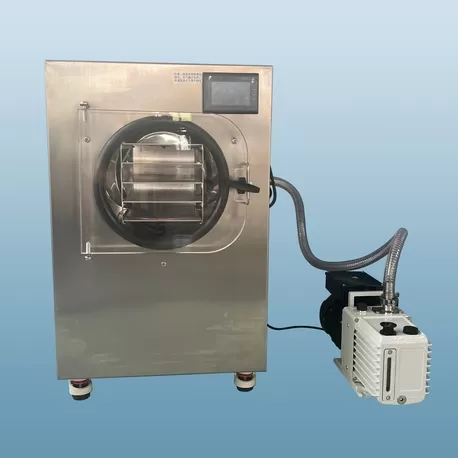
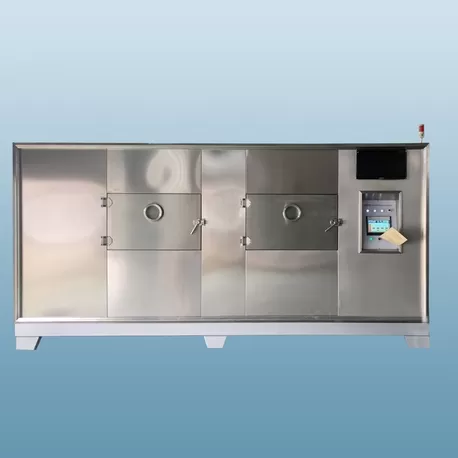
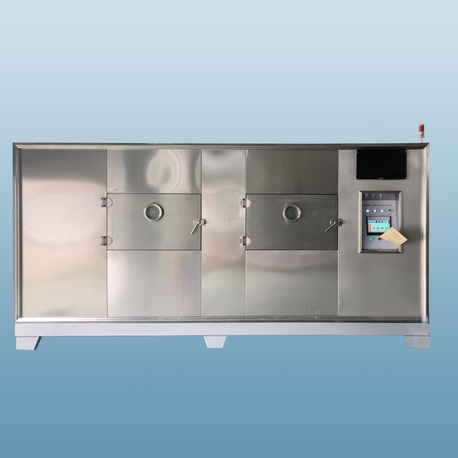
Vacuum Microwave Dehydration: Principles, Applications & Industrial SystemsIn the industrial processing of heat‑sensitive products, conventional drying often forces a compromise between throughput and quality. Hot air or freeze‑drying methods either degrade thermolabile compounds or incur prohibitive energy costs. Vacuum microwave dehydration resolves this dilemma by combining the volumetric heating of microwaves with the low‑pressure environment of a vacuum. This synergy enables rapid moisture removal at temperatures as low as 30 °C, preserving molecular structure, colour, and bioactivity. As a trusted engineering partner, Nasan has deployed custom‑designed systems that translate these principles into reliable, large‑scale production tools.
Understanding the physics behind vacuum microwave dehydration is essential for engineers and quality managers. The process leverages two distinct mechanisms that work in concert to achieve exceptional drying kinetics.
1.1 Dielectric Heating and Volumetric Energy Transfer
Microwaves (typically 915 MHz or 2450 MHz) interact directly with polar molecules—primarily water—within the material. This interaction, governed by the dielectric loss factor, causes molecular rotation and frictional heating throughout the entire volume, not just at the surface. Volumetric heating generates an internal vapour pressure that drives moisture outward rapidly, preventing case hardening and surface crust formation. Materials with high moisture content absorb energy more efficiently, allowing the process to self‑regulate: wetter zones receive more energy, balancing the drying front.
1.2 Synergistic Effect of Vacuum on Moisture Removal
By reducing the absolute pressure inside the chamber (typically to 20–80 mbar), the boiling point of water drops to 25–35 °C. The combination of lowered boiling point and internal vapour pressure creates a steep pressure gradient from the core to the surface. This gradient accelerates mass transfer without the need for high temperatures. Moreover, the oxygen‑free environment inhibits oxidation, discoloration, and degradation of unsaturated lipids or vitamins. The result is a dried product that retains the sensory, nutritional, and functional properties of the fresh material.
2. Critical Design Parameters for Industrial Dehydration Systems
Industrial implementation of vacuum microwave dehydration requires precise engineering to ensure uniform energy distribution, consistent vacuum levels, and safe operation. Below are the key technical factors that influence system performance.
2.1 Microwave Frequency and Power Modulation
915 MHz vs. 2450 MHz: Lower frequencies (915 MHz) offer greater penetration depth, making them suitable for bulk products or thicker layers. Higher frequencies (2450 MHz) are often used for thin films or small particles where rapid surface heating is desired. Industrial dryers may employ multiple magnetrons to optimise field uniformity.
Power modulation: Modern solid‑state generators or inverter‑controlled magnetrons allow continuous adjustment of microwave power. This prevents localised overheating (arcing) and enables precise temperature profiling based on real‑time feedback from fibre‑optic or infrared sensors.
2.2 Vacuum Integrity and Condensation Efficiency
The vacuum pump and condenser are as critical as the microwave source. As water vapour is generated under vacuum, it must be continuously removed to maintain the pressure differential. A high‑efficiency condenser captures the vapour, converting it back to liquid. In pharmaceutical applications, this also allows recovery of valuable solvents. Data from pilot installations show that optimising condenser surface area and coolant temperature can reduce overall energy consumption by 15–20%.
2.3 Material Handling: Rotary, Batch, and Continuous Configurations
The physical state of the feed material dictates the dryer design. For pastes, slurries, and sticky products, rotary vacuum microwave dehydrators are preferred. The rotation constantly exposes fresh surfaces to the microwave field, preventing agglomeration and ensuring uniform moisture content. Nasan offers batch systems for high‑value, low‑volume products and continuous systems for large‑scale operations, both equipped with advanced control software that logs every batch parameter.
3. Industrial Applications Across Key Sectors
Vacuum microwave dehydration has been successfully adopted in industries where product integrity is paramount. The following sections detail specific use cases backed by technical rationale.
3.1 Pharmaceutical and Biotech: Preserving Potency and Stability
Active pharmaceutical ingredients (APIs), intermediates, and herbal extracts are notoriously sensitive to heat and oxygen. Traditional tray drying can degrade thermolabile compounds, while freeze‑drying is slow and energy‑intensive. Vacuum microwave dehydration operates at temperatures below 40 °C, retaining >95% of the original potency for many APIs. The oxygen‑free environment prevents oxidative degradation, which is critical for compounds like coenzyme Q10, curcumin, and peptides. In one comparative study, a major European pharma manufacturer reduced drying time for a probiotic culture from 48 hours (freeze‑drying) to 4 hours while achieving the same viability count.
3.2 Food Processing: Retention of Nutritional and Sensory Attributes
Fruits, vegetables, herbs, and functional food ingredients lose volatile aromatics and vitamins when subjected to hot air. Vacuum microwave dehydration preserves up to 90% of anthocyanins in berries and more than 85% of vitamin C in citrus peels. The rapid vapor expansion creates a porous microstructure, which gives the dried product excellent rehydration properties—a key quality parameter for instant soups, beverages, and ingredients. Additionally, the low temperature prevents caramelisation of sugars, retaining the natural colour and flavour profile.
3.3 Chemical and Advanced Materials: Achieving Ultra‑Low Moisture
In the production of catalysts, battery materials, and nanopowders, even trace moisture can affect performance. Conventional drying often causes particle agglomeration due to capillary forces. The gentle, volumetric heating of vacuum microwave dehydration minimises these forces, yielding free‑flowing powders with high specific surface area. Manufacturers of lithium‑ion battery cathodes have adopted the technology to achieve moisture levels below 100 ppm without compromising particle morphology.
4. Solving Industry Challenges with Vacuum Microwave Dehydration
Adopting any new technology involves overcoming practical hurdles. Below we address the most common pain points and how engineered solutions from Nasan mitigate them.
4.1 Uniformity and Scalability from Lab to Production
Challenge: Results obtained in a small laboratory unit may not replicate in a large industrial dryer due to changes in electromagnetic field distribution.
Solution: Nasan employs multi‑physics simulation (e.g., COMSOL) during the design phase to model field uniformity and drying kinetics. Pilot‑scale rental units allow customers to verify performance with their own product, and data from those trials is used to scale up linearly. Our production systems incorporate mode stirrers and variable‑speed turntables to ensure every particle experiences identical conditions.
4.2 Energy Optimization and Sustainability
Challenge: Drying is often one of the most energy‑intensive unit operations in a plant.
Solution: Because microwave energy heats only the water molecules—not the chamber walls or ambient air—the specific energy consumption (SEC) of vacuum microwave dehydration typically ranges from 0.9 to 1.3 kWh per kg of water removed. This is 30–50% lower than conventional vacuum drying. When combined with a heat recovery system on the condenser, the overall carbon footprint can be further reduced.
4.3 Handling High‑Viscosity and Heat‑Sensitive Products
Challenge: Pasty materials such as honey, yeast cream, or herbal extracts tend to foam or scorch in conventional dryers.
Solution: Rotary vacuum microwave dehydrators are specifically designed for such products. The gentle tumbling action combined with low‑temperature evaporation prevents foaming and ensures a homogeneous final product. Inline sensors monitor viscosity and adjust rotation speed and microwave power in real time.
5. Economic and Quality Benefits: Data‑Driven Insights
Investing in vacuum microwave dehydration yields measurable returns beyond quality improvement. Independent cost‑benefit analyses for botanical extraction facilities show that the shortened drying cycle (from 12 hours to 2 hours) reduces in‑process inventory and labour costs by approximately 40%. The superior product quality—brighter colour, higher potency, and instant rehydration—allows manufacturers to command premium pricing in markets such as organic ingredients and high‑end nutraceuticals. Furthermore, the enclosed system minimises contamination risk and simplifies cleaning, contributing to higher overall equipment effectiveness (OEE).

6. Future Outlook and Technological Innovations
The next generation of vacuum microwave dehydration systems will be fully integrated with Industry 4.0 principles. Real‑time monitoring of dielectric properties will allow predictive end‑point detection, eliminating over‑drying. Hybrid systems combining microwave vacuum with infrared or radio frequency are under development to handle multi‑layer products. Nasan is actively researching continuous microwave vacuum tunnels for high‑throughput lines, aiming to offer the food and pharma industries a seamless transition from batch to continuous processing.
Frequently Asked Questions (FAQ)
Q1: What exactly is vacuum microwave dehydration?
A1: It is a drying process that combines microwave volumetric heating with a vacuum environment. Microwaves penetrate the material and excite water molecules, generating heat internally. The vacuum lowers the boiling point of water, allowing rapid evaporation at low temperatures (typically 25–40 °C) while preventing oxidation.
Q2: How does it differ from freeze‑drying?
A2: Freeze‑drying sublimates ice under high vacuum and requires freezing the product first, which is slow and energy‑intensive. Vacuum microwave dehydration works with liquid or solid feed directly; it does not require freezing and is typically 5–10 times faster, while still preserving heat‑sensitive compounds.
Q3: Which products benefit most from this technology?
A3: Any product that is sensitive to heat or oxygen: pharmaceuticals (APIs, enzymes), nutraceuticals (herbal extracts, probiotics), high‑value foods (berries, herbs, instant coffee), and advanced materials (catalysts, battery powders, ceramics).
Q4: Can the process handle liquid or pasty materials?
A4: Yes. Rotary vacuum microwave dehydrators are designed specifically for pastes, slurries, and high‑viscosity liquids. The rotation continuously exposes fresh surfaces to the microwave field, ensuring uniform drying without scorching.
Q5: What are the typical energy savings compared to conventional drying?
A5: Depending on the product and initial moisture, energy savings range from 30% to 50%. The specific energy consumption is usually 0.9–1.3 kWh per kilogram of water removed, significantly lower than hot‑air or vacuum‑only drying.
Q6: Is vacuum microwave dehydration easy to scale up from laboratory to production?
A6: Yes, when guided by proper engineering. Nasan offers pilot‑scale testing and uses simulation software to ensure that production units replicate lab results. Factors like field uniformity and condenser capacity are scaled proportionally to maintain product quality.
Q7: What safety measures are in place for industrial systems?
A7: Industrial systems are built with multiple interlocks, pressure relief valves, and microwave leakage detectors. The vacuum environment inherently suppresses plasma formation, and modern generators include arc detection that shuts down power within milliseconds.