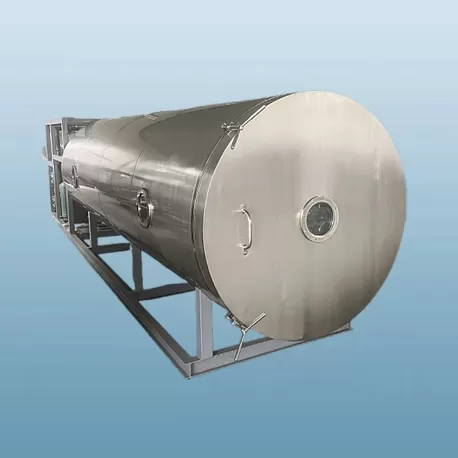
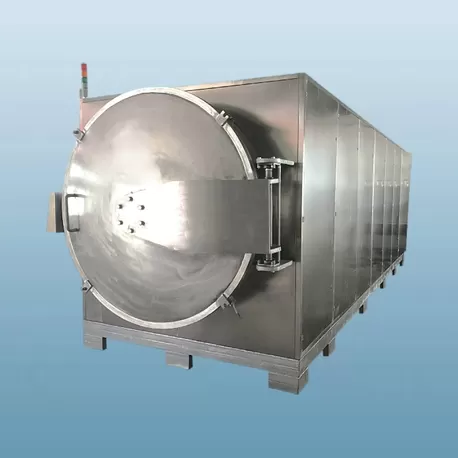
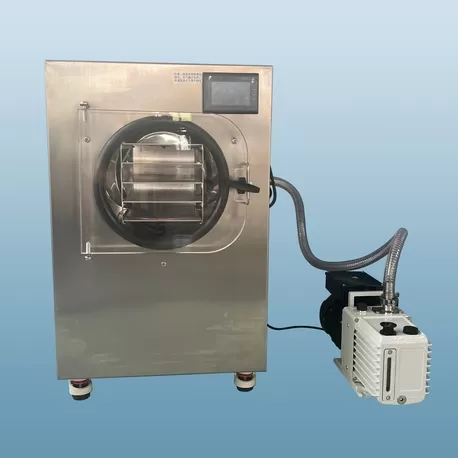
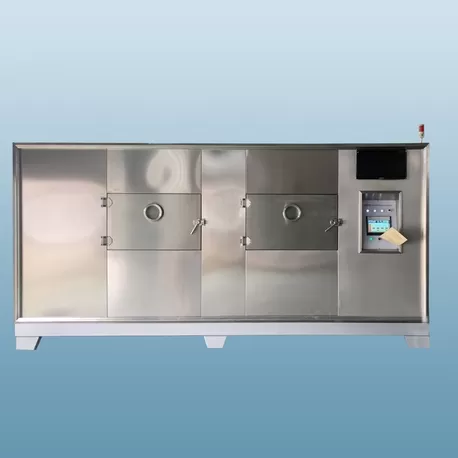
In modern food processing, chemical, and pharmaceutical industries,
conventional hot air drying presents persistent challenges: non-uniform moisture
removal, surface case hardening, prolonged thermal exposure, and high energy
consumption. The microwave dehydrator offers a
fundamental shift through volumetric dielectric heating. This article provides a
technical assessment of microwave dehydrator systems, comparing them with
conventional methods, examining industrial applications, and presenting
quantitative performance data. For B2B engineering teams seeking to upgrade
drying lines, understanding these parameters is essential for ROI
validation.

1. Principles of Microwave Dielectric Drying: Volumetric Heating vs. Thermal
Gradients
Unlike conductive or convective drying, where heat flows from the surface
inward, a microwave dehydrator generates heat
directly within the wet material. Microwaves (typically 915 MHz or 2450 MHz)
cause polar molecules—primarily water—to rotate rapidly, producing internal
friction and uniform heat generation. This volumetric effect reverses the
traditional moisture gradient: internal vapor pressure expels water outward,
preventing surface crust formation and enabling faster drying at lower bulk
temperatures.
Key technical advantages of dielectric drying include:
Selective energy coupling: Water absorbs microwave energy
more efficiently than dry solids, avoiding overheating of already-dry
zones.
Reduced drying time: Typical processing cycles shorten from
6–12 hours (hot air) to 15–90 minutes, depending on product geometry and initial
moisture.
Microbial reduction: The combined thermal and non-thermal
effects of microwave fields lower bacterial loads, extending shelf life without
chemical preservatives.
Nutrient retention: Rapid drying at ≤70°C preserves
thermolabile vitamins, enzymes, and bioactive compounds.
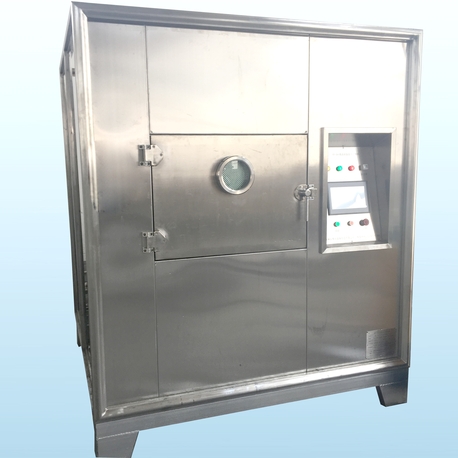
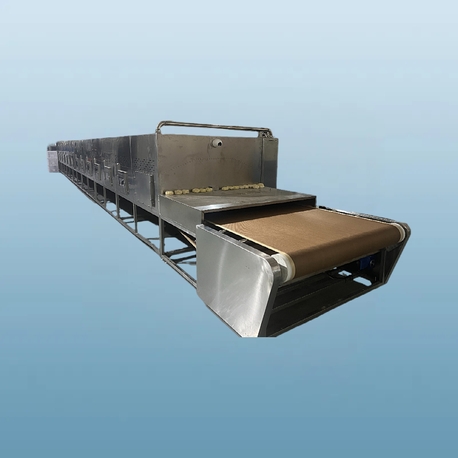
Industrial-scale microwave dehydrator systems incorporate rotating
applicators, variable power magnetrons, and real-time moisture sensors to ensure
field uniformity. Nasan integrates these components into continuous
belt or batch tunnel designs, with power outputs ranging from 6 kW to over 100
kW for high-throughput operations.
2. Quantitative Comparison: Microwave Dehydrator vs. Conventional Hot Air
& Freeze Drying
For procurement and engineering managers, comparing process metrics is
critical. The table below summarizes performance indicators based on industrial
operation data (average values across fruit, vegetable, and herb
applications).
2.1 Energy Efficiency & Drying Kinetics
Specific energy consumption: Microwave dehydrator achieves
1.2–1.8 kWh per kg of water removed, versus 2.5–4.0 kWh/kg for hot air and 8–12
kWh/kg for freeze drying.
Drying time reduction: 70–85% shorter than hot air; 90%
shorter than freeze drying.
Moisture uniformity: Coefficient of variation <3% in
microwave systems vs. 12–18% in tray dryers.
2.2 Product Quality Metrics
Vitamin C retention in fruits: 82–94% (microwave) vs.
45–65% (hot air) vs. 90–97% (freeze drying).
Color difference (ΔE): ≤3.5 for microwave, acceptable for
premium export grades.
Rehydration ratio: 4.5–5.2 (microwave) vs. 2.8–3.5 (hot
air), approaching freeze-dried quality at lower cost.
Bulk density reduction: Minimal shrinkage (≤12%) preserving
original structure.
These figures confirm that for many high-value materials (herbs, functional
mushrooms, premium fruit slices), a microwave dehydrator provides the optimal balance
between throughput, energy cost, and final product grade. Nasan provides plant-specific simulations to validate these metrics for each
customer's raw material.
3. Industrial Applications: From Food Ingredients to Technical
Materials
The versatility of microwave dehydration extends across multiple B2B sectors.
Below are high-demand applications where industrial drying solutions based on microwave
technology have replaced conventional lines.
3.1 Fruit & Vegetable Processing
Banana chips & apple rings: Achieve crispy texture
without oil-frying; maintain natural sweetness.
Carrot and beetroot powders: Uniform drying preserves
betalains and carotenoids for natural colorants.
Tomato slices: 90% moisture reduction in 40 minutes with
minimal browning.
3.2 Herbs, Spices & Medicinal Plants
Basil, mint, oregano: Volatile oil retention 3x higher than
hot air drying.
Ginseng, echinacea, chamomile: Microwave drying eliminates
mold risks while preserving active glycosides.
3.3 Protein & Meat Products
Beef jerky, fish fillets: Uniform moisture distribution
prevents case hardening; reduced cooking loss.
Insect protein (larvae, crickets): Rapid dehydration at low
temperatures avoids protein denaturation.
3.4 Wood, Paper & Biopolymer Drying
Thin wood veneers: No warping or surface checks; drying
time from 3 days to 2 hours.
Paper honeycomb cores: Uniform moisture without adhesive
degradation.
PLA filaments: Controlled microwave drying prevents thermal
hydrolysis.
Each application requires precise tuning of microwave power density, conveyor
speed, and air circulation. Nasan offers pilot-scale testing to
determine optimal drying curves before full-scale equipment investment.
4. Solving Industry Pain Points: Technical and Economic Challenges
Addressed
Despite clear benefits, many B2B buyers hesitate due to concerns about
upfront cost, field uniformity, and process control. Below we address each pain
point with concrete solutions.
4.1 Non-Uniform Heating & Hot Spots
Problem: Inadequate applicator design leads to arcing or
scorching. Solution: Advanced microwave systems use mode stirrers,
rotating belts, and variable power magnetrons (pulse-width modulation) to
achieve field uniformity >95%. Nasan employs 3D electromagnetic
simulation to map energy distribution before fabrication.
4.2 High Initial Capital Expenditure
Problem: Microwave dehydrators cost 2–3x more than
comparable hot air dryers. Solution: ROI analysis shows payback
within 12–24 months due to 40–60% lower energy bills, reduced labor (automated
loading/unloading), and higher product selling price (premium grade). For
example, drying 500 kg/hr of mango slices: annual energy savings of $38,000 +
increased revenue of $210,000 from better color grade.
4.3 Limited Throughput for High-Moisture Products
Problem: Single-cavity batch systems may not match
continuous production needs. Solution: Industrial continuous
microwave dehydrators with multi-stage power zones and integrated hot-air
assistance (hybrid drying) handle 1–10 tons per hour. Nasan designs modular systems that scale from 50 kW to 500 kW.
4.4 Regulatory Compliance & Safety
Problem: Microwave leakage and emission standards.
Solution: All industrial units comply with FCC (USA), CE (EU),
and IEC 60519-6 standards, featuring double-interlock doors, leakage monitors
(<5 mW/cm² at 5 cm), and automatic power cutoff.

5. Selecting an Industrial Microwave Dehydrator: Key Technical
Specifications
When evaluating equipment from different suppliers, B2B engineering teams
must request and compare these parameters:
Frequency choice: 915 MHz (better penetration for thick or
high-moisture loads, up to 100 mm depth) vs. 2450 MHz (cost-effective for
thin-layer products).
Power density control: Adjustable from 0.5 to 5 W/g to
avoid thermal runaway.
Atmosphere options: Vacuum microwave drying for
oxygen-sensitive materials, or modified atmosphere (N₂ flushing).
Integration with existing lines: Pre-dryer (hot air) +
microwave finish drying to reduce overall energy cost.
Data acquisition: SCADA connectivity, real-time moisture
feedback using near-infrared sensors, and batch traceability.
Nasan provides a technical datasheet package
including: power draw curves, temperature profiles, and predicted drying
kinetics for your specific product. Explore
the full range of industrial drying equipment for side-by-side
specification comparisons.
6. Total Cost of Ownership and Operational Best Practices
Beyond purchase price, consider these operational factors to maximize
ROI:
Magnetron lifetime: High-quality magnetrons (e.g., from
Toshiba or Muegge) last 8,000–10,000 hours. Replacements cost $800–$2,000 per
unit. Nasan uses industrial-grade magnetrons with 2-year
warranty.
Energy recovery: Install a heat exchanger to capture
exhaust vapor heat (typically 35–50°C) and preheat inlet air, reducing total
energy use by another 15%.
Cleaning protocols: For food applications, CIP-friendly
design with sloped floors and quick-release waveguide seals is mandatory. Weekly
magnetron inspection prevents arcing.
Operator training: Optimize power profiles for seasonal
moisture variations. Nasan includes on-site training and remote
performance monitoring.
Case study: A Southeast Asian spice processor replaced two 15-meter hot air
tunnels with a single microwave dehydrator (60 kW continuous
system). Results: drying time for turmeric root reduced from 10 hours to 38
minutes; curcumin retention increased from 68% to 92%; annual energy cost
decreased by $47,000. Equipment payback occurred in 14 months.
Frequently Asked Questions (B2B Microwave Dehydration)
Q1: Can a microwave dehydrator handle sticky or sugar-rich products
like honey or molasses?
A1: Yes, with precautions.
For high-sugar or viscous materials, we recommend a hybrid design: a short
hot-air pre-drying step (surface moisture reduction) followed by microwave
finish drying. This prevents localized overheating due to low water mobility.
Nasan offers tailored waveguide coatings (PTFE or
ceramic) to resist sugar adhesion.
Q2: What is the typical production capacity for an industrial
microwave dehydrator?
A2: Single-line capacities
range from 100 kg/h (moisture removal basis) up to 8,000 kg/h for pre-dried
materials. For wet feed at 70% moisture, a 100 kW system processes approximately
500–800 kg/h of raw product, depending on thermal sensitivity. We provide
detailed capacity calculators upon request.
Q3: How does microwave dehydration compare to freeze drying for
pharmaceutical intermediates?
A3: Freeze drying
remains superior for extremely heat-labile proteins (e.g., vaccines). However,
for small molecules, herbal extracts, and many APIs, microwave drying achieves
equivalent moisture levels (<1%) at 30% of the capital cost and 20% of the
operating cost. The absence of vacuum systems also reduces maintenance
complexity.
Q4: What certifications are required for a microwave dehydrator used
in organic food production?
A4: The equipment must
be constructed from food-grade stainless steel (316L), with no chemical
lubricants near product zones. Microwave systems comply with EU Organic
Regulation (EC) No 2018/848 as a physical processing method. Nasan units are supplied with validation documentation for organic certification
bodies.
Q5: Is it possible to retrofit an existing hot air dryer with
microwave modules?
A5: Yes, hybrid retrofitting is
increasingly common. We install microwave applicators in the final section of a
hot air dryer to eliminate residual moisture non-uniformity. This reduces total
retrofit cost by 40–50% compared to a new standalone system. Nasan performs feasibility audits and supplies retrofit kits with waveguides and power
supplies.
Q6: What maintenance schedule is required for a high-power microwave
dehydrator?
A6: Daily: check waveguide seals and
door interlocks. Weekly: inspect magnetron cooling fans and clean air filters.
Monthly: measure microwave leakage with a calibrated meter. Annually: replace
magnetron filaments (if applicable) and test high-voltage capacitors. Nasan provides a complete maintenance logbook and remote diagnostics.
Request a Process Validation & Quotation
Every industrial drying application has unique parameters—initial moisture,
target final moisture, thermal sensitivity, throughput, and available floor
space. Generic equipment seldom meets all requirements without engineering
adjustments. Nasan offers a three-step technical consultation:
Sample testing at our pilot facility (5–50 kg batch) to
determine optimal microwave power density and drying curve.
Scale-up simulation using finite element analysis to
predict uniformity and energy consumption at full production rates.
Customized proposal including CAD drawings, electrical
schematics, and a detailed ROI model based on your local energy costs and
product pricing.
Contact our engineering team directly to discuss your project. Provide your
material type, target capacity, and any specific quality constraints. We will
respond within 24 hours with a preliminary feasibility assessment and available
test slots.
Send your drying requirements to Nasan’s process specialists —
include your material name, moisture targets, and desired daily output for a
prioritized technical review.