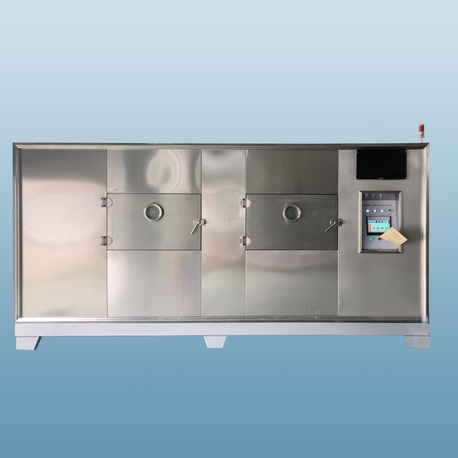
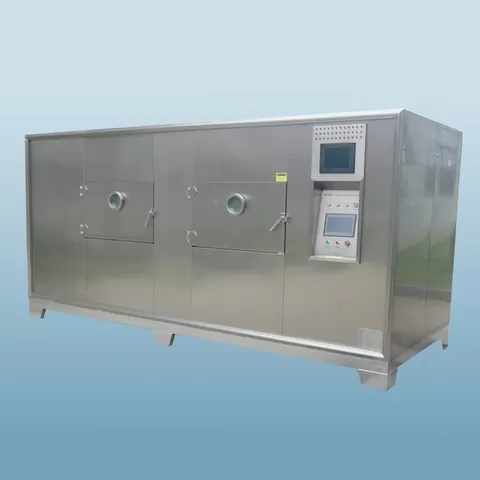
Conventional thermal drying creates steep temperature gradients, often
resulting in case hardening and nutrient degradation. A microwave drying
machine addresses these limitations through volumetric heating:
dipolar molecules and ionic conduction directly convert electromagnetic energy
into heat inside the material. This article examines the physical principles,
industrial configurations, and process parameters that define high-performance
microwave drying. Drawing from field data across food, timber, ceramic, and
chemical sludge applications, we quantify how a correctly engineered microwave drying
machine reduces drying time by 50–80% compared to hot air, while
preserving product quality. Nasan integrates industrial
microwave systems with intelligent power control and real-time moisture
feedback, bridging laboratory research and 24/7 production.

1. Volumetric Heating vs. Conductive/Convective Transfer: The Physics
Advantage
Traditional dryers rely on surface heat transfer; moisture must migrate from
the interior to the boundary. This creates a falling-rate period limited by
diffusion. In contrast, a microwave drying
machine generates heat simultaneously throughout the product
volume. The result: internal vapor pressure pumps water toward cooler surfaces,
a phenomenon termed “moisture pumping” or pressure-driven flow. This mechanism
shortens the diffusion path and avoids surface overheating. Key comparative
data:
Thermal gradient: Conventional drying shows 40–60°C
surface-to-core difference; microwave reduces this to <10°C, eliminating
cracks.
Drying rate (first 10 minutes): Hot air removes ~2%
moisture; microwave removes 12–18% given sufficient power density.
Energy efficiency: For high-moisture products (60–80% wb),
microwave conversion efficiency from electricity to water evaporation reaches
70–85%, versus 30–50% for steam-heated air.
These advantages are most pronounced for thick or low-thermal-conductivity
materials. For example, drying 50mm thick oak timber from 65% to 12% moisture
content (MC) consumes only 1.1 kWh per kg of water removed in a well-tuned
industrial microwave
dryer, compared to 2.3 kWh/kg in a conventional kiln.
2. Dielectric Properties and Frequency Selection (915 MHz vs. 2450 MHz)
Performance of any microwave drying
machine depends on the complex permittivity (ε' and ε'') of the
load. Materials with high loss factor (ε'') absorb energy efficiently; water
exhibits a peak around 20–30°C. Two industrial frequencies dominate:
2.1 2450 MHz (Common for smaller batch and continuous systems)
Penetration depth in wet materials: 15–25 mm. Suitable for thin layers,
granules, or products where heating uniformity is managed via multiple
waveguides or mode stirrers. Many conveyor-belt microwave
dryers operate at 2450 MHz, processing herbs, chopped vegetables,
and nuts.
2.2 915 MHz (High-power industrial, mainly for thicker loads)
Penetration depth: 60–100 mm. Used for wood boards, sludge cakes, and whole
fruit pieces. Requires special magnetrons and waveguides but delivers better
uniformity for dense materials. Nasan provides both frequency
platforms, with application engineers performing dielectric spectroscopy to
match frequency to product geometry and initial MC.
Ignoring penetration depth leads to thermal runaway: surface layers overheat
while core remains wet. A professional microwave drying machine specification
always includes FDTD (finite-difference time-domain) modeling of field
distribution.
3. Industrial Configurations: Batch Cavities, Continuous Tunnel, and
Combined Vacuum-Microwave
Depending on throughput and product sensitivity, three main microwave drying
machine architectures are deployed:
Batch rotary or cabinet dryers: 5–200 kW, used for
small-batch pharmaceuticals, ceramic cores, and lab-scale R&D. Features
programmable power ramping and in-cavity weighing.
Continuous belt (tunnel) dryers: 50–500 kW, with
variable-speed PTFE belts passing through multiple microwave applicator
sections. Integrated with hot-air recirculation for surface finishing. Suitable
for pet food, seeds, and industrial pastes.
Vacuum-microwave dryers: Operating at 40–80 kPa absolute
pressure, they reduce boiling point of water, enabling low-temperature drying
(30–50°C) for heat-labile enzymes or probiotics. Vacuum microwave processing
systems achieve final moisture <2% without thermal
degradation.
A case study: Freeze-dried bacteria culture (30-hour cycle) replaced by
vacuum-microwave drying at 40°C, cutting time to 3.5 hours while maintaining 98%
viability. This demonstrates technology substitution potential.
4. Moisture Uniformity and Control Strategies: Closed-Loop Power
Modulation
Non-uniform heating is the primary technical challenge for any microwave drying
machine. Solutions involve both hardware and software:
Rotating turntables or product agitation – reduces standing
wave patterns.
Phase-shifted multiple magnetrons – six or more sources
with independent phase control to flatten energy distribution.
Real-time moisture sensing (near-infrared or capacitance
probes) coupled with PID or fuzzy logic controllers that adjust
magnetron anode current per zone.
Advanced systems from Nasan implement model predictive
control (MPC) that uses historical drying curves to anticipate power needs,
preventing hotspots or runaway. Field data from 35-ton/day sludge drying plant
shows endpoint MC variation reduced from ±4% to ±0.7% after retrofitting
MPC.
5. Energy Recovery and Integration with Heat Pumps
While microwave drying is efficient for bound water removal, evaporating the
last 10% moisture still requires significant energy. Integration with heat pump dehumidification
systems captures latent heat from exhaust vapor and recycles it to
preheat incoming air or to warm the product following microwave treatment.
Hybrid microwave-heat pump dryers achieve specific energy consumption as low as
0.8 kWh per kg water evaporated, outperforming standalone units.
Moreover, for materials that release volatile organic compounds (VOCs) during
drying, closed-loop microwave systems with condenser recovery allow VOC capture
and compliance with EPA/EC regulations.
6. Safety Standards: Leakage Prevention, Arc Suppression, and EMI
Shielding
Industrial microwave drying machines must comply with IEC 60519-6 (safety in
microwave heating equipment) and FCC/CE limits for stray radiation. Key
engineering measures:
Choke flange designs on doors and inspection windows, maintaining leakage
below 1 mW/cm² at 5 cm distance.
Arc detection sensors linked to magnetron shutoff within 2 ms – vital when
drying metal-embedded products (e.g., recycled electronic scrap).
Double shielding (copper mesh plus steel housing) to avoid interference with
nearby PLCs or medical devices.
Regular inspection of door interlocks and waveguide seals is mandatory.
Nasan provides
certification testing as part of commissioning, including thermal imaging to
locate any leakage points.

7. Industry Application Deep-Dive
Three specific scenarios where a finely tuned microwave drying
machine outperforms alternatives:
Food – preserving aromatics in herbs (basil, oregano): Conventional hot air at 60°C loses >40% volatile terpenes. Microwave drying
at 40°C under mild vacuum retains 89% of essential oils, with final moisture
<8% in 18 minutes vs. 240 minutes. Colorimetric L-values stay closer to fresh
product.
Wood drying (Eucalyptus grandis): Standard kiln schedule
takes 28 days to reach 12% MC, with 18% collapse and surface checks. A
frequency-controlled 915 MHz microwave dryer with periodic resting achieves 12%
MC in 26 hours, zero collapse, and 60% reduction in energy per board foot.
Ceramic green bodies (alumina substrates): Microwave drying
eliminates binder migration, reducing warpage from 0.2 mm to 0.03 mm after
sintering. Throughput increases 4x compared to infrared preheating.
Q1: What is the maximum initial moisture content suitable for
microwave drying?
A1: A microwave drying
machine can handle free moisture up to 85% (wet basis) if the
product is flowable or placed on a conveyor. However, excessive free water may
cause arcing if it pools. For liquids or slurries, combine microwave with hot
air or a paddle agitator to maintain uniform exposure. For very high moisture, a
preliminary mechanical dewatering step (centrifuge, press) is recommended to
reduce energy cost.
Q2: How to avoid thermal runaway in low-moisture
zones?
A2: Once product reaches <15% MC, its dielectric loss
factor drops, but any remaining wet spot can absorb more power. Solutions: (a)
switch to pulsed power (10–30% duty cycle), (b) use multiple input ports with
phase diversity, or (c) integrate a low-power finishing
section with forced air to flatten residual moisture. Advanced
machines automatically reduce magnetron power when exiting moisture is detected
below setpoint.
Q3: Can a microwave drying machine process materials that contain
metals?
A3: With precautions. Discrete metal parts (screws, wires)
can cause intense arcing. However, powdered metals (e.g., iron oxide pigment) or
uniformly distributed conductive fibers (carbon) may be processed if the
electric field is kept below 3 kV/cm. A risk assessment per IEC 60519-6 is
mandatory. For safety-critical applications, use a microwave dryer with arc
sensors and fast power cut-off.
Q4: What maintenance does an industrial microwave drying machine
require?
A4: Routine tasks: (1) Clean waveguide surfaces and ceramic
window with isopropanol monthly to avoid product buildup; (2) Check door
interlock and choke seals every 500 operating hours; (3) Magnetron anode current
and filament voltage verification – typical magnetron lifetime 8,000–12,000
hours; (4) Replace teflon conveyor belt if used for acidic or oily products.
Nasan offers service
contracts with remote diagnostic connectivity.
Q5: Is a microwave drying machine suitable for low-volume, high-mix
products?
A5: Yes, using a batch cavity dryer with programmable
recipes. Operators can store drying profiles for 100+ products (power vs. time,
turn rate, vacuum level). Changeover time between batches is under 15 minutes,
requiring no tooling. Combined with an in-line moisture sensor, the system
adapts to raw material variability. For small batches (<50 kg/day), a
laboratory-scale microwave dryer is cost-effective and scalable.
Q6: How does microwave drying compare to infrared or radio-frequency
(RF) drying?
A6: Infrared heats only the surface (0.1–2 mm
penetration) and is ineffective for thick products. RF (27.12 MHz) penetrates
deeper than microwave but requires contact electrodes and works poorly for
irregular shapes. Microwave provides intermediate penetration (20–100 mm) and
non-contact operation, making it optimal for most food, wood, and chemical
drying tasks. RF remains better for very large logs (300mm+ diameter) where 915
MHz microwave may still have limited penetration.
Evaluation and Engineering Inquiry
Specifying a microwave drying
machine demands understanding material dielectric properties,
throughput requirements, and integration with upstream/downstream processes. A
poorly matched system leads to hotspots, low uniformity, or safety risks.
Nasan provides a full
engineering workflow: dielectric testing at the customer lab, pilot-scale trials
(batch or continuous), FEA simulation of field distribution, and turnkey
installation with training. Our portfolio includes both 915 MHz and 2450 MHz
platforms, as well as hybrid vacuum-microwave and heat-pump integrations.
For a technical datasheet tailored to your product—whether it is
moisture-laden fruit, ceramic slurry, or chemical paste—submit an inquiry with
your material properties, target final moisture, and intended throughput.
Receive a process simulation and energy cost estimate within 5 business
days.
➤ Send an Inquiry: Request
Microwave Drying Machine Design & Quotation →