

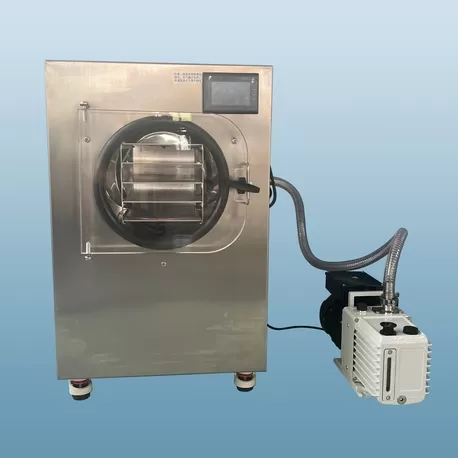
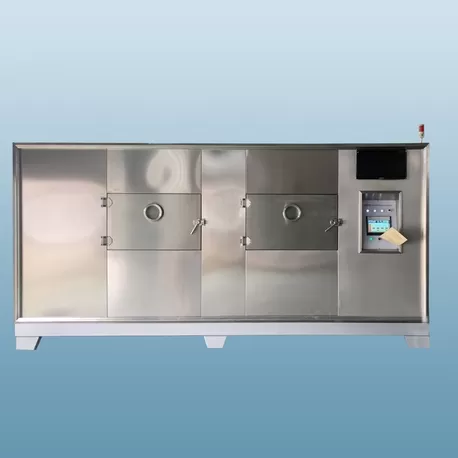

1. Operating principle: why vacuum and microwave synergy works
At the core of a vacuum microwave oven lies the ability to reduce the boiling point of water (or solvents) while delivering energy directly into the material volume. Microwave radiation (typically 2450 MHz or 915 MHz for industrial systems) causes polar molecules to oscillate, generating heat through dielectric loss. By simultaneously maintaining a vacuum (absolute pressures from 1 kPa to 50 kPa), the phase change occurs at temperatures as low as 30–40 °C. This eliminates the temperature gradients inherent in conduction-based vacuum drying and prevents case hardening.
1.1 Dielectric properties and penetration depth
The efficiency of a vacuum microwave oven depends heavily on the dielectric loss factor of the material. Wet compounds absorb microwaves preferentially, creating a self-regulating effect: moist areas receive more energy, while dry zones receive less. This avoids overheating. Penetration depth at 2450 MHz is typically 10–30 mm in high-moisture materials, but in vacuum, the liberated vapour is rapidly removed, maintaining the electromagnetic field uniformity.
2. Seven quantifiable advantages over legacy drying systems
Data from industrial installations confirm that a well-designed vacuum microwave oven outperforms freeze dryers, hot-air ovens, and traditional vacuum shelves in multiple dimensions. Below are the critical differentiators, supported by operational metrics.
Drying time reduction: 70–90 % shorter compared to convective drying. For botanical extracts, a cycle that took 24 h in a vacuum tray dryer can be completed in 2–3 h in a microwave vacuum system.
Energy consumption per kg of water removed: Typically 0.8–1.2 kWh/kg, versus 1.5–3.0 kWh/kg for freeze drying and 1.2–2.5 kWh/kg for hot-air drying (depending on insulation and magnetron efficiency). Nasan units incorporate variable-power magnetrons that further optimise this ratio.
Retention of volatile compounds: Low temperature and oxygen-free environment preserve terpenes, flavonoids, and active pharmaceutical ingredients (API) with >95 % retention, compared to 60–80 % in spray drying.
Uniform moisture distribution: Final moisture content variation across a batch ≤ ±0.5 %, thanks to rotating drums or mode stirrers that eliminate standing waves.
Solvent recovery capability: Closed-loop vacuum systems can condense and recover organic solvents, reducing operational costs and emissions.
Footprint efficiency: A continuous vacuum microwave oven can process up to 500 kg/h on a floor space one-third that of a freeze dryer with equivalent throughput.
Scalability from R&D to production: Pilot units with 5 kW microwave power can be scaled to industrial 100 kW systems using identical control algorithms – a key consideration for process validation.
3. Industrial application segments and process specifics
Vacuum microwave technology is not a one-size-fits-all solution; its adoption is driven by material characteristics and product value. The following sectors have integrated vacuum microwave ovens into their production lines with documented success.
3.1 Food & nutraceutical processing
Fruit powders, instant coffee, and probiotics require low-temperature drying to preserve colour and bioactivity. For example, drying raspberry purée in a vacuum microwave oven yields a powder with anthocyanin retention >90 %, while freeze drying retains ~85 % but at double the energy cost. The rapid expansion of vapour also creates a porous structure, improving rehydration.
3.2 Pharmaceutical intermediates
Heat-labile antibiotics, peptides, and vaccine adjuvants are often dried from organic solvents. A vacuum microwave oven equipped with explosion-proof magnetrons and solvent recovery condensers (like those engineered by Nasan) meets GMP requirements while reducing drying time from days to hours. Patented designs prevent cross-contamination through smooth internal surfaces and CIP (clean-in-place) nozzles.
3.3 Advanced materials and chemicals
Catalyst precursors, graphene oxide films, and specialty polymers benefit from the precise moisture control. The absence of surface overheating prevents skin formation, which is critical for uniform doping in catalyst manufacturing.
4. Solving industrial pain points: uniformity, vacuum integrity, and control
Despite the clear benefits, engineers often worry about plasma formation (arcing) under vacuum and uneven heating. Modern vacuum microwave oven designs have overcome these issues through:
Pulsed microwave delivery: Avoiding plasma generation by modulating the power envelope, especially during the initial high-moisture phase.
Multi-point fibre-optic temperature sensors: Placed directly in the material bed, providing real‑time feedback to the PLC. Unlike infrared sensors, they are unaffected by vapour or steam.
Rotating drum or conveyor configurations: Ensuring that every particle is exposed equally to the microwave field, even in large 500 L chambers.
Nasan integrates these features with adaptive control algorithms that learn the drying curve of each product, automatically adjusting vacuum level and microwave power to stay below the glass transition temperature.
5. Technical specifications: what to look for in an industrial unit
When procuring a vacuum microwave oven, the following parameters define its process capability:
| Parameter | Typical range / options | Process relevance |
|---|---|---|
| Microwave frequency | 915 MHz (deeper penetration, 50 kW+ magnetrons) / 2450 MHz (standard) | 915 MHz preferred for bulk materials > 100 mm thickness |
| Vacuum level | 1 mbar to 200 mbar absolute | Lower pressure = lower boiling point, but longer pump-down time |
| Material construction | SS316L with polished finish, PTFE or ceramic liners for corrosive products | Compliance with FDA/EU food contact, solvent resistance |
| Control system | PLC with recipe management, 21 CFR Part 11 option | Validation in pharma requires audit trails and data integrity |
| Condenser type | −15 °C to −40 °C, with automatic defrost | Solvent recovery efficiency directly affects operating cost |
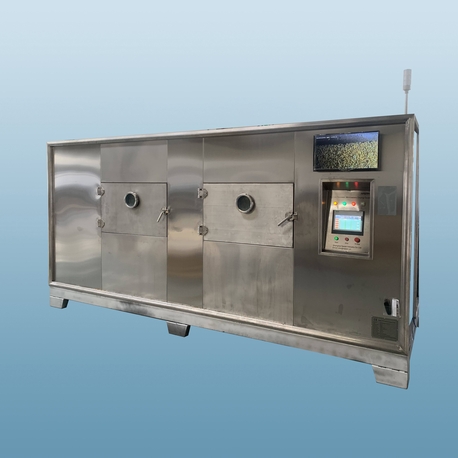
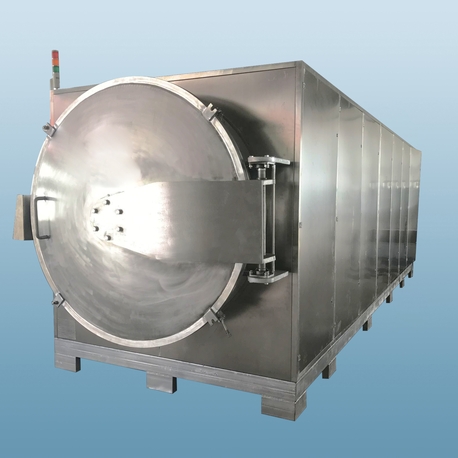
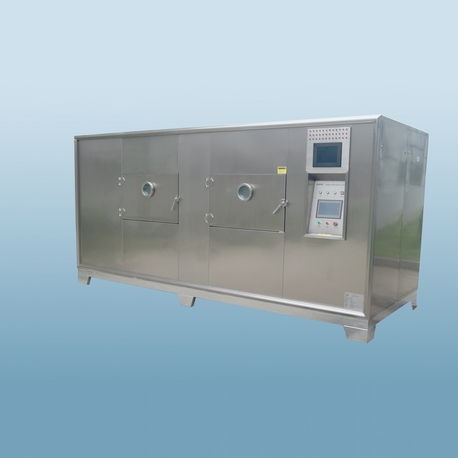
Nasan’s vacuum microwave oven series offers modular configurations that match these specifications, with the ability to retrofit additional condensers or CIP systems.
6. Economic justification: TCO and payback analysis
A financial model comparing a 100 kg/batch vacuum microwave oven with a freeze dryer of equal capacity shows:
Capital cost: microwave system is 30–40 % lower (no expensive refrigeration for −50 °C condensers).
Operating cost: 50 % lower electricity consumption, plus reduced labour due to shorter cycles.
Payback period: typically 12–24 months for high-value products, based on yield improvement and energy savings alone.
For contract manufacturers processing multiple products, the flexibility of a vacuum microwave oven allows quick changeover and recipe storage, further improving OEE (overall equipment effectiveness).
7. Conclusion: why precision engineering defines the future of drying
The vacuum microwave oven has transitioned from a laboratory curiosity to a mainstream industrial tool. Its ability to deliver high-quality dried materials at a fraction of the energy and time of conventional methods is backed by decades of material science and electromagnetic engineering. Companies like Nasan continue to push the boundaries with robust designs, integrated process controls, and scalable platforms. For engineers and decision-makers, the question is no longer whether vacuum microwave technology works, but how quickly they can implement it to gain competitive advantage.
Frequently asked questions about industrial vacuum microwave ovens
Q1: What is the fundamental difference between a vacuum microwave oven and a conventional vacuum dryer?
A1: A conventional vacuum dryer relies on conduction or radiation to transfer heat from heated shelves or walls to the material. This creates a temperature gradient and slow drying. A vacuum microwave oven generates heat volumetrically inside the wet material via dielectric loss, independent of thermal conductivity. Drying is much faster, and the risk of surface overheating is eliminated.
Q2: Can a vacuum microwave oven handle continuous production, or is it only batch?
A2: Both configurations exist. Batch vacuum microwave ovens are common for high-value, low-tonnage products (pharmaceuticals, specialty foods). Continuous systems (microwave vacuum belt dryers or rotary valves) are used for larger volumes, such as citrus powders or instant coffee, where material enters and exits through vacuum locks. Nasan offers both types, depending on throughput requirements.
Q3: How does the energy efficiency compare with freeze drying?
A3: Independent studies show that a vacuum microwave oven consumes 40–60 % less electrical energy per kilogram of water removed compared to freeze drying. The main reason is that freeze drying requires the entire chamber to act as a condenser at −40 °C, while microwave vacuum systems use smaller, more efficient condensers and shorter cycles. For a typical pharmaceutical batch, this translates to savings of several thousand dollars per week.
Q4: Are there any materials that should not be dried in a vacuum microwave oven?
A4: Materials with very low dielectric loss (non-polar substances, pure oils) do not heat efficiently unless they contain water or a polar solvent. Also, highly conductive materials (metals, carbon black above a certain loading) can cause arcing. A dielectric property pre-test is recommended. Nasan’s vacuum microwave oven test centre offers such characterization.
Q5: What maintenance is typical for an industrial vacuum microwave oven?
A5: Magnetrons have a lifespan of 8,000–10,000 h and are replaceable within 30 minutes. Vacuum seals (silicone or Viton) should be inspected every 6 months. The condenser coils may need periodic descaling if water is the recovered liquid. Nasan’s design uses quick-release flanges and self-aligning doors to minimise downtime.
Q6: Is it possible to retrofit an existing vacuum dryer into a microwave system?
A6: Technically yes, but it is rarely cost-effective. Retrofitting requires waveguide ports, mode stirrers, shielding modifications, and control integration – essentially rebuilding the chamber. It is almost always better to invest in a dedicated vacuum microwave oven engineered from the ground up for electromagnetic and vacuum integrity.