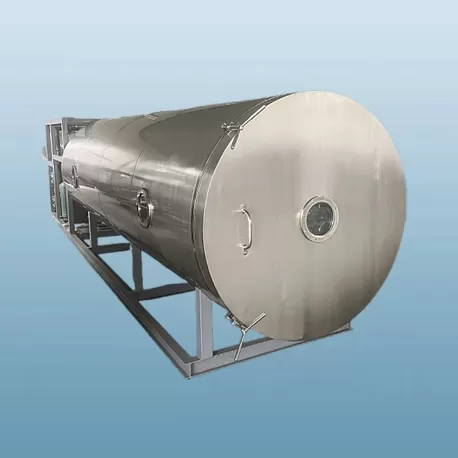
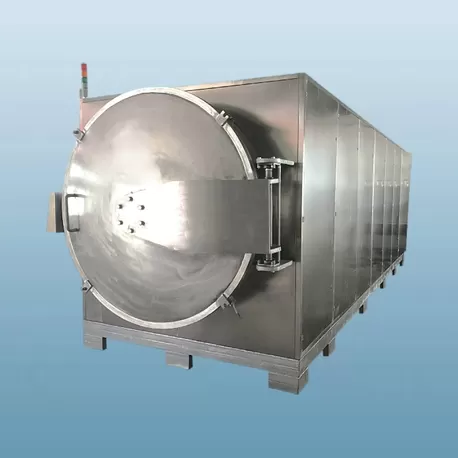
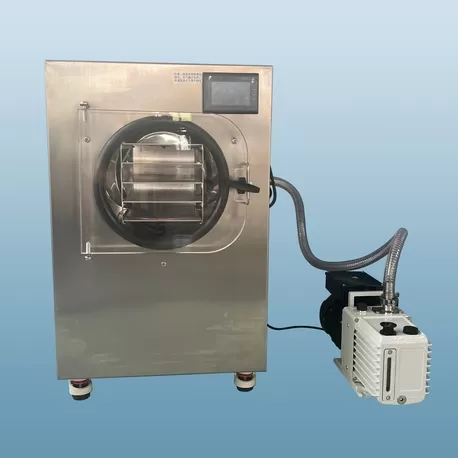
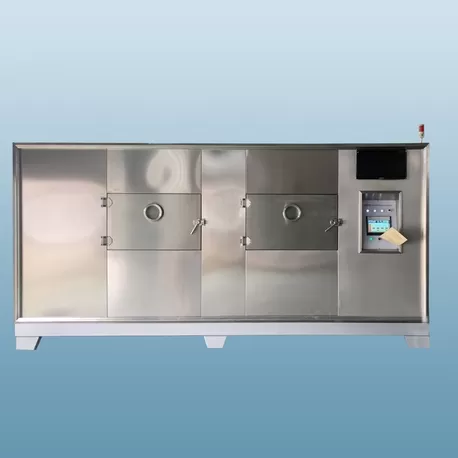
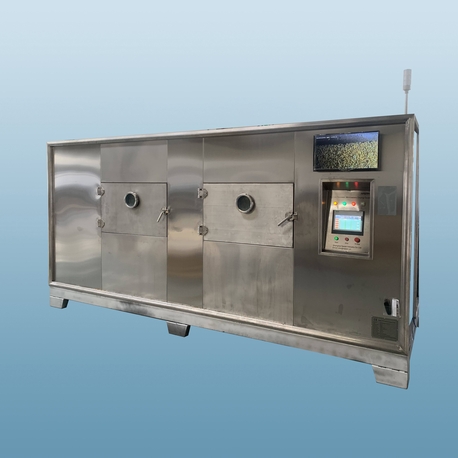
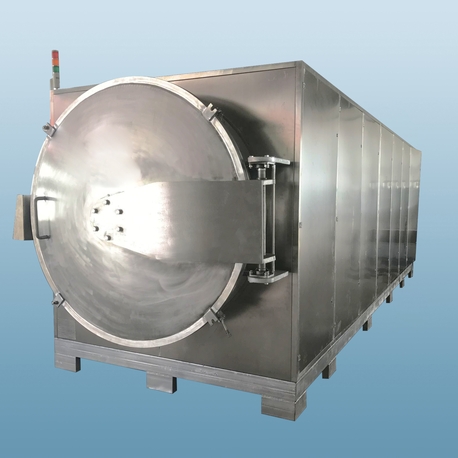
If you work in food, pharmaceutical, or advanced materials manufacturing, you've likely heard the buzz. The vacuum microwave oven is not your average piece of heating equipment. It represents a fundamental shift in how industries approach drying, curing, and dehydrating sensitive materials.
Forget slow convection ovens or quality-sacrificing high-speed dryers. This technology is different. By marrying microwave energy with a controlled vacuum environment, it solves age-old problems of efficiency and product degradation.
Companies leading in innovation, like Nasan, are integrating vacuum microwave oven technology into their lines to gain a decisive competitive edge. Let's break down why.

How It Works: The Power of Combined Physics
A standard microwave oven heats food using radiation that excites water molecules. A vacuum chamber lowers the air pressure to dramatically reduce the boiling point of water.
An industrial vacuum microwave oven does both at once.
Inside a sealed, robust chamber, a vacuum pump first pulls out the air. This can lower the boiling point of water to as low as 20-30°C (68-86°F). Then, precisely controlled microwave energy is introduced.
The microwaves penetrate the material uniformly, causing internal water molecules to vibrate and generate heat from the inside out. Because of the low pressure, this water instantly vaporizes at this low temperature and is efficiently removed.
The result? Rapid, uniform, low-temperature processing that conventional methods can't match.
The synergy of vacuum and microwave creates a list of compelling advantages for commercial operators.
Blazing Speed: Drying times can be reduced by 50-80% compared to traditional methods. Microwave energy heats the entire product volume simultaneously, not just the surface.
Uncompromised Quality: Low-temperature operation preserves everything that heat destroys: vitamins, essential oils, colors, flavors, and biological activity. It's the key to premium products.
Remarkable Energy Efficiency: Energy is directly absorbed by the water in the product, not wasted on heating air, trays, or the chamber walls. This leads to significant utility cost savings.
Perfect Uniformity: The "volumetric heating" effect tackles cold spots and uneven drying. You get consistent moisture content and quality across the entire batch.
Enhanced Safety: Operating at lower temperatures reduces fire risks, especially for materials with volatile compounds or high sugar content.
A Step-by-Step Look at the Operational Process
Using an industrial vacuum microwave drying oven is a controlled, repeatable process.
Loading: Product is arranged on microwave-friendly trays to ensure even energy distribution. The chamber door is sealed.
Vacuum Phase: The vacuum system activates, drawing down the chamber to the pre-set pressure level. This is often a gentle, controlled pull to prevent product disturbance.
Microwave Drying Cycle: Microwave magnetrons pulse energy according to a tailored recipe. Sophisticated sensors monitor product core temperature and chamber pressure in real-time, adjusting power to prevent overheating.
Conditioning (If Needed): The system may cycle or hold conditions to allow internal moisture to migrate, ensuring perfect uniformity.
Cooling & Release: After microwaving stops, the product may be cooled under partial vacuum. Finally, the vacuum is slowly broken, and the chamber is opened for unloading.
Key Industrial Applications: Where This Technology Shines
This isn't for making popcorn. The industrial vacuum microwave oven is a versatile workhorse in high-value sectors.
Food & Ingredients: Perfect for creating superior dried fruits, vegetables, herbs, and spices with locked-in color and flavor. It's also used for instantizing powders, drying dairy cultures, and processing high-sugar products without caramelization.
Pharmaceuticals & Nutraceuticals: Gently dries heat-sensitive granules, herbal extracts, probiotics, and active pharmaceutical ingredients (APIs) without loss of potency. Critical for meeting strict quality control standards.
Chemicals & Polymers: Dries catalysts, advanced pigments, and polymer resins at low temperatures, preventing chemical alteration or agglomeration.
Biotechnology: Preserves enzymes, yeast, and other delicate biological materials far more effectively than air drying.
Electronics & Ceramics: Used in the controlled drying of coatings and delicate components where moisture must be removed without thermal shock.

Solving Real-World Production Challenges
Many manufacturers turn to a vacuum microwave oven as a targeted solution to costly problems.
Problem: Long drying times bottleneck overall production.
Solution: Drastically faster cycles increase throughput and free up floor space.
Problem: High energy bills from running gas-fired dryers or freeze dryers.
Solution: Direct, efficient microwave heating slashes energy consumption per batch.
Problem: Finished product quality is inconsistent or degraded.
Solution: Low-temperature, uniform processing ensures premium, shelf-stable output every time.
Problem: Need to develop new, higher-quality products to enter premium markets.
Solution: Enables processing of previously impossible delicate formulations, opening new revenue streams.
Forward-thinking engineers at Nasan specialize in configuring microwave vacuum oven systems to address these exact pain points, delivering not just equipment but a full productivity solution.
Looking Ahead: The Future is Efficient and Precise
As global industries focus on sustainability and premiumization, technologies that save energy while enhancing quality will dominate. The vacuum microwave oven is perfectly positioned in this shift.
It moves beyond simply removing moisture to enabling precise, controlled thermal processing for a smarter factory floor.
For businesses ready to step up, partnering with an experienced provider is crucial. With deep application knowledge, Nasan helps companies implement robust vacuum microwave oven technology that delivers a fast return on investment and a stronger market position.
Frequently Asked Questions (FAQ)
Q1: Is it safe to use metal trays or containers in a vacuum microwave oven?
A1: Generally, no. Traditional metal containers cause arcing (sparks) in a microwave field, which is dangerous and damages the equipment. Specialized, microwave-transparent trays made from materials like PTFE or certain advanced composites must be used. Any metal parts, like thermocouples, must be specially designed and shielded for this environment.
Q2: How does a vacuum microwave oven differ from a freeze dryer for creating premium products?
A2: Both produce high-quality results, but through different mechanisms. Freeze drying (lyophilization) sublimates ice directly to vapor under deep vacuum and minimal heat, excellent for structure. A vacuum microwave oven uses low-temperature evaporation, is typically much faster, and often more energy-efficient. The choice depends on the specific product's required texture, solubility, and economic factors.
Q3: Can this technology handle liquid or slurry products, or only solids?
A3: Yes, it can process liquids and slurries, but the system design changes. Instead of trays, a specialized vacuum microwave drying oven might use a rotating drum or a spreader to create a thin film for efficient drying. This is common for concentrating fruit purees or extracting botanical oils without damaging heat-sensitive compounds.
Q4: What are the major maintenance requirements?
A4: Primary maintenance focuses on two areas: the vacuum system (regular pump oil changes, seal inspections) and the microwave generators (magnetrons have a finite operational lifespan, often several thousand hours). A well-designed industrial unit, like those from Nasan, allows for easy access to these components to minimize downtime.
Q5: Is continuous production possible, or is it only a batch process?
A5: Both configurations exist. Batch vacuum microwave ovens are common for flexibility and R&D. For high-volume production, continuous systems are engineered. These use sophisticated airlocks to maintain vacuum while product moves on a conveyor belt through microwave zones, allowing for non-stop, automated processing.