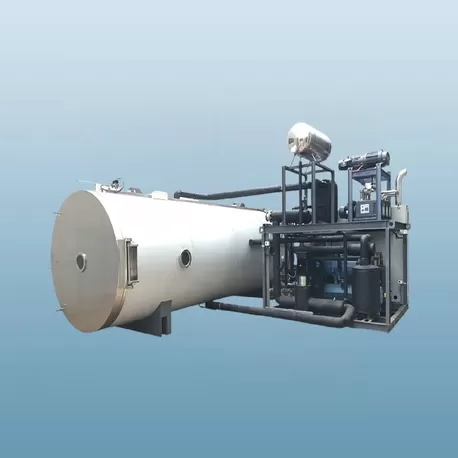
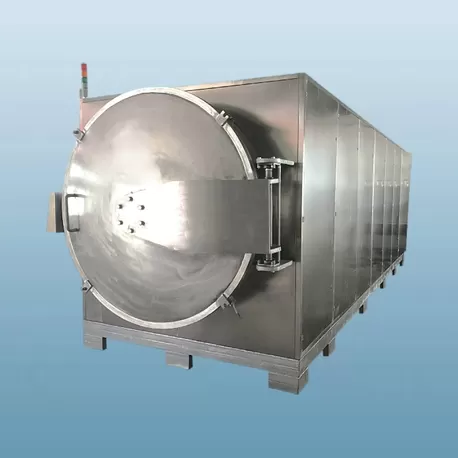
In the demanding landscape of pharmaceutical, biotechnological, and advanced
food manufacturing, the lyophilizer (freeze
dryer) remains the gold standard for dehydrating sensitive products without
compromising structural integrity or biological activity. With the global
freeze-drying market projected to exceed $8.5 billion by 2028, selecting and
operating a high-performance industrial lyophilizer is no
longer just an operational decision—it is a strategic imperative. This technical
deep dive, informed by decades of engineering expertise from Nasan, explores the
critical parameters, applications, and solutions that define modern
freeze-drying success.

1. The Physics of Preservation: Core Principles of Industrial
Lyophilization
Understanding the thermodynamic and kinetic foundations of a
lyophilizer is essential for process optimization. Unlike
conventional drying methods that rely on heat, freeze-drying is a
sublimation-based process. It occurs under vacuum conditions where ice
transitions directly to vapor, bypassing the liquid phase. This preserves the
delicate lattice structure of biological products, proteins, and high-value
nutrients. The typical cycle comprises three distinct phases: freezing, primary
drying (sublimation), and secondary drying (desorption). Each phase imposes
unique demands on the lyophilizer's mechanical and control
systems.
1.1 Freezing: Nucleation and Eutectic Formation
The initial freezing step dictates ice crystal morphology. Rapid freezing
produces smaller crystals, which can protect cellular structures but increase
sublimation resistance. Conversely, slower freezing—often controlled via
shelf-ramping in a modern lyophilizer—creates larger ice
channels, facilitating faster primary drying. Advanced systems integrate
annealing steps to encourage complete crystallization of bulking agents like
mannitol, ensuring elegant cake structure and stability.
1.2 Primary and Secondary Drying Dynamics
During primary drying, chamber pressure is reduced to approximately 50–200
mTorr, and shelf temperature is gradually increased to provide sublimation
energy. The condenser, operating at -50°C to -85°C, traps the vapor. Secondary
drying then removes bound water molecules by ramping the temperature, typically
to 20°C–40°C, under high vacuum. The entire process can take 24 to 72 hours for
industrial batches, making energy efficiency and precise control paramount.
2. Seven Technical Parameters Governing Lyophilizer Performance
Optimizing an industrial lyophilizer requires mastery of
interrelated physical and engineering variables. Below are the seven parameters
that Nasan engineers
prioritize when designing systems for high-throughput GMP environments.
Shelf Temperature Uniformity: Variations across shelves or
positions can lead to batch heterogeneity. Top-tier
lyophilizers maintain uniformity within ±1°C across all
shelves, a critical factor for scale-up and validation.
Condenser Capacity and Ice Tolerance: Industrial units must
handle 300–800 kg of ice per cycle. Condenser coil design and defrost efficiency
directly impact cycle time and energy consumption.
Chamber Vacuum Leak Rate: A leak rate below 0.02 mbar·L/s
ensures consistent sublimation rates and prevents contamination. Helium leak
testing is standard for pharmaceutical-grade installations.
Heat Transfer Fluid (HTF) Dynamics: Silicone oil
circulation rate and viscosity at low temperatures affect heat flux. Advanced
lyophilizer designs use three-way control valves and tuned flow
paths to eliminate hot spots.
Vapor Flow Resistance: The geometry between the chamber and
condenser creates inherent resistance (Rp). Optimizing duct dimensions and using
full-shelf stoppering mechanisms minimize this bottleneck.
Product Temperature Monitoring: Wireless thermocouples or
RTDs placed in vials provide real-time data to compare against the critical
product temperature (e.g., collapse temperature). This enables cycle adjustments
via PAT.
Automation and Recipe Control: Modern SCADA systems allow
multi-step recipes with ramping/holding functions, ensuring repeatability across
campaigns and compliance with 21 CFR Part 11.
3. Industry-Specific Applications and Technical Challenges
The versatility of the lyophilizer is evident across diverse
sectors. However, each application presents unique engineering hurdles that
require tailored solutions.
3.1 Pharmaceutical & Biologics: Sterility and Containment
Lyophilization is indispensable for thermolabile drugs, vaccines (e.g., mRNA
formulations), and monoclonal antibodies. Here, the lyophilizer must operate under strict aseptic conditions. Clean-in-place (CIP) and
steam-in-place (SIP) systems are integrated to eliminate bioburden. Barrier
systems, such as restricted access barrier systems (RABS), are often
incorporated to protect the product during loading and unloading. Aseptic
transfer carts and automated guided vehicles (AGVs) are increasingly paired with
Nasan industrial units to minimize human intervention.
3.2 Food and Nutraceuticals: Structure and Shelf-Life
For premium instant coffee, probiotics, and functional fruits, the goal is
retention of volatiles and nutrients. Industrial food
lyophilizers operate at larger scales, often with continuous or
semi-continuous loading. A major challenge is ensuring uniform drying of
particulate materials. Nasan addresses this with
variable shelf spacing and specialized tray designs that promote consistent heat
transfer even with varying bed depths.
3.3 Advanced Materials and Bioprocessing
Lyophilization is also used to stabilize active pharmaceutical ingredients
(APIs), liposomes, and even archaeological artifacts. In these cases, the
lyophilizer must offer extreme temperature control (down to
-70°C) and inert gas backfilling capabilities to prevent oxidation. The need for
rapid turnaround and flexible batch sizes drives demand for modular industrial
designs.
4. Solving Chronic Industry Pain Points with Engineered Lyophilizer Solutions
Despite its prevalence, industrial freeze-drying is plagued by high energy
consumption, lengthy cycles, and scale-up failures. Below, we dissect these pain
points and present Nasan's evidence-based remedies.
4.1 Energy Inefficiency and Cycle Time Reduction
A typical industrial batch can consume as much energy as 50 households
annually. Nasan integrates frequency-controlled vacuum pumps
and variable-speed drives on compressors, reducing energy usage by up to 25%.
Furthermore, using computational fluid dynamics (CFD) to optimize duct geometry
reduces vapor flow resistance, shortening primary drying time by 15% without
compromising product quality.
4.2 Scale-Up Discrepancies
One of the most common complaints is the failure to replicate lab-scale
results in production. This often stems from differences in heat transfer
mechanisms. Lab units rely more on radiation, while industrial
lyophilizers depend on conduction through vials.
Nasan mitigates this by offering pilot-scale systems with
identical heat transfer coefficients to production models, enabling seamless
tech transfer.
4.3 Validation and Compliance Overhead
Pharmaceutical manufacturers face rigorous validation requirements
(IQ/OQ/PQ). Modern lyophilizers from Nasan incorporate automated valve leak testing, integrated mapping probes, and data
integrity software that automates report generation, drastically reducing
validation time and human error.

5. Future Horizons: Continuous Lyophilization and PAT Integration
The industry is moving away from batch-centric thinking. Continuous
lyophilizer technologies, such as spin-freezing and single-vial
processing lines, are emerging. These systems promise to reduce footprint and
enable true continuous manufacturing. Concurrently, Process Analytical
Technology (PAT) tools—like Raman spectroscopy and mass spectrometry—are being
integrated to monitor critical quality attributes in real time.
Nasan is actively developing modular platforms that support
these innovations while maintaining the robustness required for GMP
production.
Selecting the Right Industrial Lyophilizer Partner
Choosing a lyophilizer is a long-term capital investment
that directly impacts product quality, operational costs, and market agility.
Beyond the hardware, partners must offer deep process knowledge, validation
support, and lifecycle services. With decades of specialization in industrial
drying, Nasan provides
turnkey solutions—from laboratory R&D units to full-scale production
lines—engineered to meet the most stringent regulatory and performance
standards. Whether you are developing a novel biologic or scaling up a
functional food, a precision-engineered lyophilizer is the
cornerstone of reliable, high-quality drying.
Frequently Asked Questions (FAQ) on Industrial Lyophilizers
Q1: What is the typical lifecycle cost of an industrial lyophilizer,
and what factors influence it?
A1: The total cost of ownership
includes initial capital expenditure (equipment, installation, qualification),
energy consumption, maintenance (vacuum pump rebuilds, condenser defrost), and
validation costs. Factors like ice capacity, control system sophistication, and
material of construction (316L stainless steel vs. higher alloys) heavily
influence the price. Nasan offers detailed cost-benefit
analyses to help clients forecast TCO accurately.
Q2: How do I determine the required condenser ice capacity for my
production scale?
A2: Ice capacity is dictated by the batch size and
product formulation. You must calculate the total water mass to be removed per
cycle. A rule of thumb is to add 20% safety margin to account for variations in
filling volume. The lyophilizer's condenser must handle this
load without a rise in pressure, which would impede sublimation.
Nasan engineers use proprietary software to model ice buildup
dynamics based on your specific vial configuration.
Q3: Can I use the same lyophilizer for both pharmaceutical and food
products?
A3: Technically yes, but it is not recommended due to
cross-contamination risks and differing regulatory requirements (cGMP vs.
food-grade). Pharmaceutical lyophilizers require cleanability
validated for endotoxin removal, while food units may prioritize higher
throughput and easier cleaning of particulates. Nasan designs
dedicated platforms optimized for each sector to ensure compliance and prevent
carryover.
Q4: What maintenance schedule is recommended for an industrial freeze
dryer?
A4: Preventive maintenance should include quarterly checks of
vacuum pump oil and belts, semi-annual calibration of temperature sensors and
pressure gauges, and annual inspection of door gaskets, condenser coils, and
refrigeration system performance. Nasan offers service
contracts with remote monitoring that predict failures before they cause
downtime.
Q5: How does annealing improve the lyophilization
cycle?
A5: Annealing is a thermal treatment step performed after
freezing. The shelf temperature is raised to just below the eutectic point and
held, then re-cooled. This promotes crystallization of amorphous components,
reduces primary drying time by creating larger ice crystals, and prevents
product collapse. Many modern lyophilizers include automated
annealing recipes that are easily programmed via the HMI.
Q6: What is the difference between a manifold lyophilizer and a
tray-style industrial lyophilizer?
A6: Manifold
lyophilizers are typically used for small batches where flasks
are attached to ports; they are common in laboratories. Industrial tray-style
lyophilizers feature temperature-controlled shelves that
directly support vials or trays, allowing for uniform heat transfer and
scalability. For commercial production, tray-style lyophilizers from manufacturers like Nasan are the standard due to their
precise control and larger capacities.