


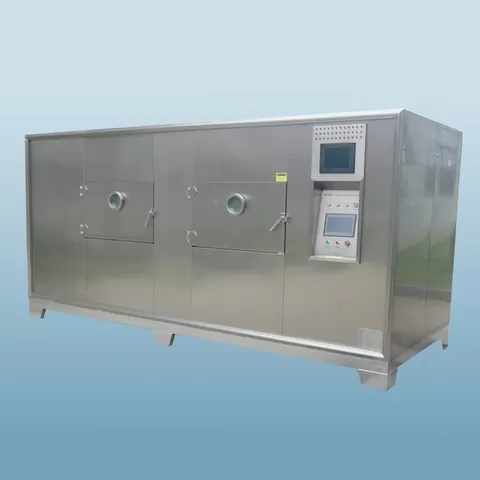

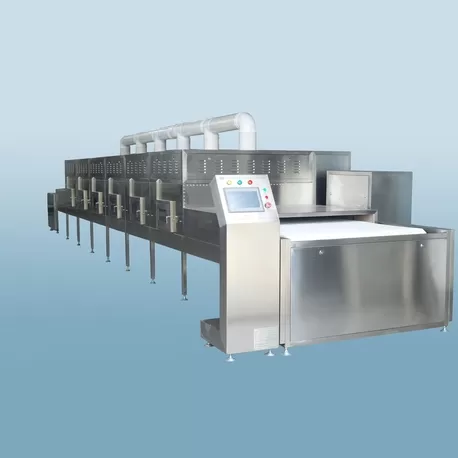
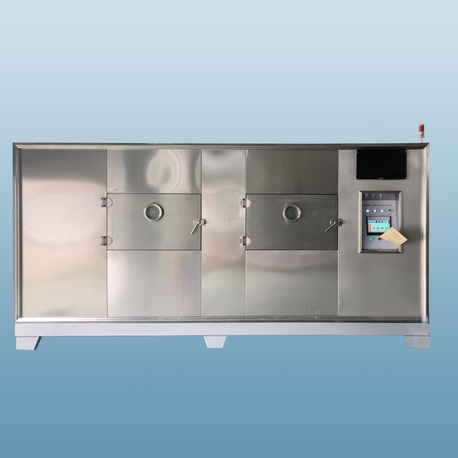
For manufacturers of pharmaceuticals, nutraceuticals, and premium dehydrated foods, conventional hot-air or vacuum-tray drying often introduces thermal degradation, extended batch cycles, and non-uniform moisture exit profiles. The vacuum microwave drying machine solves these challenges by combining low-pressure environments with volumetric microwave heating. This hybrid mechanism preserves thermolabile compounds, reduces drying time by up to 70%, and delivers consistent residue moisture across the entire load. This article explores the physics, industrial applications, critical control parameters, and proven solutions from Nasan’s engineering portfolio.

1. Principles of Operation: Synergy Between Microwave Energy and Vacuum Conditions
Unlike conventional conductive or convective drying, where heat propagates from the surface inward, a vacuum microwave drying machine uses electromagnetic waves at 915 MHz or 2.45 GHz to directly excite polar molecules—primarily water—within the product. The vacuum environment, typically between 10 to 100 mbar, lowers the boiling point of water to 30–45 °C, enabling rapid vaporization without raising the bulk material temperature.
Key physical advantages include:
Volumetric heat generation – Heat originates inside each particle, eliminating thermal gradients and the “case-hardening” effect common in air drying.
Low-temperature dehydration – Sensitive APIs, probiotics, and enzymes retain >95% bioactivity compared to 60–70% in conventional drying.
Accelerated moisture removal – Microwave energy density of 1–5 W/g shortens drying cycles from hours to minutes.
Industrial-scale systems integrate rotating drum mechanisms or vibrating trays to ensure field uniformity. Nasan designs its chambers with 3D electromagnetic simulation (HFSS) to minimize standing wave ratios, achieving ±2% heating homogeneity across a 600 L working volume.
2. Comparative Performance: Vacuum Microwave Drying vs. Conventional Technologies
Process engineers frequently evaluate alternatives: vacuum shelf dryers, freeze dryers, and continuous belt dryers. The table below quantifies distinct performance indicators for a typical heat-sensitive herbal extract (initial moisture 65% wb, final ≤3%).
Vacuum Tray Dryer (60 °C, 50 mbar) – Cycle time 18–24 h; residual moisture variation ±1.5%; significant surface oxidation.
Freeze Dryer (Lyophilization) – Excellent product quality but capital cost >$500k, cycle 36 h, energy consumption 2.5 kWh/kg water removed.
Vacuum microwave drying machine – Cycle 90 minutes, residual moisture ±0.3%, energy consumption 0.9 kWh/kg water, with continuous discharge option.
For high-value products such as ginseng extracts, anthocyanin-rich berries, or probiotic powders, the combination of short residence time and inert vacuum atmosphere prevents Maillard reactions and vitamin degradation. Nasan has validated a 40% increase in total phenolic retention compared to conventional forced-air ovens.
3. Critical Engineering Parameters for Industrial Scale-Up
Selecting or specifying a vacuum microwave drying machine requires precise data on six interdependent variables. Failing to optimize these leads to arcing, product charring, or low energy efficiency.
3.1 Microwave Power Density and Pulsed Modes
Power density is expressed as W/kg of wet load. For most organic powders, 1.2–2.0 W/g yields safe heating rates (2–5 °C/min). Advanced controllers from Nasan’s product lineup offer pulsed magnetron operation (on/off cycles as low as 5 seconds), avoiding thermal runaway near the end of drying when less moisture remains to absorb microwave energy.
3.2 Vacuum Level & Vapor Extraction Capacity
Lower chamber pressure (abs. 20 mbar) promotes rapid vapor diffusion, but excessive vacuum may induce puffing or foam collapse in liquid concentrates. A multistage vacuum pump with a condenser and a high-flow rotary vane design maintains 50 mbar while extracting up to 15 kg water/hour per m³ of chamber volume.
3.3 Real-Time Moisture and Temperature Feedback
Closed-loop control relies on near-infrared (NIR) sensors and fiber-optic thermometry. Integrating these sensors with a PLC allows dynamic power adjustment, preventing hot spots. Nasan equips each dryer with a proprietary moisture endpoint detection algorithm that automatically stops the cycle at target residual humidity, reducing energy waste by 18–25%.
4. Industry-Specific Use Cases and Formulation Suitability
Four sectors have rapidly adopted the vacuum microwave drying machine as a standard technology for premium products.
Pharmaceutical & API Manufacturing – Drying of sterile powders, insulin intermediates, and liposomal formulations. Vacuum microwave dryers comply with cGMP (clean-in-place nozzles, polished 316L stainless steel). Example: Drying of cephalosporin precursor from 45% to 1% moisture in 55 minutes without impurity formation.
Functional Food Ingredients – Dehydrating matcha, spirulina, and baobab pulp. Microwave vacuum preserves chlorophyll and avoids browning, delivering a superior green color score (ΔE < 2).
Industrial Enzymes & Bio-catalysts – For enzyme-coated granules, low-temperature drying retains >90% activity, whereas spray drying often causes denaturation above 65 °C.
Advanced Ceramics & Cathode Materials – Removing organic binders from lithium-ion battery cathodes: uniform drying prevents cracking in green bodies, improving final electrode density.
A recent Nasan installation for a European botanical extractor processed 250 kg batches of chamomile in 2.5 hours, compared to 14 hours in a vacuum oven, with essential oil retention improved from 58% to 91%.
5. Addressing Common Industrial Challenges with Engineered Solutions
Despite its advantages, vacuum microwave drying can present technical hurdles. Below are five frequent pain points and corresponding mitigation strategies validated by Nasan’s engineering team.
Challenge: Non-uniform electromagnetic field distribution – Leads to local overheating or under-dried zones.
Solution: Mode stirrers rotating at 15 rpm, plus variable frequency microwave power supplies that sweep across 2.4–2.5 GHz. This homogenizes the field and eliminates standing wave patterns.Challenge: Plasma discharge (arcing) at low pressure – Sharp edges or metallic dust can generate corona discharges.
Solution: Smooth internal welds, rounded corners, and HEPA-filtered inert gas bleeding (nitrogen at 200 ml/min) to suppress ionization.Challenge: Difficulties in continuous operation – Batch processing limits throughput for high-volume lines.
Solution: A continuous vacuum microwave dryer with rotary airlock feeders and staggered microwave chambers allows a throughput of 500 kg/h for sliced fruits.Challenge: Product lumping or sticking – High-sugar materials become adhesive during initial drying.
Solution: Employ a vibratory conveyor with polytetrafluoroethylene (PTFE) coating inside the vacuum vessel, combined with intermittent microwave pulsation.Challenge: High initial capital investment – ROI uncertainty.
Solution: Lifecycle cost analysis: 70% shorter drying cycles reduce labor and energy costs; premium product pricing (e.g., organic-certified ingredients) often provides payback within 12–18 months.
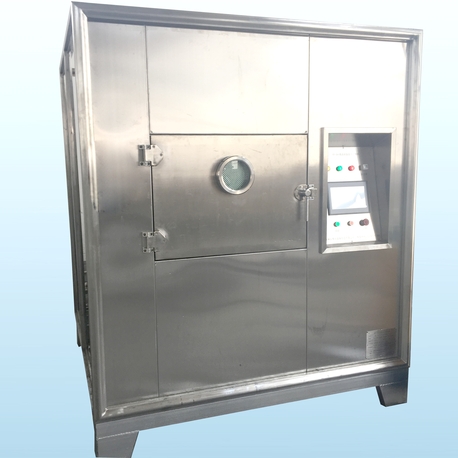
6. Maximizing ROI: Process Integration and Automation
Modern vacuum microwave drying machine systems are designed to integrate with upstream wet granulation and downstream milling/sieving stations. Nasan provides a full digital twin simulation before manufacturing, ensuring that the microwave applicator geometry matches the dielectric properties of the client’s specific material. SCADA connectivity allows remote batch reporting, predictive maintenance (magnetron lifetime monitoring), and full batch traceability per 21 CFR Part 11.
Moreover, energy recovery modules preheat inlet water for cleaning-in-place circuits, reducing total steam consumption by 12–18%. For a medium-scale food processor processing 600 tons/year of dried vegetables, switching to vacuum microwave drying cut the carbon footprint by 34 t CO₂ equivalent annually.
7. Frequently Asked Questions (FAQs) About Vacuum Microwave Drying Systems
Q1: What is the maximum moisture reduction percentage achievable with a vacuum microwave drying machine in one cycle?
A1: Depending on the material’s dielectric loss factor, you can reduce moisture from 85% (wet basis) down to 1–3% in a single batch. For free-flowing powders, typical operation takes 90 minutes from 65% to ≤2%. However, extremely thick layers (>10 cm) may require intermediate mixing. Nasan’s product guide provides layer thickness recommendations per product category.
Q2: Can this technology be used for organic solvents besides water?
A2: Yes, but with caveats. Ethanol, acetone, and isopropanol have different dielectric constants and lower flash points. Special ATEX-compliant designs (pressurized waveguide windows, inert gas purging, explosion relief panels) are mandatory. Nasan’s explosion-proof series handles Class I Div 1 environments for solvent-based slurries.
Q3: What is the expected lifespan of magnetrons in an industrial vacuum microwave drying machine?
A3: Industrial magnetrons (continuous wave, 1.5 kW each) typically last 5,000–8,000 operating hours when run below 80% of rated power. Nasan uses air-cooled magnetrons with replaceable filaments and offers a preventive maintenance contract including annual power output measurement. Many installations exceed 10,000 hours before first replacement.
Q4: Is vacuum microwave drying suitable for high-fat or high-oil content products (e.g., nuts, fatty fish)?
A4: Yes, but fat’s lower dielectric loss factor means it heats slower than water. The process effectively dries without oxidizing unsaturated fats due to the oxygen-free vacuum. For example, drying salmon skin or avocado pulp is achievable at 40 °C, preventing rancidity. Preconditioning with brief IR preheating can accelerate initial moisture mobilization.
Q5: How does the operational cost compare to freeze drying per kg of water removed?
A5: Freeze drying requires approx. 2.2–2.8 kWh per kg of water sublimated, while a vacuum microwave drying machine typically consumes 0.85–1.1 kWh/kg water evaporated (including vacuum pump and magnetron losses). Additionally, cycle time is 70–80% shorter, reducing labor overhead and increasing equipment utilization. For a 100 kg batch, operational savings exceed $150 per cycle compared to lyophilization.
8. Future Outlook: Intelligent Drying and Industry 4.0 Integration
As sensor costs decline, the next generation of vacuum microwave dryers will incorporate real-time dielectric spectroscopy to adjust power distribution per individual product zone. Nasan’s R&D pipeline includes AI-based drying recipes that self-optimize after each batch using cloud-based comparison across multiple installations. Early adopters can expect a further 15% reduction in energy consumption and near-zero rejects due to over-drying.
For contract manufacturers and in-house production teams, moving to vacuum microwave technology is not merely a substitution but a strategic upgrade that enables premium pricing, faster turnaround, and compliance with strict organic/non-GMO certifications. The initial investment quickly translates into competitive differentiation in markets where clean-label and high-potency ingredients command price premiums.
Ready to improve product quality and reduce drying costs? Submit your material specifications, target moisture, and desired throughput to Nasan’s process engineering team for a detailed feasibility study and ROI simulation. We provide free-of-charge sample testing in our pilot vacuum microwave drying machine lab.
Send your inquiry today – a customized drying solution is just one step away.