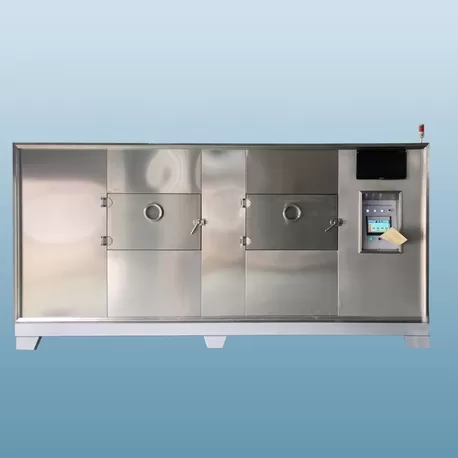
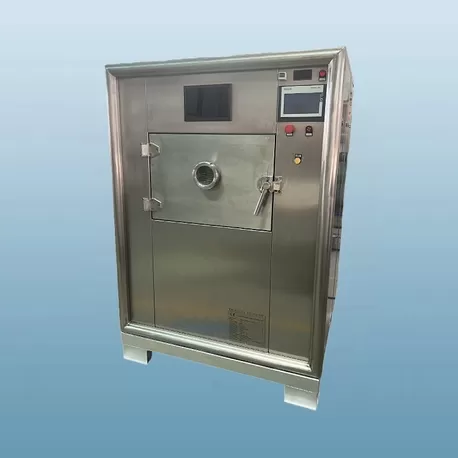
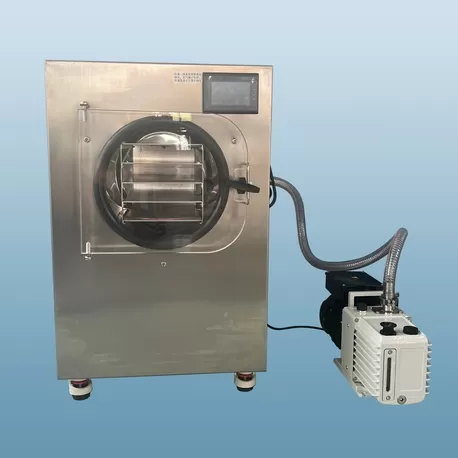
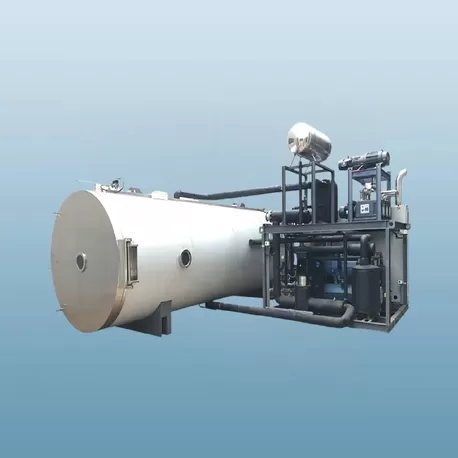
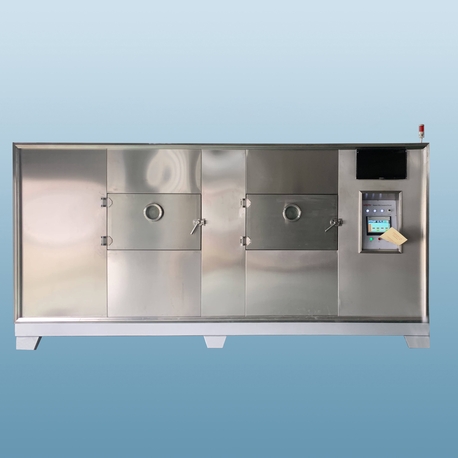
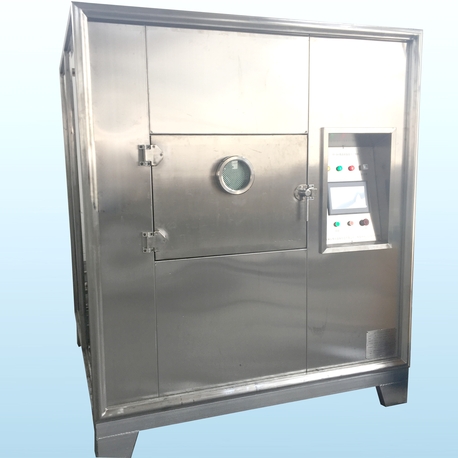
An industrial freeze drying machine (lyophilizer) is the most capital-intensive and energy-demanding drying equipment in industrial processing, requiring deep thermodynamic coordination across sub-triple-point vacuums (<611 pa="">20 years of equipment manufacturing history and reliable installations in over 40 countries—including the USA, Germany, France, Italy, Canada, and Australia—Nasan manufactures precision freeze dryers engineered to maintain ±0.5°C shelf uniformity, zero product melt-back, and maximum condenser ice-capture efficiency.
Industry Proven20 YearsFabrication Mastery
Global Reach40+ NationsExport Compliance
Thermal Plane±0.5°CSilicone Oil Uniformity
Deep Vacuum< 1.0 PaBase Ultimate Level
[EXECUTIVE SUMMARY // CORE SPECIFICATION CRITERIA]
An industrial freeze drying machine must be specified through three coupled thermodynamic metrics: usable shelf area ($m^2$) calibrated to cake depth (10–15 mm), ice condenser trapping capacity (kg/24h) calculated at 1.5x total batch moisture with an evaporation surface holding below -50°C to -85°C, and vacuum pumping displacement pulling under 10 Pa. Nasan manufactures certified SUS304/SUS316L lyophilization systems featuring closed-circuit thermal fluid shelf plates, pressure rise testing (PRT) endpoint automation, and oversized vapor transfer ports that eliminate sonic choking during peak primary sublimation.
TECHNICAL SIZING LEDGER FOR INDUSTRIAL LYOPHILIZATION
| Subsystem | Physical Engineering Bound | Nasan Production Benchmark |
|---|
| Shelf Fluid Circulation | Direct expansion vs. electric resistance vs. hollow plate silicone oil | Hollow-milled plates; Dowtherm/silicone oil loop (±0.5°C across all tiers) |
| Condenser Trap Architecture | Internal base coils vs. isolated external chamber with spool butterfly valve | External rear/side isolated cylinder; zero radiant heat transfer back to product |
| Compressor Cryogenics | Single stage (-40°C) vs. two-stage cascade reciprocating/screw (-75°C to -85°C) | Semi-hermetic Bitzer/Frascold compressors; dual refrigeration stages |
| Vacuum Pumping Train | Dry scroll vs. multi-stage rotary vane backed by Roots booster blower | Leybold/Edwards dual-vane + Roots blower train (<1 pa="" ultimate="" limit=""> |
| Sanitary Standard | Welded structural frame, surface Ra roughness, clean-in-place (CIP) rating | SUS304 or SUS316L; internal mirror electropolish Ra < 0.38 µm; ASME/CE |

1. Vapor Dynamics & Choked Flow: The Physics of Shortening Freeze Drying Cycles
The limiting factor in commercial freeze drying is rarely refrigeration power; it is mass transfer resistance. When water ice sublimates at 10 Pa under deep vacuum, one kilogram of ice expands into more than 1,000 cubic meters of low-density water vapor. If the transfer duct connecting the drying chamber to the condenser is undersized, the vapor velocity hits the speed of sound (Mach 1), resulting in choked flow, chamber pressure spikes, and catastrophic batch melt-back.
In high-capacity freeze drying (100 kg to 2,000 kg per batch), managing this volumetric surge requires precise fluid dynamic engineering. Under thermodynamic frameworks codified by the American Society of Heating, Refrigerating and Air-Conditioning Engineers (ASHRAE), fluid velocity through isolation valves must be maintained well below sonic thresholds to preserve the driving pressure differential ($\Delta P$) between the product ice front and the cold trap.
[PHASE 01: SUBLIMATION RESTRAINT]Primary Drying (Latent Heat Supply)
Hollow shelves supply heat of sublimation (2,838 kJ/kg ice) through circulating silicone fluid. The core product temperature must be held 2°C to 5°C below the glass transition collapse temperature ($T_c$) or eutectic point ($T_e$).
[PHASE 02: DESORPTIVE DIFFUSION]Secondary Drying (Bound Water Removal)
Once all visible ice crystals have sublimated, shelf temperatures are ramped to +30°C to +45°C. At maximum vacuum (<5 pa="">
2. Condenser Surface Geometry: Why Ice Thickness Dictates Chamber Pressure
The cold trap condenser functions as the primary cryogenic pump in a freeze drying machine. As ice accumulates on the condenser coils, its low thermal conductivity ($k \approx 2.2 \text{ W/m·K}$) creates a growing thermal insulating barrier. If the refrigeration system cannot continuously drive the surface temperature down as the ice sheet thickens, vapor condensation ceases and chamber pressure climbs.
To eliminate this failure mode, Nasan's freeze dryer engineering team calculates coil surface areas with a minimum 1.4x to 1.8x volumetric margin over the total moisture content of the wet batch. Utilizing two-stage semi-hermetic reciprocating or screw compressors charged with eco-refrigerants, our systems maintain coil core temperatures down to -75°C to -85°C across the entire primary drying ramp.
Isolated External Spool Configuration: Isolating the condenser behind a high-speed pneumatic butterfly valve prevents radiant refrigeration losses back to the product shelves, eliminating cool-spots during the secondary drying phase.
Automated Pressure Rise Testing (PRT): Periodically sealing the isolation valve for 15 seconds allows the PLC to measure the rate of chamber pressure rise. When pressure rise flatlines, primary sublimation is complete—eliminating costly hours of unnecessary cycle over-drying.
Hot-Gas Defrost Fluidics: High-efficiency hot compressor discharge gas is diverted directly through the condenser coils post-batch, melting down 1,000 kg ice sheets in under 45 minutes to maximize machine uptime.
3. 20 Years of Cross-Disciplinary Rigor: Pharma, Chemical, and Food Synergy
Nasan's distinct advantage in the global drying machinery landscape is two decades of multi-industry manufacturing. Rather than building food freeze dryers down to minimum agricultural standards, we build our commercial equipment up to the stringent sanitary and structural protocols established in our pharmaceutical and chemical engineering divisions.
In accordance with global hygienic manufacturing guidelines enforced by the U.S. FDA cGMP standards, ISO 13408 aseptic processing protocols, and ASME BPE bio-processing equipment criteria, every Nasan freeze dryer incorporates heavy-duty structural safeguards:
ASME Pressure Vessel Vacuum Shell
Manufactured from heavy-gauge SUS304 or SUS316L stainless steel reinforced with external stiffening rings. Finite element analysis (FEA) certified to eliminate structural deflection under 100 kPa full external atmospheric crush pressure.
Global Operational Footprint (40+ Nations)
Operating continuously across the USA, Germany, France, Italy, Spain, Sweden, Australia, New Zealand, and South Korea. Electrical panels pre-engineered with Siemens or Schneider PLCs compliant with UL 508A and CE machinery directives.

4. Engineering Sourcing Guide: Technical Audit Ledger (Do's & Don'ts)
[AUDIT PASS // MANDATORY CRITERIA]
Mandate silicone fluid shelf loops: Eliminate electric heating coils that generate destructive ±5°C hot spots across trays.
Verify condenser ice-to-water ratio: Ensure the cold trap handles at least 1.4x the batch's total evaporable mass.
Demand certified helium leak detection: Require vacuum integrity testing confirming leak rates under 1x10⁻⁵ mbar·L/s.
Inspect valve and vapor spool diameters: Ensure vapor connection piping is sized to prevent Mach 1 choked flow bottlenecks.
[AUDIT FAIL // PROCUREMENT RED FLAGS]
Don't evaluate quotes on chamber size alone: True throughput is governed by usable shelf area ($m^2$) and cake thickness.
Don't purchase non-isolated bottom condensers: Internal open coils reflect parasitic radiant heat back onto bottom trays.
Don't accept flexible plastic vacuum lines: High-vacuum connections must be solid sanitary SUS304/316L tri-clamp piping.
Don't buy from non-manufacturing brokers: Intermediaries lack cleanroom testing bays and cannot modify PLC cycle curves.
5. The Nasan Factory Acceptance Test (FAT): 6-Step Verification Protocol
Drawing upon two decades of equipment fabrication, Nasan subjects every industrial freeze drying machine to a structured 6-phase Factory Acceptance Test (FAT) prior to crating, validating vacuum holding, refrigeration thermal pull-down, and sublimation rates.
| Stage | Validation Objective | Instrument & Metrology Tool | Tolerance Bound |
|---|
| FAT-01 | Helium Mass Spectrometry | Calibrated Helium Leak Sniffer | < 1x10⁻⁵ mbar·L/s |
| FAT-02 | Multi-Tier Shelf Thermal Map | 24-Channel NIST Thermocouple Data Logger | ±0.5°C at Setpoint |
| FAT-03 | Condenser Pull-Down Benchmark | Pressure Transducers & RTD Sensors | +20°C to -80°C in < 30 min |
| FAT-04 | Clean-in-Place (CIP) Riboflavin | UV Blacklight Optical Inspection | 100% Zero Shadow Coverage |
| FAT-05 | Pure Water Sublimation Trial | Digital Mass Load Cells | ≥ 1.2 kg/m²·h Sublimation |
| FAT-06 | Pressure Rise Test (PRT) Calibration | Capacitance Manometer vs. Pirani Gauge | Automated Endpoint Detection |
QUERY 01 // CYCLE ECONOMICS
How does Nasan reduce freeze drying cycle times without causing melt-back?
A1: We eliminate cycle bottlenecks by optimizing the heat-transfer and mass-transfer balance. First, our hollow-milled shelves circulating silicone oil maintain tight thermal uniformity (±0.5°C), allowing operators to drive shelf temperatures closer to the critical collapse point ($T_c$) without localized overheating. Second, our oversized vapor spools and isolation valves eliminate aerodynamic vapor choking, lowering mass transfer resistance and cutting standard 36-hour cycles down to 18–24 hours.
QUERY 02 // REFRIGERATION & VACUUM
Why is silicone oil circulation superior to direct electric shelf heating?
A2: Electric heating wires embed localized hot spots that vary by up to ±5°C, inevitably scorching delicate food or collapsing pharmaceutical cakes. Hollow shelves circulating silicone oil distribute fluid continuously via balanced manifold channels, providing smooth thermal gradients (±0.5°C) across every shelf tier. Crucially, silicone loops also allow active pre-freezing on the shelves, eliminating external blast-freezer transfer steps.
QUERY 03 // GLOBAL EXPORT COMPLIANCE
How does Nasan support equipment installations across 40+ international markets?
A3: Nasan builds for international harmonization. We engineer electrical enclosures to local codes (480V 60Hz for North America, 400V 50Hz for Europe and Australasia), utilize globally serviced Tier-1 components (Bitzer compressors, Leybold/Edwards vacuum pumps, Siemens touchscreens), provide English/multilingual software documentation, and support overseas commissioning alongside secure remote IoT diagnostics.
QUERY 04 // SIZING & LOAD CALCULATIONS
How do you accurately calculate shelf area and condenser capacity?
A4: Sizing begins with wet product volume and cake thickness. Typical loading density is 8 to 12 kg/m² of usable shelf area for liquid extracts or diced fruits. A 1,000 kg batch requires roughly 100 m² of shelf space. The cold trap condenser is then sized at 1.4x to 1.8x the total batch moisture weight (e.g., 1,200 to 1,500 kg ice capacity) to prevent ice build-up from choking the vapor path during the peak primary drying surge.
QUERY 05 // RAW MATERIAL TESTING
Can Nasan test my raw materials before final machine fabrication?
A5: Yes. In our thermal engineering pilot lab, we perform differential scanning calorimetry (DSC) and freeze-drying microscopy (FDM) to identify your raw product’s precise eutectic point ($T_e$) and collapse temperature ($T_c$). We generate an empirical drying curve and produce pilot samples for your physical review before engineering your production-scale freeze dryer.
QUERY 06 // LEAD TIME & FABRICATION
What is the typical manufacturing lead time for Nasan industrial lyophilizers?
A6: Standard pilot and pilot-production machines (1 to 10 m²) generally deliver within 4 to 6 weeks. Custom production plants (20 to 100+ m² shelf area) require 8 to 12 weeks for chamber fabrication, ASME pressure testing, cascade refrigeration assembly, and full 6-step FAT validation prior to export wood-crate packaging.
Request a Technical Sizing Review With Nasan Engineers
TURNKEY ENGINEERINGPlan your next-generation freeze drying installation with verified engineering data. Partner with a manufacturer backed by 20 years of thermal fabrication experience and field installations across 40+ countries. Contact our thermal team to calculate shelf requirements, size external cold traps, and schedule pilot material testing.
[✓] 20 Years Manufacturing[✓] 40+ Export Markets[✓] Silicone Oil Shelf Loop (±0.5°C)[✓] Factory-Direct Pricing