Drying governs the profitability of any industrial pasta operation. It is the
longest, most energy-intensive, and most delicate phase of the manufacturing
process. Freshly extruded pasta enters the drying zone at roughly 30% moisture
and must exit below 12.5% to achieve shelf stability and structural
strength.
Remove moisture too fast, and the outer layer hardens while the core stays
damp. This imbalance causes internal tension, resulting in stress fractures,
checking, and broken product during transport. Dry too slowly, and you risk
souring, microbial proliferation, and bottlenecked production.
Selecting the wrong pasta dryer directly impacts your energy
bills, labor allocation, and batch reject rates. At Nasan, our engineering team
works alongside food manufacturing plants to right-size drying systems that
protect profit margins while maintaining strict product standards. If you are
re-evaluating your plant layout or planning an expansion, contact our process engineers for a detailed technical
review.
The Basics: How Static and Continuous Pasta Dryers Work
Pasta dehydration relies on thermodynamics, controlled air velocity, and
targeted relative humidity. The goal is to bring moisture from the core to the
surface without collapsing the starch-protein matrix. Both static and continuous
systems achieve this, but their mechanical approaches serve distinct operating
models.
What is a Static Pasta Dryer? (Batch Drying System)
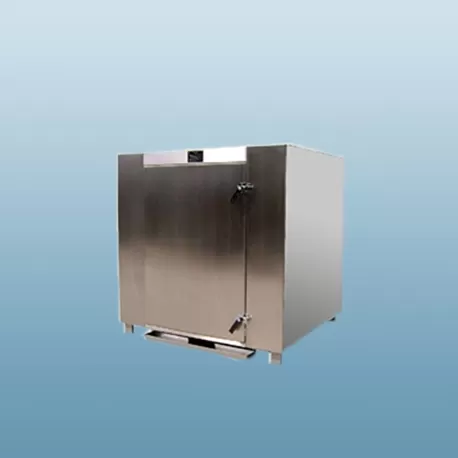
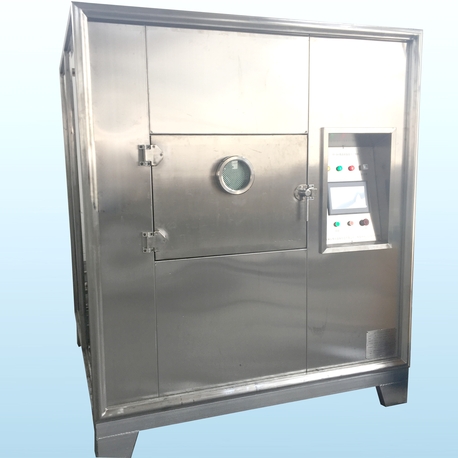
A static pasta dryer operates as an insulated, sealed chamber where batches
of pasta dry under programmed environmental conditions. Operators load wet pasta
onto slatted wooden or food-grade aluminum trays, stack them onto mobile
trolleys, and roll them into the drying room.
Inside the cabinet, bi-directional fans circulate warm air across the trays.
Advanced dampers cycle fresh air in while venting humid air out to follow a
pre-set multi-phase drying curve: pre-drying (often called incartata),
sweating, main drying, and stabilization.
Because the product remains physically stationary during the cycle, static
dryers excel at handling fragile items, artisanal short pasta, nest-shaped
pasta, long strands on rods, and specialty gluten-free formulations.
What is a Continuous Pasta Dryer? (Automated In-Line System)
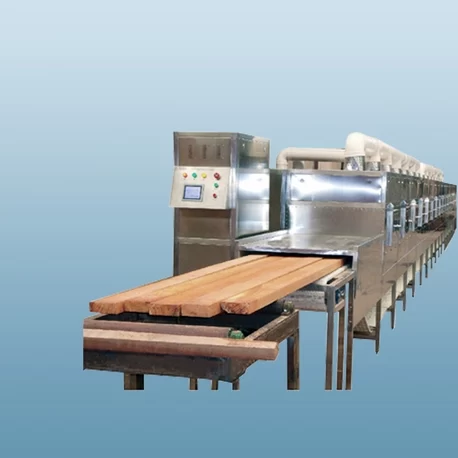
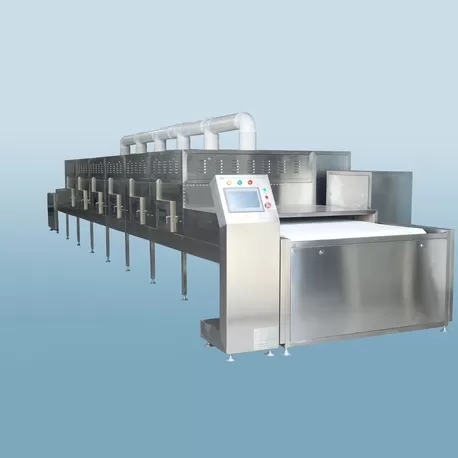
A continuous pasta dryer forms an uninterrupted processing tunnel connected
directly to the output of an industrial extruder. Wet pasta drops directly from
the cutter onto a vibrating pre-dryer (shaker), which quickly seals the surface
so pieces do not clump together.
From the shaker, mechanical elevators transfer the pasta through multi-tier
conveyors or wire-mesh belts inside a long drying tunnel. The pasta travels
through distinctly regulated climate zones, moving gradually from
high-temperature pre-drying down to moisture equalization and final cooling.
These automated tunnels operate non-stop. Wet dough enters one end, and
ready-to-pack dry pasta emerges continuously from the other without manual
intervention.
Deep-Dive Comparison: Static vs. Continuous Pasta Dryers
Plant managers must weigh five core technical and economic factors before
specifying a drying platform. Here is how static and continuous technologies
compare under factory conditions.
1. Production Capacity and Output
Static drying chambers operate strictly on batch logic. Cycle times vary from
6 to 14 hours for short cuts and up to 18 to 24 hours for traditional long pasta
or dense shapes. A single commercial static cabinet generally yields between 400
kg and 1,200 kg per batch.
A continuous pasta dryer measures its output in kilograms or metric tons per
hour, running 24 hours a day, 7 days a week. Industrial lines usually start
around 300 kg/h and scale up to 3,000 kg/h or more.
If your production target exceeds 4 to 5 tons per day, operating a fleet of
static cabinets becomes a logistical bottleneck. For lower, variable volumes,
the static model prevents overproduction and reduces operational complexity.
2. Floor Space and Facility Requirements
Static dryers offer flexible layouts. You can install cabinets against walls,
position them in modular clusters, or expand your footprint incrementally as
capital permits. They require standard ceiling heights and straightforward
ventilation ductwork.
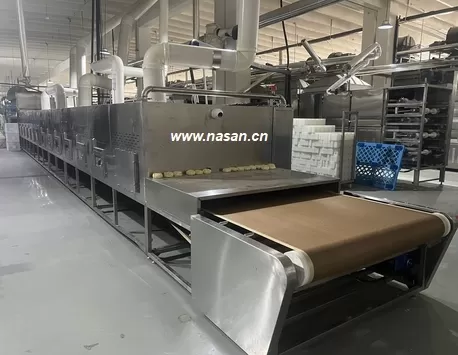
Continuous drying lines demand significant linear floor space. A
medium-capacity continuous tunnel can extend 20 to 50 meters in length. It
requires high ceilings for multi-tiered belt elevators, along with specialized
sub-floor drainage and industrial steam or thermal oil piping.
Plants operating in restricted urban locations or retrofitted warehouses
often choose static units because their structural footprints are far easier to
accommodate.
3. Labor Costs and Automation Level
Labor is the greatest operating expense for static installations. Workers
must spread extruded pasta evenly across trays, load carts, push them into
chambers, monitor batch cycles, and unload the dried product into packaging
hoppers.
Continuous lines eliminate routine handling. Programmable logic controllers
(PLCs) automate the movement of product from extrusion through to final
packaging. One or two operators can manage an entire continuous floor by
monitoring central SCADA panels.
Where industrial labor rates are high, automated continuous machinery lowers
the cost per finished kilogram substantially.
4. Energy Efficiency and Running Costs
Thermal efficiency depends directly on system design. Modern continuous
dryers feature tightly integrated heat recovery loops. They recycle hot, moist
air through enthalpy exchangers, using sensible heat from exhaust streams to
pre-heat incoming fresh air.
Static dryers lose thermal energy each time doors open for loading and
unloading. However, because static cabinets shut down between production runs,
they consume zero baseline power during quiet shifts or slow sales periods.
Maintaining product quality during drying requires precise measurement of
relative humidity and moisture equilibrium, as described by moisture sorption isotherms.
Manufacturers like Nasan build advanced sensor-driven ventilation dampers into
static and continuous equipment to minimize wasted thermal energy during air
exchange.
5. Product Versatility and Quality Control
Static dryers provide unmatched versatility for multi-SKU processors. If your
facility produces short penne in the morning, delicate egg tagliatelle in the
afternoon, and gluten-free lentil spirals the next day, static rooms handle the
variety effortlessly. You simply change the PLC recipe program for each
room.
Continuous lines show poor adaptability to frequent product changes. Purging
a 40-meter drying tunnel to switch from a standard semolina tube to a delicate
curled shape wastes raw material, causes extensive downtime, and disrupts line
equilibrium.
For consistent, high-volume production of standard SKUs, a continuous system
offers superior moisture uniformity throughout the entire run. This consistent
outcome makes it simple to comply with international standards such as ISO 712 for determining moisture content in cereal
products.
Comparison Matrix: Static vs. Continuous Systems
- Daily Output: Static fits 100 kg to 3,000 kg/day;
Continuous fits 3,000 kg to 50,000+ kg/day.
- Cycle Duration: Static takes 8 to 24 hours per batch;
Continuous runs in 2 to 5 hours in-line.
- Labor Requirement: Static requires moderate-to-high manual
handling; Continuous requires minimal monitoring.
- Format Flexibility: Static easily accommodates multiple
shapes and formulas; Continuous is optimized for dedicated shapes and standard
runs.
- Capital Expenditure (CapEx): Static features
low-to-moderate initial setup costs; Continuous requires significant machinery
investment.
The Factory Scale Match: Which Pasta Dryer Do You Need?
Choosing the right pasta dryer comes down to aligning your production reality
with long-term commercial goals. Buying too small creates bottlenecks, while
buying too large burns working capital on idle machinery.
Small & Craft Pasta Producers (Output: Under 500 kg/Day)
Small-batch processors, regional culinary brands, and specialty pasta shops
benefit most from static drying systems. At this scale, flexibility matters more
than pure throughput.
Static cabinets allow craft manufacturers to experiment with heritage grains,
vegetable purees, and regional cut shapes without massive operational overhead.
A cluster of two to four static units offers redundant capacity, so routine
maintenance will never shut down the entire facility.
Medium-Scale Expanding Factories (Output: 1 to 5 Tons/Day)
This output level represents the most difficult turning point for food plant
directors. You can either deploy a large bank of automated static chambers or
invest in a compact, entry-level continuous drying line.
If you produce 15 or more individual SKUs in short runs, a battery of
high-efficiency static chambers remains the most agile choice. It keeps upfront
debt service low and accommodates shifting client orders.
However, if 70% of your production volume consists of just two or three
standard shapes (such as macaroni, penne, or fusilli), moving to an automated
continuous pasta dryer is the right operational move. It cuts labor costs, keeps
bulk product flowing, and prepares your facility for wholesale distribution
contracts.
Large Industrial Pasta Manufacturers (Output: Above 5 Tons/Day)
High-volume commercial processors operating around the clock require
continuous drying equipment. At this industrial scale, manual loading cannot
keep pace with high-speed extruders.
Continuous lines provide the unit economics, tight process control, and labor
efficiency required to compete on wholesale supermarket shelves. In these
facilities, drying tunnels connect directly to downstream automated weighing,
carton packaging, and palletizing systems.
Total Cost of Ownership (TCO): Initial Investment vs. Long-Term ROI
Looking only at the machinery purchase price often results in poor
procurement choices. Factory management must evaluate the complete Total Cost of
Ownership (TCO) across a 10-year horizon.
Static dryers carry a far lower initial CapEx. The machinery is mechanically
simple, requires fewer high-voltage connections, and installs quickly. However,
the recurring OpEx—driven by manual loading, unloading, and tray
sanitization—remains fixed and scales directly with volume.
Continuous drying lines demand substantial capital outlays for the machinery,
dedicated utility drops, and specialized engineering installation. Despite the
high entry point, the long-term ROI is compelling for growing facilities:
- Labor costs drop by up to 75% per metric ton of packaged pasta.
- Continuous, closed-loop thermal profiles reduce drying times from 10+ hours
down to 2 to 4 hours via high-temperature processing.
- Automated mechanical transfers minimize product breakage and waste during
handling.
According to industrial engineering benchmarks compiled by groups like the Society of
Manufacturing Engineers (SME), integrating automation into thermal
processing reduces batch-to-batch variation and slashes scrap rates across
consumer goods production.
Frequently Asked Questions (FAQ)
Q1: How long does a static pasta dryer take to complete a
cycle?
A1: A static drying cycle typically lasts between 8 and 14
hours for standard short-cut shapes. It can extend up to 18 to 24 hours for long
strands like spaghetti or thick-walled artisanal shapes. Drying times depend
heavily on dough wall thickness, initial hydration, and the chosen thermal
profile.
Q2: Can continuous pasta dryers handle multiple product
shapes?
A2: Yes, but switching between shapes requires careful
coordination. Changing from one cut to another of similar thickness takes
minimal adjustment. However, moving between radically different geometries (such
as flat sheets to thick-walled rigatoni) requires purging the line and
recalibrating tunnel retention times and temperature zones.
Q3: How does industrial drying equipment prevent checking and
cracking?
A3: Modern dryers use multi-phase humidity management. By
keeping ambient relative humidity high during initial pre-drying, the machine
keeps the pasta surface pliable while the core begins shedding water. This
controlled moisture migration prevents steep internal stress gradients,
eliminating the cracks that cause pasta to disintegrate in boiling water.
Q4: What heating sources can power an industrial pasta
dryer?
A4: Both static and continuous systems support multiple
thermal sources. Common configurations use electric heating elements, hot water
coils, indirect gas-fired burners, or industrial steam systems. Plant utility
availability and regional fuel costs typically dictate the best heat source for
the site.
Q5: How can a plant verify that dried pasta is safe for long-term
storage?
A5: Factory quality control teams verify moisture content
using calibrated halogen moisture analyzers or standard hot-air oven
loss-on-drying tests. The final moisture content must measure below 12.5%,
alongside a water activity (aw) rating below 0.65 to inhibit all mold, yeast,
and bacterial activity during storage.
Conclusion & Expert Recommendation
Choosing between static and continuous drying is not about which machine is
superior in the abstract. It is about matching technology to your production
volume, SKU count, and balance sheet.
A static pasta dryer offers the agility, lower capital
barrier, and broad format handling required by specialty and small-to-medium
food businesses. A continuous line provides the automation, speed, and
rock-bottom marginal processing costs needed to fuel industrial-scale
distribution.
At Nasan, we engineer robust drying hardware tailored to your product
specifications, plant dimensions, and target outputs. Whether you need an
individual high-precision drying room or a high-capacity continuous production
line, our technical sales engineers will help design the right installation for
your floor.
Request an equipment quote or line consultation with Nasan today to discuss your plant requirements, review detailed consumption
data, and calculate your return on investment.