For operations managers and process engineers in pharmaceutical, biotech, and
specialty food sectors, the freeze dryer (lyophiliser) is not merely an equipment line item — it is the critical control
point that dictates final product quality, shelf stability, and batch
repeatability. Unlike generic drying systems, an industrial‑scale freeze dryer
must balance three‑phase heat transfer, vacuum dynamics, and clean‑in‑place
(CIP) protocols. This article examines the engineering parameters that define
modern freeze
dryer performance, common scale‑up pitfalls, and how Nasan integrates these
principles into its commercial and industrial units.

Fundamentals of Freeze Drying: Beyond the Three Stages
Every freeze
dryer operates on the principle of lyophilisation — removing water
via sublimation and desorption under vacuum. However, industrial applications
demand precise control over:
Eutectic temperature (Teu) & collapse temperature (Tc): product must remain frozen throughout primary drying to avoid melt‑back.
Differential scanning calorimetry (DSC) data is essential for cycle
development.
Chamber pressure and condenser capacity: typically between
50–200 µbar, with condenser surfaces reaching –80 °C to trap vapour without
overloading the vacuum pumps.
Shelf temperature uniformity: ±1 °C across all shelves
ensures every vial experiences the same heat input; deviations cause intra‑batch
moisture variation.
Advanced units from Nasan incorporate
shelf‑fluid circulation with silicon‑based thermal fluids, enabling ramp rates
of 1 °C/min without thermal gradients. This directly impacts the primary drying
time, which can account for up to 70 % of the total cycle.
Critical Design Criteria for Commercial‑Scale Freeze Dryers
Hygienic Architecture and Material Selection
For pharmaceutical and food applications, the drying chamber must meet cGMP
and 3‑A sanitary standards. Aseptic freeze dryer designs
feature electropolished 316 L stainless steel (Ra ≤ 0.4 µm), crevice‑free welds,
and sloped drain ports for complete evacuation during CIP. Nasan uses orbital welding
and borescope inspection to validate weld integrity — a detail often overlooked
by generic manufacturers.
Heat Transfer Fluids and Refrigeration Systems
Industrial units typically employ two‑stage refrigeration with compressors
using eco‑friendly refrigerants (R‑507 or R‑404A alternatives). The condenser
coils are designed with high‑efficiency fin geometry to maximise ice capacity
before defrost. Modern freeze dryer systems now incorporate
variable‑speed drives on vacuum pumps, reducing energy consumption by up to 30 %
during the secondary drying stage when gas load diminishes.
Process Analytical Technology (PAT) Integration
To comply with FDA’s PAT framework, advanced freeze dryer installations include:
Wireless temperature probes (thermocouples or RTDs) in reference vials.
Manometric temperature measurement (MTM) to estimate ice front temperature
without invasive sensors.
Near‑infrared (NIR) spectroscopy ports for real‑time moisture
monitoring.
This data enables model‑based control, shifting from fixed recipes to
adaptive cycles that reduce drying time by 15–25 % while safeguarding product
quality.
Sector‑Specific Challenges and Freeze Dryer Configurations
Pharmaceutical & Biotech: Sterility and Containment
Lyophilised injectables require stopper insertion under vacuum (stop‑tray
systems) and sometimes isolator technology. A barrier‑integrated freeze
dryer must maintain leak rates below 5 × 10⁻³ mbar·L/s.
Nasan offers split‑door designs that interface directly with
restricted access barrier systems (RABS), minimising particle ingress during
loading and unloading.
Industrial Food Processing: Throughput and Energy Efficiency
For instant coffee, freeze‑dried fruits, or military rations, the focus
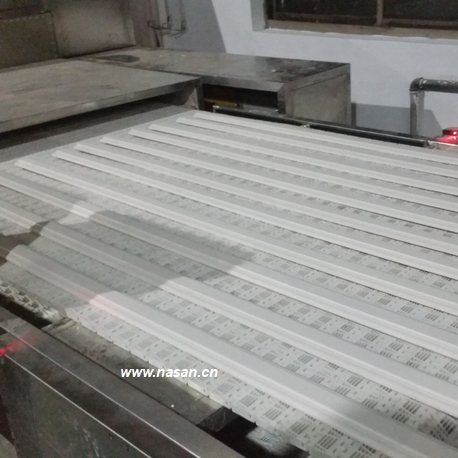
shifts to throughput. Tunnel‑type continuous freeze dryer systems (vs. batch) are gaining traction. They employ multiple chambers with
vacuum locks, allowing material transfer without breaking vacuum. Key parameters
include:
Belt loading density (typically 8–15 kg/m²).
Infrared or conductive heating from both sides to shorten primary
drying.
Ice capacity: a 200 m² condenser surface can trap more than 2 tons of ice
per cycle before defrost is required.
Nasan has
engineered hybrid systems that combine batch flexibility with near‑continuous
material flow for high‑value ingredients, reducing footprint by 40 % compared to
traditional tunnel dryers.
Quantifying Operational Benefits: Energy, Yield, and Payback
An industrial freeze dryer is an intensive energy consumer —
refrigeration and vacuum pumps account for roughly 85 % of total electricity
use. However, recent innovations in heat recovery and adaptive control yield
measurable ROI:
Variable‑frequency drives on vacuum pumps reduce energy use during secondary
drying (when sublimation is complete).
Optimised shelf‑ramp profiles shorten primary drying: a 10 % reduction in
cycle time for a 200 m² unit can save over €50,000/year in electricity and
labour.
Higher ice condenser efficiency (lower coil temperature) allows faster water
capture, enabling shorter pump‑down times between batches.
Data from a 2023 installation of a Nasan industrial
freeze dryer in a European pharma contract manufacturing
organisation showed a 22 % decrease in specific energy consumption (kWh/kg of
dry product) after implementing model predictive control — equivalent to a
14‑month payback on the control upgrade.
Maintenance, Validation, and Lifecycle Management
To maintain sterility and performance, a freeze dryer requires periodic validation of:
Shelf temperature mapping: temperature distribution across
all shelves (typically ±1 °C) must be re‑qualified annually.
Vacuum leak tests: using helium or pressure‑rise methods;
leak rates above 0.01 mbar·L/s necessitate gasket inspection or door‑seal
replacement.
Condenser ice capacity: measured by water load tests to
confirm that defrost cycles are scheduled correctly.
Gaskets and door seals in commercial freeze dryer systems
are often the first components to degrade — silicone seals should be replaced
every 2–3 years depending on CIP frequency. Nasan provides
OEM‑certified spare parts and remote diagnostics via PLC connectivity, reducing
unplanned downtime.

Future Trajectories: Continuous Lyophilisation and Industry 4.0
The next frontier for industrial freeze drying is the transition from batch
to continuous processing. Several pilot‑scale continuous freeze
dryer designs have emerged, using rotating drums or multi‑chamber
vacuum locks. While still in early adoption, these systems promise:
Uniform product thickness and improved heat transfer.
Reduced footprint (up to 50 % less floor space than a batch dryer of
equivalent capacity).
In‑line quality monitoring with real‑time moisture sensors.
Digital twins and IoT‑enabled freeze dryer controls are
already available from Nasan, allowing operators
to simulate cycle changes, predict maintenance, and upload recipes via
cloud‑based platforms — a significant step toward the paperless, self‑optimising
pharma plant.
Frequently Asked Questions
Q1: What is the typical lifespan of an industrial freeze dryer, and
what factors influence it?
A1: A well‑maintained freeze
dryer can operate 20–25 years. Key longevity factors include the
quality of vacuum pump maintenance (oil changes, filter replacements),
refrigeration compressor overhauls every 8–10 years, and periodic replacement of
door gaskets. Units with CIP/SIP systems require careful monitoring of steam
traps and valve seals.
Q2: How does one determine the optimal shelf area for a new
production line?
A2: Shelf area (m²) is driven by batch size and
product loading. For pharmaceutical vials, calculate the number of vials per
tray and trays per shelf, accounting for 10–15 % extra space for heat radiation
effects. For bulk food products, consider the product depth (typically 10–25 mm)
and bulk density. A conservative rule is 1 m² of shelf area can process 8–12 kg
of water per 24 h cycle, but this varies widely with product resistance.
Q3: What is the difference between a pharmaceutical‑grade and a
food‑grade freeze dryer?
A3: Pharmaceutical freeze
dryer systems require higher surface finish (Ra < 0.4 µm),
sterilisation‑in‑place (SIP) capability with pure steam, and often isolator
integration. Food‑grade units prioritise throughput and ease of cleaning, may
use 304 L stainless steel, and sometimes employ belt or tunnel configurations
instead of shelves. Both must meet their respective regulatory standards (cGMP
vs. HACCP).
Q4: Can an existing freeze dryer be retrofitted with advanced PAT
tools?
A4: Yes, many older freeze dryer installations can be upgraded with additional ports for wireless temperature
sensors, pressure rise test systems, and even NIR probes. Retrofitting usually
requires validation of new control software and may involve chamber
modifications. Nasan offers retrofit packages that include new
PLCs, HMI, and sensor integration, extending the life of legacy equipment while
adding PAT capabilities.
Q5: How do energy costs compare between freeze drying and other
drying methods (spray, vacuum, air)?
A5: Freeze drying is generally
more energy‑intensive per kg of water removed because of the refrigeration load
and vacuum operation. Typical specific energy consumption is 1.5–2.5 kWh/kg of
ice, versus 0.8–1.2 kWh/kg for vacuum drying and 0.2–0.5 kWh/kg for air drying.
However, freeze drying preserves heat‑sensitive compounds and yields superior
rehydration, justifying the energy premium for high‑value products. Advances in
heat pump‑assisted freeze dryer designs are narrowing this
gap.
Selecting an industrial freeze dryer requires
balancing thermodynamics, mechanical reliability, and validation protocols. With
over two decades of installations across 30 countries, Nasan provides scalable
solutions — from 5 m² R&D units to 50 m² production systems — each
engineered for precise lyophilisation and long‑term operational economy. For
detailed cycle development or equipment specifications, consult our process
engineers directly.