Conventional thermal sterilization (steam, hot water, or autoclaving) often
degrades product quality, creates temperature gradients, and consumes large
amounts of energy. A microwave
sterilization machine offers rapid, volumetric heating that
inactivates microorganisms while preserving heat-sensitive compounds. Based on
performance data from over 150 industrial installations across food,
pharmaceutical, and cosmetic sectors, this guide presents seven technical
parameters that determine sterilization efficacy, throughput, and regulatory
compliance. Nasan designs and manufactures
microwave
sterilization machines that achieve 5-log reduction of pathogens
(Salmonella, E. coli, Bacillus stearothermophilus) with minimal impact on
nutrients and active ingredients.
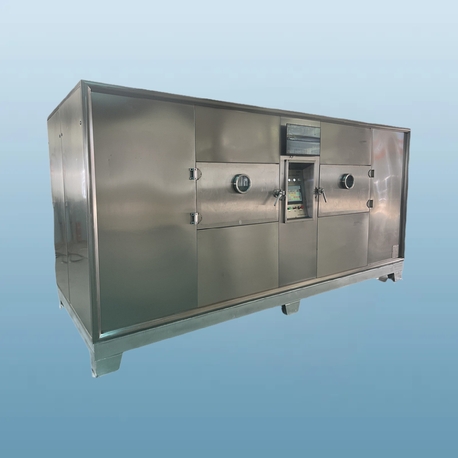
Microwave Sterilization Mechanism: Thermal and Non-Thermal Effects
A microwave
sterilization machine operates at 915 MHz or 2450 MHz. The
electromagnetic field causes polar molecules (water) and charged ions in
microbial cells to oscillate, generating heat volumetrically. Additionally,
non-thermal effects disrupt cell membranes and DNA without raising bulk
temperature – a phenomenon recognized by the International Microwave Power
Institute. Key advantages over conventional methods:
Rapid heating (seconds to minutes vs. 30–60 minutes for retort).
Uniform temperature distribution in packaged or bulk products.
Lower process temperatures (60–95°C) for heat-sensitive products.
Reduced formation of furans, acrylamide, and other thermal
contaminants.
Industrial microwave sterilization
systems are validated using biological indicators (Geobacillus
stearothermophilus spores) and temperature mapping. Nasan provides turnkey microwave
sterilization machines with integrated validation protocols.
Parameter 1: Microwave Frequency and Penetration Depth
Two frequencies dominate industrial microwave
sterilization machines:
2450 MHz (2.45 GHz): Penetration depth 2–5 cm in moist
foods. Suitable for thin-layer products (sliced meat, herbs, powders). Lower
equipment cost.
915 MHz: Penetration depth 8–12 cm. Used for larger
packages (ready meals, pouches) and bulk liquids. Higher capital cost but better
uniformity for thick products.
Penetration depth (Dp) is defined as the distance where power density drops
to 1/e (37%). For a given product, Dp = λ0 / (2π √(2ε')) where λ0 is free-space
wavelength and ε' is dielectric constant. Nasan measures product dielectric
properties to recommend optimal frequency and waveguide design. Mismatched
frequency leads to surface overheating and under-sterilization of core.
Parameter 2: Power Density and Distribution Uniformity
Sterilization efficacy requires that every particle receives sufficient
microwave energy. The microwave
sterilization machine must achieve power density of 5–15 kW per
cubic meter of treatment zone. Uniformity is measured by the coefficient of
variation (CV) of absorbed power – acceptable CV < 20%. Methods to improve
uniformity:
Rotating mode stirrers (3–6 blades).
Multiple magnetron feeds (2–12 units) with phase control.
Conveyor belt or turntable motion for continuous products.
Use of susceptors (lossy materials) for low-moisture products.
Nasan's microwave applicator
design includes electromagnetic simulation (CST) to predict
hot/cold spots before fabrication. Field mapping with an ethanol-loaded phantom
confirms uniformity during factory acceptance testing.
Parameter 3: Temperature Control and Fiber-Optic Sensing
Conventional thermocouples cannot be used inside a microwave
sterilization machine because they spark and distort the field.
Fluoroptic probes (GaAs-based or ruby) provide ±0.3°C accuracy. Install 4–8
sensors at critical locations: product core, surface, and corners. The control
system adjusts magnetron power individually per zone to maintain product
temperature within ±2°C of setpoint. For continuous systems, infrared cameras
with microwave-shielded windows map surface temperature in real time. Data
logging at 1-second intervals supports FDA validation (21 CFR Part 11).
Parameter 4: Product Dielectric Properties and Loading Density
Sterilization efficiency depends on the product's loss factor (ε''), which
determines how well it absorbs microwave energy. Materials with low ε'' (e.g.,
dry powders, oils) require pre-moistening or susceptor additives. For a
microwave
sterilization machine, optimal loading:
Moisture content > 20% – efficient coupling.
Product layer depth ≤ 2× penetration depth.
Bulk density between 300–800 kg/m³ for powders; higher density requires
longer residence time.
Nasan's lab measures your product's dielectric constant (ε') and loss factor
(ε'') at 25–95°C using a network analyzer. This data drives power and residence
time calculations. For mixed products (e.g., ready meals with different
components), the machine must be tuned to the coldest (lowest ε'')
component.
Parameter 5: Validation and Biological Indicators
Regulatory bodies (FDA, USDA, EU) require validated sterilization processes.
For a microwave
sterilization machine, validation includes:
Temperature mapping under worst-case load (minimum product mass, coldest
starting temperature).
Biological indicator (BI) challenge – place Geobacillus stearothermophilus
spore strips (10^6 spores) at cold spots. Achieve 12-log reduction (F0 > 12
minutes equivalent).
Heat penetration studies using wireless temperature loggers (Ellab,
TMI).
Microbial challenge tests with inoculated product (e.g., Salmonella in
chicken, Listeria in ready meals).
Nasan provides a validation protocol template and on-site support for
regulatory submissions. Machines include automatic reporting of process
parameters (time, temperature, power, reflected power) for batch
traceability.
Parameter 6: Continuous vs. Batch Configuration
Industrial microwave
sterilization machines are available in two main formats:
Batch (cabinet): Chamber volume 0.5–5 m³. Suitable for
packaged products (pouches, trays) and laboratory validation. Load/unload
manually or via cart.
Continuous (tunnel or belt): Belt width 0.6–2.0 m, length
4–20 m. Processes unpackaged powders, grains, nuts, spices, or sealed pouches on
conveyor. Throughput 200–3000 kg/hour.
Continuous systems require careful sealing at entrance/exit to prevent
microwave leakage. Nasan's continuous microwave sterilization
tunnels use choke flanges and absorber curtains to meet leakage
< 1 mW/cm² at 5 cm. Choose batch for low-volume, high-mix products;
continuous for high-volume, single-SKU lines.
Parameter 7: Safety and Compliance Standards
A microwave
sterilization machine must meet:
IEC 60519-6 (Safety in electroheating – microwave frequency).
FDA 21 CFR 1030.10 (microwave leakage limits).
NFPA 86 for ovens with flammable atmospheres (if packaging contains
solvents).
CE marking (EMC and LVD directives).
Mandatory safety features: dual door interlocks, automatic power shutdown
when door opens, leakage monitoring with alarm, emergency stop (red mushroom)
within reach, and warning lights. For products with metal packaging (foil
trays), microwave sterilization is not suitable – use alternative methods. Nasan
provides full documentation for CE, FDA, and USDA compliance.
Industry Pain Points and Microwave Sterilization Solutions
Common sterilization challenges and how a microwave
sterilization machine resolves them:
Pain point: Long retort cycles degrade texture and color –
Solution: Microwave reduces processing time from 45 minutes to 3 minutes.
Example: canned vegetables – retained firmness 85% vs. 55% after retort.
Pain point: Non-uniform heating in solid foods – Solution:
Volumetric heating eliminates cold spots. Validation data shows temperature
spread ±2°C vs. ±12°C in conventional steam.
Pain point: High energy consumption of autoclaves –
Solution: Microwave sterilization uses 0.3–0.6 kWh per kg of product vs. 1.2–2.0
kWh for retort. Savings of $25,000–$60,000 annually for a 1000 kg/hour
line.
Pain point: Loss of probiotics and vitamins – Solution:
Lower process temperature (70–90°C) preserves B vitamins and lactic acid
bacteria. Retention rates >90% vs. <60% after thermal
sterilization.
Nasan offers a free feasibility
test: send 5–10 kg of your product, receive a sterilization report including
D-value (decimal reduction time) and recommended machine size.

Application Scenarios Across Industries
Food processing: Sterilization of spices (black pepper,
cumin) – reduces aerobic plate count from 10^6 to <10^2 CFU/g without
essential oil loss. Ready meals (rice, curry, pasta) in retort pouches – shelf
life extended to 12 months at ambient temperature. Nuts and seeds (almonds,
sunflower) – eliminates Salmonella without rancidity.
Pharmaceuticals: Sterilization of herbal powders,
probiotics, and enzyme preparations – no degradation of active pharmaceutical
ingredients (APIs). Continuous microwave
sterilization machines for pre-filled syringes and vials are in
development (low moisture content requires susceptor).
Cosmetics: Sterilization of face powders, loose minerals,
and natural clays – eliminates mold and yeast without clumping.
Biotechnology: Sterilization of growth media and
fermentation substrates – 5-log reduction of vegetative cells while preserving
heat-sensitive components.
For each application, Nasan provides customized sterilization
protocols including power ramping, belt speed, and hot air assist
to maintain surface temperature.
Frequently Asked Questions (FAQ)
Q1: What is the difference between microwave sterilization and
microwave pasteurization?
A1: Pasteurization targets vegetative
pathogens (e.g., Salmonella, Listeria) with a 5-log reduction and uses lower
temperatures (60–85°C). Sterilization targets bacterial spores (e.g.,
Clostridium botulinum, Geobacillus stearothermophilus) requiring 12-log
reduction and higher temperatures (90–130°C under pressure). A microwave
sterilization machine must achieve F0 ≥ 12 minutes. Nasan designs
machines with pressurized chambers (up to 3 bar) for spore inactivation.
Q2: Can a microwave sterilization machine process products in metal
or foil packaging?
A2: No. Metal reflects microwaves, causing arcing
and damage to the magnetron. Use only microwave-safe packaging: polypropylene
(PP), polyethylene (PE), PET, or glass. For retort pouches with aluminum foil
layer, microwave sterilization is not possible. Nasan offers packaging testing
to identify suitable materials.
Q3: What is the typical throughput of an industrial microwave
sterilization machine?
A3: Batch machines: 50–500 kg per cycle
(cycle time 15–45 minutes). Continuous machines: 200–3000 kg/hour depending on
belt width and product depth. For example, sterilizing ground spices at 500
kg/hour requires 40 kW of microwave power (2450 MHz) and a 6-meter tunnel. Nasan
provides a throughput calculator based on your product's specific heat and
dielectric loss.
Q4: How do I validate the sterilization efficacy of a microwave
system?
A4: Use the following protocol: (1) Map product temperature
with fiber-optic sensors to locate cold spots. (2) Place biological indicators
(Geobacillus stearothermophilus spore strips, 10^6 population) at cold spots.
(3) Run the sterilization cycle. (4) Incubate BIs at 55–60°C for 7 days. No
growth indicates sterility. Repeat for worst-case load (maximum batch size,
minimum initial temperature). Nason's validation report is accepted by FDA and
CFIA.
Q5: Does microwave sterilization cause nutrient loss compared to
conventional methods?
A5: Studies show that microwave sterilization
retains 15–40% more vitamins (B1, C, folic acid) and antioxidants compared to
retort. For example, vitamin C retention in broccoli: microwave sterilization
78%, retort 42%. The shorter exposure time and lower bulk temperature minimize
thermal degradation. However, non-thermal effects do not significantly affect
nutrients. Request Nasan's nutrient retention data for your product
category.
Q6: What maintenance is required for a microwave sterilization
machine?
A6: Daily: check door seals for damage, clean waveguide
window (product buildup absorbs microwaves and overheats). Monthly: inspect
magnetron cooling water flow and temperature, measure microwave leakage with a
meter (limit 5 mW/cm²). Every 8000 operating hours: replace magnetrons (cost
$800–2000 each). Every 2 years: replace door gaskets and mode stirrer bearings.
Nasan provides a preventive maintenance contract with remote diagnostics.
Q7: Can microwave sterilization be combined with vacuum to lower
processing temperature?
A7: Yes. A vacuum microwave
sterilization machine operates at 50–80 mbar, allowing water to
boil at 35–45°C. This is ideal for very heat-sensitive products (probiotics,
enzymes). However, vacuum prevents spore inactivation because temperatures above
100°C are needed for sterilization. Vacuum microwave is typically used for
pasteurization, not terminal sterilization. Nasan builds hybrid systems with
both vacuum and pressure modes.
Selecting the right microwave
sterilization machine requires analysis of product dielectric
properties, target pathogen reduction, throughput, and packaging. Nasan provides free material testing in our application laboratory, process scale-up
services, and turnkey installation with operator training. Send your product
name, initial microbial load, target shelf life, and daily throughput to receive
a detailed proposal including sterilization curve, power requirement, energy
cost estimate, and validation protocol. All inquiries receive a response within
48 hours.
Request your inquiry now → Visit https://www.nasandry.com/ or email
info@nasandry.com. Include your product's moisture content and packaging type.
For urgent projects, attach a safety data sheet (SDS) and photos of your
existing production line.