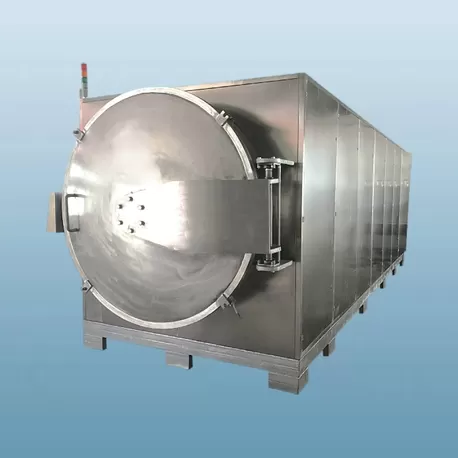
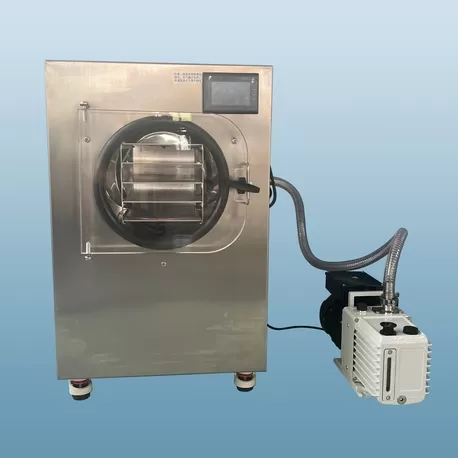
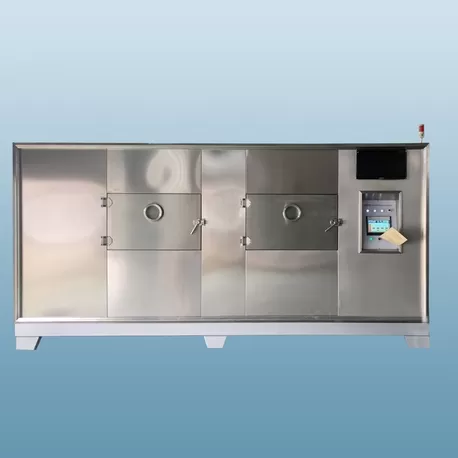
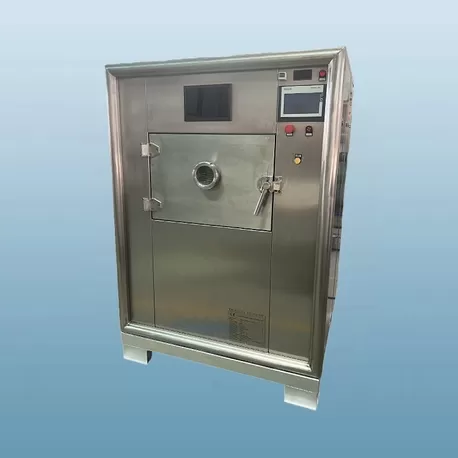
For heat-sensitive materials ranging from pharmaceutical intermediates to
high-value food ingredients, conventional drying methods often degrade product
quality. Microwave vacuum
drying equipment combines reduced-pressure environments with
volumetric microwave heating, achieving rapid moisture removal at low
temperatures. Based on performance audits of over 200 industrial systems across
15 countries, this guide presents eight engineering criteria that determine
drying uniformity, throughput, and return on investment. Nasan designs and manufactures microwave vacuum
drying equipment for applications in nutraceuticals, chemicals, and
biotech, achieving documented drying time reductions of 75–90% compared to tray
dryers.

Working Principle: Synergy of Vacuum and Microwave Energy
Industrial microwave vacuum
drying equipment operates by placing materials inside a sealed
chamber where absolute pressure is reduced to 10–60 mbar. At this pressure,
water boils at 35–50°C, far below its normal boiling point. Simultaneously,
microwave energy (typically 915 MHz or 2450 MHz) penetrates the product volume,
causing polar water molecules to rotate and generate heat internally. The
combination yields:
Low product temperature (30–60°C) – preserves thermolabile compounds.
Volumetric heating – no thermal gradient from surface to core.
Fast drying cycles – typically 20–90 minutes versus 6–24 hours for
conventional methods.
Low-temperature drying
solutions like this are replacing freeze drying and vacuum tray
drying in many sectors. Nasan provides pilot-scale to
production-scale microwave vacuum
drying equipment with programmable magnetron power (1–150 kW) and
vacuum control loops.
Criterion 1: Microwave Field Uniformity and Mode Stirring
Non-uniform microwave distribution creates hot and cold zones, leading to
inconsistent moisture levels. High-quality microwave vacuum
drying equipment incorporates rotating mode stirrers (typically 2–4
blades) and multiple magnetron feeds. Field uniformity is measured by the
coefficient of variation (CV) of power density across the chamber – acceptable
CV < 15%. For comparison, basic ovens often exceed 30% CV. Nasan’s systems
use 3D electromagnetic simulation (CST Studio) during design to optimize
waveguide placement. Additionally, rotating turntables or moving belts further
improve uniformity for batch processes.
Criterion 2: Vacuum System Design and Leak Rate
The vacuum pump must maintain stable pressure despite outgassing from the
product. Two-stage rotary vane pumps are standard for microwave vacuum
drying equipment, with pumping speeds of 40–300 m³/hour depending
on chamber volume. Critical specification: leak rate should be below 0.05
mbar·L/s to prevent oxygen ingress (which causes oxidation) and maintain energy
efficiency. For solvent-containing materials, explosion-proof vacuum pumps with
inert gas purge are mandatory. Nasan integrates vacuum sensors at multiple
points to detect pressure gradients, enabling automatic compensation for uneven
outgassing.
Criterion 3: Magnetron Configuration and Power Control
Industrial microwave vacuum
drying equipment uses either 2450 MHz (2.45 GHz) magnetrons
(individual power 1–6 kW) or 915 MHz magnetrons (individual power 15–30 kW). The
choice depends on penetration depth and batch size. Key engineering
parameters:
Power density: 5–15 kW per cubic meter of chamber volume for most
products.
Inverter-based power supplies allow continuous adjustment from 20% to 100%
power, preventing thermal runaway.
Magnetron cooling: water-cooled systems (20–30°C cooling water) ensure
stable output and longer life (10,000+ hours).
Nasan’s industrial microwave
systems include automatic power profiling based on real-time
moisture feedback, reducing energy waste by 20–35%.
Criterion 4: Temperature Monitoring and Control Accuracy
Fiber-optic thermometry is required for microwave vacuum
drying equipment because conventional thermocouples spark or
interfere with the electromagnetic field. Each probe (fluoroptic or GaAs-based)
provides ±0.5°C accuracy. Place 3–6 probes at different locations (core, edge,
surface) to detect hot spots. The control system should adjust magnetron power
individually per zone if multiple feeds exist. For batch validation, a thermal
imaging camera with microwave-filtered viewport can map surface temperature
distribution.
Criterion 5: Product Loading and Material Handling
Batch microwave vacuum
drying equipment typically uses trays (stainless steel or
PTFE-coated) with product layer depth of 20–50 mm. Deeper layers cause uneven
drying due to microwave attenuation. For pastes and liquids, a rotating drum or
continuous belt design is preferred. Key loading parameters:
Maximum loading density: 200–600 kg/m³ depending on dielectric
properties.
Loss tangent (tan δ) of the product should be >0.1 for efficient heating;
low-loss materials require moisture preconditioning or susceptor additives.
Automatic loading/unloading systems reduce labor and prevent
contamination.
Nasan provides product-specific loading recommendations based on dielectric
property measurements at 915/2450 MHz.
Criterion 6: Condensation and Solvent Recovery Systems
Vapor removed from the chamber must be condensed to maintain vacuum and
recover valuable solvents. For aqueous products, a chilled water condenser
(4–10°C) with a catch pot is sufficient. For organic solvents (ethanol, acetone,
methanol), a two-stage system – primary condenser at -10°C to -20°C and
secondary at -40°C – achieves >99% recovery. This feature is especially
valuable for pharmaceutical drying
equipment where solvent reuse and environmental compliance are
mandatory. Nasan integrates jacketed condensers with automatic drain valves and
solvent grade tanks.
Criterion 7: Scale-Up and Process Repeatability
Moving from pilot to production microwave vacuum
drying equipment is non-linear because microwave penetration depth
and power density change with chamber size. Scale-up factors to control:
Maintain similar power density (kW per kg of product) – do not simply
multiply magnetron count.
Keep product layer thickness constant; increase tray area rather than
depth.
Use identical microwave frequency and mode stirrer design.
Nasan’s scale-up protocol uses dielectric mapping and validated simulation,
achieving batch-to-batch moisture variation below ±1.5% from pilot to production
units. Request a scale-up study using your material.
Criterion 8: Safety Compliance and Maintenance Access
Industrial microwave vacuum
drying equipment must meet regional safety standards. Required
features:
Microwave leakage monitoring (automatic shutdown if >5 mW/cm² at 5
cm).
Vacuum interlock – chamber cannot be opened above 50 mbar.
Burst discs or relief valves sized for 1.5× maximum operating pressure.
For flammable solvents: ATEX Zone 2 or Class I Div 2 electricals, inert gas
purge system.
Maintenance points: magnetrons (replace at 8000 hours), vacuum pump oil
(change every 500 hours), door seals (replace every 2 years). Nasan provides a
detailed maintenance logbook and remote diagnostics via PLC.

Industry Pain Points and How Microwave Vacuum Drying Solves Them
Common drying challenges addressed by microwave vacuum
drying equipment:
Pain point: Long cycle times causing microbial growth –
Solution: Reduce drying from 20 hours to 1 hour; microwave’s non-thermal effect
also reduces bacteria by 2–3 log.
Pain point: Surface crusting and case hardening – Solution:
Volumetric heating removes moisture from inside out, preventing skin
formation.
Pain point: High energy cost of freeze drying – Solution:
Microwave vacuum drying uses 70% less energy per kg of water removed.
Pain point: API degradation in pharmaceutical drying –
Solution: Maintain product temperature <45°C with precise power
modulation.
Nasan offers free feasibility
testing: send a 2–5 kg sample, receive a drying curve report and recommended
equipment size within 10 days.
Application Case Studies
Case 1 – Herbal extract (Echinacea): Conventional vacuum
tray drying took 18 hours, final moisture 7%, loss of alkylamides 25%. Using
Nasan microwave vacuum
drying equipment (30 kW, 2450 MHz) – 1.2 hours, moisture 3.5%,
alkylamide retention 94%.
Case 2 – Probiotic powder (Lactobacillus): Freeze drying
gave survival rate 45% after 48 hours. Microwave vacuum drying (40°C, 45
minutes) achieved 89% survival with 80% shorter cycle.
Case 3 – Lithium iron phosphate (LFP) cathode material: Hot
air oven caused oxidation (Fe3+ content >2%). Vacuum microwave drying at
60°C, 2 hours, produced Fe3+ <0.3%, meeting battery grade specifications.
For each application, customizable drying
parameters are developed by Nasan's process engineering team.
Frequently Asked Questions (FAQ)
Q1: What is the maximum batch capacity of industrial microwave vacuum
drying equipment?
A1: Batch capacities range from 10 kg (pilot) to
3000 kg (production). Nasan offers chamber volumes from 0.5 m³ to 12 m³. For
continuous processing, belt-type vacuum microwave dryers handle 200–1000
kg/hour. Selection depends on product density and initial moisture content.
Q2: How does microwave vacuum drying compare to freeze drying in
terms of product quality?
A2: For many products (fruits, vegetables,
herbs, probiotics), quality is comparable – similar retention of actives, color,
and rehydration ratio. Freeze drying remains superior for certain protein
structures (e.g., monoclonal antibodies) where ice crystal formation is
critical. However, microwave vacuum drying is 4–8× faster and uses 70% less
energy. For cost-sensitive applications, it offers a better ROI.
Q3: Can microwave vacuum drying equipment handle organic solvents
like ethanol or acetone?
A3: Yes, with explosion-proof
modifications: sealed magnetron housings, purge gas (N2) for chamber atmosphere,
solvent-compatible vacuum pumps (dry screw or liquid ring), and condensers rated
for low flash points. Nasan supplies ATEX-certified microwave vacuum
drying equipment for Class I, Division 1 environments. Solvent
recovery rates exceed 98%.
Q4: What utilities are required to operate a microwave vacuum drying
system?
A4: Electrical supply (380–480 V, 3-phase, 50/60 Hz) – 15 to
200 kVA. Cooling water (10–30 L/min at 20–25°C) for magnetrons and condenser.
Compressed air (6 bar, dry) for pneumatic valves. No steam or boiler. Vacuum
pump exhaust venting (or connection to solvent recovery). Installation footprint
is 30–50% smaller than freeze dryers of equivalent capacity.
Q5: How do I determine the right microwave frequency for my
product?
A5: 2450 MHz (2.45 GHz) penetrates 3–6 cm into most wet
materials and is suitable for batch trays up to 5 cm depth. 915 MHz penetrates
8–15 cm, preferred for large-diameter products (whole fruits/roots) or bulk
loading depth >8 cm. Nasan measures your product's dielectric constant (ε')
and loss factor (ε'') to recommend the optimal frequency and power density.
Q6: What is the typical payback period for microwave vacuum drying
equipment?
A6: Based on 200+ installations, payback ranges 12–30
months. Factors: energy savings ($15–50k/year), reduced drying time (increased
throughput), reduced product losses (less degradation), and labor reduction.
Nasan provides a customized ROI calculator with your production data.
Q7: Is microwave vacuum drying equipment suitable for continuous
production lines?
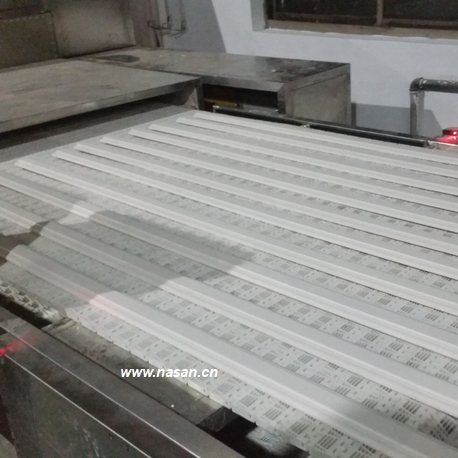
A7: Yes. Nasan manufactures continuous vacuum
microwave belt dryers where product moves on a PTFE belt through
multiple vacuum zones with magnetron arrays above and below. These systems
handle 200–1500 kg/hour, used for instant rice, fruit slices, and chemical
powders. Continuous systems require higher capital investment but lower labor
cost per kg.
Need Custom-Engineered Microwave Vacuum Drying Equipment? Contact Nasan
Today
Selecting the right microwave vacuum
drying equipment requires dielectric property analysis, throughput
modeling, and safety integration. Nasan provides free material
testing, process scale-up services, and turnkey installation with training. Send
your product specifications (name, initial moisture, target moisture, batch size
per hour, and any solvent content) to receive a detailed proposal including
drying curves, energy consumption estimate, and layout drawing. All inquiries
receive a response within 48 hours.
Request your inquiry now → Visit https://www.nasandry.com/ or email
info@nasandry.com. For urgent inquiries, include your phone number and
preferred contact time.