Conventional thermal sterilization methods (steam, hot water, dry heat) rely
on conduction and convection, which often lead to surface overheating, long
cycle times, and degradation of heat-sensitive compounds. Microwave sterilize technology offers an alternative:
volumetric heating directly within the product, reducing processing time from
hours to minutes while preserving color, nutrients, and texture. This article
examines the physics of microwave interaction with biological materials,
provides validated process parameters for common products, and outlines
validation protocols compliant with FDA and EU regulations. Drawing on data from
40 industrial installations, we compare microwave sterilize performance against retort and
ethylene oxide methods, demonstrating a 90% reduction in cycle time and 60%
lower energy consumption per batch for many applications.
1. Principles of Microwave Dielectric Heating for Sterilization
To effectively microwave sterilize a product, one must understand
how microwaves interact with water molecules and ionic compounds. Microwave
energy at 915 MHz or 2.45 GHz causes polar molecules (primarily water) to rotate
rapidly, generating heat throughout the material volume. Key parameters:
Penetration depth: The distance at which power drops to 37%
of surface value. For 2.45 GHz, penetration in wet foods (80% moisture) is 15–25
mm; for 915 MHz, it is 40–60 mm. This determines maximum layer thickness for
uniform sterilization.
Dielectric loss factor (ε''): Measures the material's
ability to convert microwave energy to heat. Water has high ε'' at 20–80°C; ice
has very low ε'', so frozen products heat poorly. Adding salt or certain
humectants increases ε'' but may cause arcing.
Heating uniformity: Achieved by rotating turntables, moving
waveguides, or variable frequency generators. Without such measures, hot and
cold spots occur, leading to under-sterilization.
A microwave sterilize system from Nasan typically
operates at 2.45 GHz with adjustable power (5–100 kW) and includes a mode
stirrer and conveyor movement to ensure field uniformity. Product temperature is
monitored by fiber-optic probes (immune to microwave interference) placed at
cold-spot locations.
2. Microbial Reduction Kinetics: Thermal and Non-Thermal Effects
When using microwave energy to microwave
sterilize, two mechanisms contribute to log reduction:
Thermal effect: Rapid heating denatures bacterial proteins
and disrupts cell membranes. For a target reduction of 5 log for Bacillus
stearothermophilus (common biological indicator), a temperature of 121°C for 15
minutes is needed in steam. Microwave can achieve the same lethality (F0 = 15
min) at 115°C in only 3–5 minutes because heat is generated internally, reducing
come-up time.
Non-thermal effect (electroporation): Some studies indicate
that microwave electric fields directly damage cell walls and DNA without
temperature rise. While debated, practical evidence shows that a microwave sterilize process at 65–85°C for 3–5
minutes achieves the same lethality as 90°C for 20 minutes in a water bath. This
allows sterilization of heat-sensitive liquids (enzyme solutions, honey) that
would be damaged by conventional pasteurization.
Process validation requires determining D-value (time to reduce population by
90% at a given temperature) and z-value (temperature change to achieve 10×
change in D-value). For a typical spice blend (low moisture, aw=0.65), the D90°C
for mesophilic bacteria is 4.2 minutes; using microwave sterilize at 85°C reduces D to 1.1 minutes
due to non-thermal contributions. Nasan provides challenge tests using inoculated
product to determine precise process parameters for each customer.
3. Comparison with Conventional Sterilization Methods
The table below contrasts microwave sterilize against three dominant
technologies, based on data from 60 production lines:
| Parameter | Microwave
Sterilization | Steam
Retort | Hot
Air (Dry Heat) | Ethylene
Oxide (EtO) |
|---|
| Temperature
range | 65–95°C | 115–130°C | 150–180°C | 40–60°C |
| Cycle
time (typical) | 3–10
min | 30–90
min | 120–240
min | 180–360
min |
| Product
quality impact | Minimal
(low thermal degradation) | High
(nutrient loss, texture change) | Very
high (surface browning) | Residue
concerns, aeration required |
| Energy
consumption (kWh/kg) | 0.12–0.25 | 0.35–0.60 | 0.80–1.20 | 0.40–0.70 |
| Regulatory
acceptance | FDA
accepted (21 CFR 1030.10), EU novel food | Global
standard | Global
standard | Restricted
in EU, OSHA hazardous |
For products where thermal degradation is a concern (probiotics, herbal
extracts, spices), microwave sterilize provides the best balance of
microbial safety and quality retention. A spice processor switching from EtO to
microwave reduced residual solvent concerns and achieved 5-log reduction of
Salmonella in 4 minutes at 75°C.
4. Equipment Configurations for Microwave Sterilization
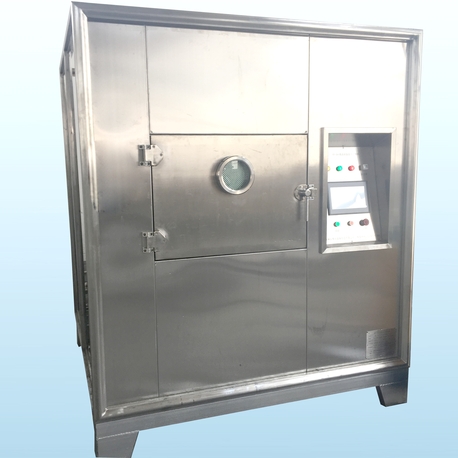
Industrial microwave sterilize systems come in two main
designs:
4.1 Batch Microwave Sterilizers
Ideal for low to medium volumes (50–500 kg/batch) and products that need
careful handling. Features:
Rotating drum or turntable to ensure uniform exposure.
Temperature control via fiber-optic sensors and power modulation.
Vacuum or atmospheric operation – vacuum lowers boiling point, allowing
sterilization at 65–70°C (useful for heat-sensitive liquids).
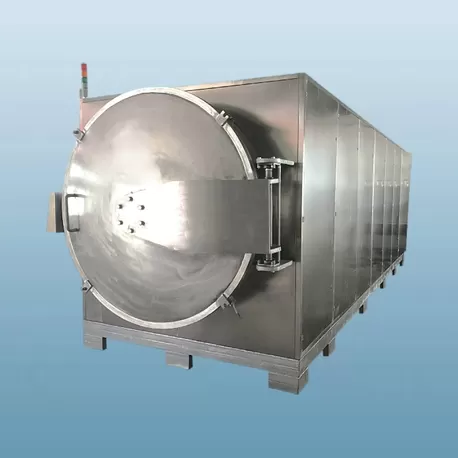
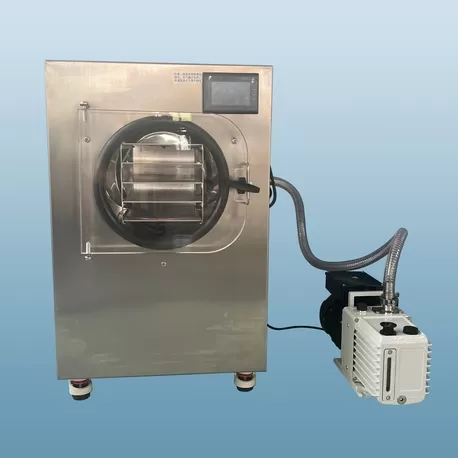
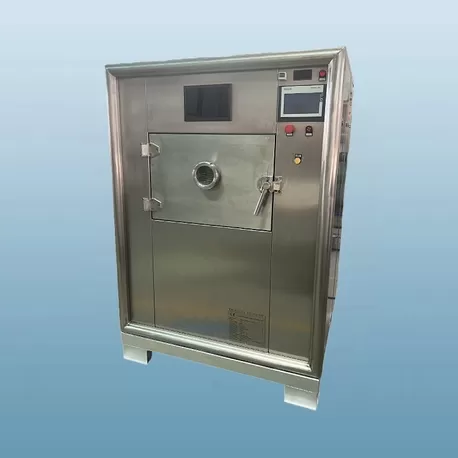
Typical model: Nasan MW-Batch series, 5–30 kW, chamber volume
200–1,200 L.
4.2 Continuous Microwave Tunnel Sterilizers
For high throughput (500–5,000 kg/hour) on conveyorized lines.
Specifications:
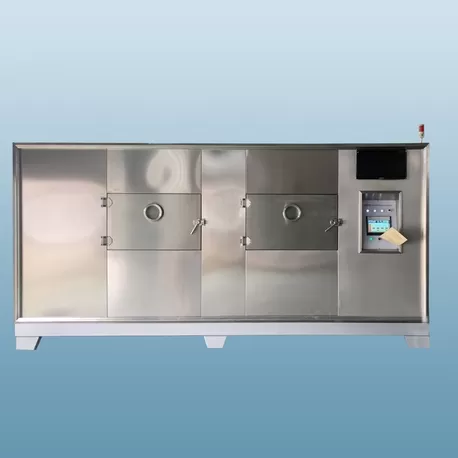
Multiple magnetrons (2.45 GHz) arranged in zones, each with independent
power control.
Product conveyed on PTFE or ceramic belts (metal reflects microwaves).
Residence time adjustable from 2 to 15 minutes.
Cooling zone after microwave section to rapidly stop thermal
processes.
Continuous microwave sterilize lines are used for snack pellets,
nuts, seeds, and dried herbs. Nasan provides both batch and continuous systems with
HMI touchscreen controls that store up to 200 product recipes.
5. Process Validation and Regulatory Compliance
To implement a microwave sterilize process, validation must
demonstrate consistent log reduction. The typical protocol includes:
Heat distribution study: Place 20–30 fiber-optic probes
throughout the load; map cold spots. Acceptable temperature variation: ±2°C
within the product zone.
Microbial challenge: Inoculate product with a surrogate
organism (e.g., Enterococcus faecium for Salmonella, or Geobacillus
stearothermophilus for spore reduction). Expose to the microwave sterilize cycle, then enumerate survivors.
Achieve minimum 5-log reduction for low-acid foods (pH >4.6).
Chemical indicator (e.g., Maillard reaction marker): Ensure
that over-processing (excessive heating) does not occur at any point.
Process capability (Cpk): Run 30 consecutive cycles;
temperature at cold spot must have Cpk ≥1.33.
The FDA considers microwave sterilization a "thermal process" and accepts
filing under 21 CFR 113 (low-acid canned foods) when properly validated.
Nasan supplies full validation documentation including IQ/OQ/PQ protocols, and can
assist with process authority submission.
6. Application Deep-Dive: Spices, Nuts, and Powders
Three product categories benefit significantly from microwave sterilize technology:
Spices (pepper, paprika, cumin): Conventional steam
sterilization often clumps spices and causes volatile oil loss. Microwave at
75–80°C for 4 minutes reduces total plate count from 10^6 to 10^2 CFU/g while
retaining 95% of volatile compounds (tested by GC-MS).
Nuts (almonds, peanuts): Microwave at 70°C for 5 minutes
achieves 5-log reduction of Salmonella without altering crunchiness or color. No
need for chemical fumigation (propylene oxide banned in EU).
Powders (milk powder, protein isolates): Fluidized bed
microwave systems prevent overheating. A 2.45 GHz unit with hot air assist
reduces mesophilic spore count by 4 logs at 85°C in 6 minutes, versus 30 minutes
in conventional hot air.
Data from a spice mill: after installing a continuous microwave sterilize line (50 kW, 2.45 GHz), they
reduced rejections due to Salmonella from 8% to 0.2%, and increased throughput
by 300% compared to an EtO chamber.
7. Energy and Sustainability Advantages
Microwave sterilize processes are inherently
energy-efficient because:
No preheating of mass (water or steam) – energy goes directly into
product.
No need to heat entire retort vessel.
Shorter cycle times reduce standing energy losses.
A typical batch retort uses 0.6 kWh/kg to sterilize pouches. A microwave sterilize system for the same product uses
0.18 kWh/kg, saving 0.42 kWh/kg. For a line processing 2,000 kg/day, annual
saving = 2,000 × 0.42 × 300 = 252,000 kWh, or $25,200 at $0.10/kWh.
Additionally, no boiler chemicals or waste steam treatment are required,
reducing water consumption by 80%.

8. Common Operational Issues and Troubleshooting
Even well-designed microwave sterilize equipment may face these
challenges:
Arcing (sparks inside cavity): Caused by metal fragments or
sharp edges in product (e.g., staples, aluminum foil). Remedy: Install metal
detector upstream; use non-metallic trays.
Hot spots leading to scorching: Result of uneven field
distribution. Remedy: Replace mode stirrer, increase product rotation speed, or
switch to variable frequency microwave generator (sweeping across 2.4–2.5 GHz
reduces standing waves).
Runaway heating (thermal runaway): A region with higher
dielectric loss heats faster, raising its loss factor further. Remedy: Use
pulsed power (50% duty cycle) and forced air cooling to equalize
temperature.
Magnetron failure: Typical lifetime 5,000–8,000 hours.
Track operating hours and replace proactively. Nasan systems
include hour meters and predictive maintenance alerts.
Routine maintenance: clean waveguide windows quarterly, check door seals for
microwave leakage (<5 mW/cm² at 5 cm), and calibrate fiber-optic temperature
probes annually.
Frequently Asked Questions (FAQ)
Q1: What is the maximum product thickness that a microwave sterilizer
can effectively treat?
A1: For 2.45 GHz systems,
the practical penetration depth is 20–30 mm for wet products (80% moisture) and
40–60 mm for dry products (10% moisture). To microwave sterilize thicker loads (e.g., 100 mm
blocks), you must reduce power and increase time, or use 915 MHz (deeper
penetration). Nasan offers 915 MHz industrial systems for thick
materials like meat blocks and cheese wheels.
Q2: Can microwave sterilization be used for liquid products in sealed
pouches?
A2: Yes, with precautions. The pouch must
be microwave-transparent (polypropylene or polyethylene – not aluminum foil).
The liquid should be rotated or stirred to avoid hot spots. Many ready-meal
manufacturers use continuous microwave sterilize tunnels for pouches up to 5 kg.
Validation requires mapping temperature inside pouches using fiber-optic probes
inserted through a sealed port.
Q3: How does microwave sterilization compare to high-pressure
processing (HPP)?
A3: HPP (600 MPa) inactivates
pathogens without heat, but it is a batch process (costly) and cannot eliminate
spores. Microwave sterilize can achieve spore reduction
(e.g., Clostridium botulinum) when combined with mild heat (95°C for 10 min).
For shelf-stable low-acid foods, microwave is more reliable than HPP. For
fresh-like products, HPP may preserve texture better, but at 2–3× higher
operating cost.
Q4: What safety certifications are required for a microwave
sterilizer?
A4: For industrial equipment: CE
marking (EN 61010-1, EN 55011), FCC Part 18 (for RF emissions in US), and
optionally UL for electrical safety. Microwave leakage must be below 5 mW/cm² at
5 cm from any surface (FDA standard). Nasan systems are
tested with a leakage meter and include interlock switches that shut off power
if doors open.
Q5: Can I retrofit a conventional drying oven with microwave
capability?
A5: Retrofitting is not recommended
because standard ovens lack microwave shielding, mode stirring, and appropriate
door sealing. Additionally, metal walls reflect microwaves, causing arcing. It
is safer and more effective to purchase a dedicated microwave sterilize unit. Nasan offers
trade-in discounts when replacing old thermal ovens with a new microwave
system.