For production managers and process engineers evaluating advanced dehydration
technologies, the microwave dryer
machine represents a departure from conventional thermal
processing. Unlike convective or conductive systems that rely on surface heat
transfer, microwave drying applies volumetric heating through dielectric
excitation. This article provides a quantitative examination of the technology,
operational parameters, material-specific outcomes, and economic justification
for upgrading to industrial microwave-based lines. Drawing from field data and
Nasan installations across multiple continents, we address the engineering realities
that determine success or failure in continuous drying operations.

At its core, a microwave dryer
machine converts electrical energy into high-frequency
electromagnetic radiation, typically at 915 MHz or 2.45 GHz, depending on
penetration depth requirements. The material placed inside the applicator cavity
interacts with the alternating field: polar molecules (primarily water) attempt
to align with the rapidly reversing field, generating molecular friction and
instantaneous heat throughout the product volume. This differs fundamentally
from hot air drying, where heat must diffuse from the surface inward, creating
thermal gradients and limiting drying rates.
Key engineering parameters include:
Penetration depth – inversely related to frequency and
moisture content; for wet materials at 2.45 GHz, depth ranges 15–30 mm, while
915 MHz reaches 60–100 mm, suitable for thicker loads.
Power density – typically 0.5–2 W/cm³ in continuous tunnel
designs; higher densities accelerate evaporation but require precise feed rate
control to avoid thermal runaway.
Reflection coefficient (VSWR) – industrial systems maintain
<1.3:1 across load variations using circulators and water loads.
These parameters are integrated into control algorithms that adjust magnetron
output based on real-time dielectric property
feedback and exhaust temperature profiles. Without such closed-loop
regulation, non-uniform heating leads to product scorching or residual moisture
pockets.
2. Comparative Process Analysis: Microwave vs. Conventional Drying
Technologies
Facility managers often request a side-by-side quantification. Below is a
data-based comparison across four critical metrics, using a continuous
microwave dryer
machine against a multi-stage hot air conveyor dryer for identical
carrot dice (initial moisture 88% to 12%):
Drying time – Microwave: 12 minutes; Hot air (80°C): 210
minutes. Reduction factor of 17.5x.
Specific energy consumption – Microwave: 1.25 kWh/kg water
removed; Hot air: 3.7 kWh/kg (including fan power).
Vitamin C retention – Microwave: 83%; Hot air: 41% due to
prolonged exposure to elevated temperatures.
Floor space – Microwave tunnel: 8 meters (for 500 kg/h
throughput); Hot air dryer: 22 meters.
Vacuum drying, while preserving heat-sensitive compounds, operates batch-wise
and requires vacuum pumps that increase maintenance intervals. Freeze drying
yields superior texture but at 5–10 times the capital and operating cost of
microwave systems. Therefore, for high-volume industrial dehydration where
speed, energy efficiency, and nutrient retention intersect, the microwave route
offers a balanced value proposition.
3. Industry-Specific Implementations and Technical Solutions to Common Pain
Points
Different sectors encounter distinct challenges when adopting microwave
drying. The following section maps typical pain points to engineered
countermeasures, based on Nasan commissioning records across 40+ installations.
3.1 Food Processing – Even Moisture Removal in Thick Products
Problem: Meat jerky, fruit slices, and vegetable pieces often develop dried
edges and wet centers under hot air. Solution: A microwave dryer
machine with staggered waveguide feed and variable belt speed
creates a uniform field distribution. Post-drying tempering sections allow
moisture equilibration without overheating. At a Southeast Asian fruit
processor, this approach reduced reject rates from 12% to 2.1% on mango
slices.
3.2 Chemical Industry – Solvent Removal and Catalyst Activation
Problem: Conventional drying of precipitated catalysts or pigments causes
surface crusting that traps solvents, requiring extended residence times.
Microwave selective heating targets the solvent (water, ethanol, or acetone)
without overheating the solid matrix. Implementation tips: use continuous microwave tunnel
dryers equipped with explosion-proof sensors and nitrogen purging
for flammable vapors. A European catalyst manufacturer reduced drying cycle from
8 hours (vacuum oven) to 22 minutes with uniform residual solvent below
0.1%.
3.3 Pharmaceutical Herbal Extraction – Pre-Drying for Grinding
Problem: Fresh medicinal herbs (ginseng, chamomile) require rapid drying to
prevent enzymatic degradation. Conventional hot air at 50°C still degrades
20-30% of active compounds. Microwave drying at controlled power (2–3 W/g)
achieves 10% final moisture in 15 minutes while retaining >90% of marker
compounds. Nasan supplies
validated protocols for each botanical, including power ramping curves and load
density limits.
3.4 Wood and Biomass – Pasteurization and Resin Setting
Problem: Wood drying must eliminate insects and fungi without causing surface
checks. Microwave processing heats from inside-out, creating vapor pressure that
expels moisture and kills larvae uniformly. For wood pallet manufacturers, a 30
kW microwave section added before kiln drying reduces overall energy use by 28%
and eliminates chemical fumigation.
4. Operational Safety and Regulatory Compliance for Industrial Microwave
Systems
Concerns about microwave leakage and electromagnetic interference (EMI) are
legitimate. Industrial dryers comply with IEC 60519-6 and FCC/CE limits (leakage
<5 mW/cm² at 5 cm distance). Standard safety features include:
Double-interlocked doors with automatic power cutoff.
Choke tunnels (quarter-wavelength) at inlet/outlet to attenuate
leakage.
Continuous magnetron health monitoring and arc detectors inside
applicator.
Operators require basic training, but no special shielding garments are
necessary when equipment is properly maintained. Industrial drying
systems from certified vendors include yearly leakage verification
as part of service contracts.
Transitioning to microwave drying involves higher initial capital (typically
1.5–2x of a comparable hot air line) but generates rapid payback through energy
savings, reduced floor space, and lower product waste. A realistic model for a
medium-scale food processor (throughput 800 kg/h wet feed) shows:
Capital investment: USD 380,000 for a 120 kW continuous system.
Annual energy cost reduction: USD 72,000 (based on 6,000 operating hours,
electricity $0.12/kWh).
Reduction in product giveaway (rejects): USD 45,000/year.
Labor reduction (one operator vs. three on hot air line): USD
60,000/year.
Total annual savings: USD 177,000 → payback period 2.1 years.
After payback, the remaining 8–10 years of service life (with magnetron
replacement every 20,000 hours) deliver substantial net present value. For
facilities with high-value products (spices, nutraceuticals), the quality
premium further shortens payback.
6. Selection Criteria: Sourcing a Microwave Dryer Machine for Your
Production Line
When evaluating vendors, request the following technical documentation:
Finite element modeling (FEM) of field uniformity inside the drying
cavity.
Power density mapping at different belt loads (measured via infrared
thermography).
Validation test report using your specific material – reputable suppliers
offer free pilot testing.
Mean time between failures (MTBF) data for magnetrons and power
supplies.
Nasan maintains a
fully instrumented laboratory dryer (adjustable from 5 kW to 75 kW) for
customer-specific trials. Over 200 materials have been characterized, resulting
in a proprietary database of dielectric loss tangents and optimal drying curves.
This empirical foundation minimizes scale-up risks.
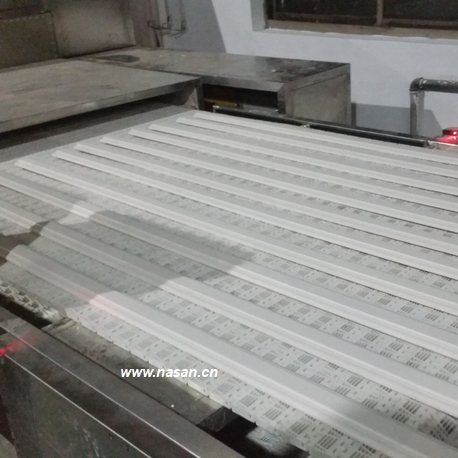
7. Frequently Asked Questions About Microwave Dryer Technology
Q1: Which materials cannot be processed in a microwave dryer machine?
A1: Metals (cause arcing and damage waveguides), pure liquids with high ionic
conductivity (e.g., concentrated brine – leads to thermal runaway), and
materials with extremely low loss factor (<0.01) like dry Teflon or certain
ceramics, which do not absorb microwaves efficiently. However, most moist
organic materials, hydrates, and many inorganic powders are suitable. A
dielectric property test is recommended for borderline cases.
Q2: How does a microwave dryer handle products with variable moisture
content?
A2: Industrial systems integrate multi-zone power control and online moisture
sensors (NIR or capacitance). The control algorithm dynamically adjusts
magnetron output per zone, preventing over-drying of dry spots or under-drying
of wet spots. For example, Nasan's adaptive drying
controllers sample 120 times per second and modulate each 15 kW
generator independently.
Q3: What is the typical maintenance schedule for a microwave dryer
machine?
A3: Routine maintenance includes monthly cleaning of waveguide windows and
air filters, quarterly inspection of high-voltage capacitors and diode stacks,
and annual replacement of magnetron cooling fans. Magnetrons themselves have a
rated life of 15,000–20,000 hours (2-3 years of continuous operation). Belt
tracking and drive motor lubrication follow standard conveyor practices. With
proper upkeep, the structural life exceeds 15 years.
Q4: Can a microwave dryer be retrofitted into an existing hot air line?
A4: Yes, many clients insert a microwave module between the pre-dryer and
final cooler. The standard approach is to remove a 6-8 meter section of the
existing hot air conveyor and install a tunnel microwave dryer. Integration
requires matching belt speed and height. Nasan provides retrofitting kits
including transition chokes and PLC integration bridges. Payback for retrofits
is often under 18 months due to lower installation costs.
Q5: What certifications should an industrial microwave dryer have for
export?
A5: For North America, UL 61010-1 or CSA C22.2; for Europe, CE marking with
EN 55011 (EMC) and EN 61000-3-2 (harmonics); for global food contact, FDA 21 CFR
1030.10 (microwave safety). Additionally, hygienic design should meet EHEDG
guidelines if used for dairy or meat. Nasan units are certified for all major
markets, and documentation is provided per shipment.
Q6: Does microwave drying cause nutrient loss in food products?
A6: Compared to hot air or freeze drying, microwave processing consistently
shows superior retention of thermolabile vitamins (B, C) and polyphenols due to
short processing times and lower bulk temperature. For example, broccoli dried
in a microwave dryer machine retained 89% of its total phenolic content versus
63% in hot air. However, excessive power density (above 10 W/g) can cause local
hotspots; thus correct parameter selection is vital.
8. Conclusion and Engineering Recommendation
The transition from convective to microwave drying is not a universal
solution but a targeted upgrade for operations where speed, energy efficiency,
and product quality are constrained by conventional technology. Materials with
high value density, moisture content above 40%, or heat-sensitive compounds
offer the strongest economic case. Proper implementation requires a partner with
demonstrable field expertise, pilot testing capabilities, and post-installation
process support.
For production teams seeking to evaluate whether a microwave dryer
machine aligns with their throughput and quality targets, Nasan
provides no-obligation material testing and a detailed ROI projection based on
your utility rates and product specifications. Our engineering team works with
you to define the optimal power configuration, safety interlocks, and control
strategy.
Ready
to move beyond conventional drying limitations? Send an inquiry to our process
engineers – include your material type, target moisture, and hourly throughput.
We will respond with a preliminary system design and commercial proposal within
3 business days.
Click here to submit your drying
project inquiry →
Or contact directly: info@nasandry.com – reference
“Microwave Dryer Analysis” for priority handling.