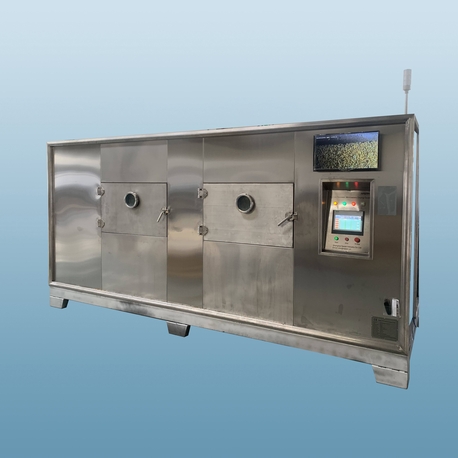
For commercial grain operations, the corn dryer represents the single most critical piece of post-harvest equipment. Corn
harvested at moisture levels between 20% and 30% must be rapidly and uniformly
reduced to 15% or lower to prevent spoilage, preserve test weight, and secure
optimal market pricing. Yet, the choice of drying technology—whether mixed-flow,
cross-flow, or tower systems—directly impacts fuel consumption, kernel stress
cracking, and overall throughput. Drawing on decades of field data and
engineering principles from manufacturers like Nasan,
this analysis outlines six performance metrics that procurement managers and
elevator operators should prioritize when selecting or upgrading a corn drying
system.

1. Defining the Modern Corn Dryer: Beyond Simple Moisture Removal
A corn dryer today is
a precision thermal processing system designed to balance throughput with
quality retention. Its core functions have expanded to include:
Test weight preservation: Minimizing thermal damage that
reduces kernel density and market grade.
Stress crack control: Limiting internal fissures that lead
to breakage during handling and reduce ethanol yield.
Energy optimization: Incorporating heat recovery and
variable-speed fans to cut fuel usage by 20–35% compared to legacy units.
Mycotoxin mitigation: Rapid drying that prevents the growth
of aflatoxin and fumonisin during the critical 24–48 hours
post-harvest.
These requirements are governed by standards such as ASABE S448.2 (Thin-Layer
Drying of Grains) and ISO 11520, which define testing protocols for moisture
removal rates and energy efficiency. Adherence to these standards is a baseline
indicator of a credible equipment supplier.
2. Dryer Architecture: Mixed-Flow vs. Cross-Flow vs. Tower Systems
The internal configuration of a corn dryer fundamentally determines its suitability for high-volume corn drying.
2.1 Mixed-Flow Dryers
Mixed-flow dryers employ alternating rows of air inlet and exhaust ducts,
allowing heated air to pass through the grain column from multiple directions.
Advantages for corn include:
Uniform temperature distribution, reducing the risk of over-drying kernels
near the heat source.
Lower specific energy consumption (typically 3,800–4,200 kJ/kg water
removed) compared to cross-flow designs.
Gentler handling, making them the preferred choice for seed corn and
high-value specialty varieties.
2.2 Cross-Flow Dryers
Cross-flow dryers push heated air perpendicular to the grain flow, creating a
temperature gradient across the column. While they offer lower initial capital
cost, they require careful management of plenum temperatures to avoid overdrying
the grain adjacent to the heat source. Modern cross-flow units incorporate
staged heating and variable-frequency drives to mitigate these effects.
2.3 Tower Dryers (Continuous Flow)
For large-scale commercial elevators handling 1,000+ tons/day, tower dryers
with multiple drying and cooling zones offer the highest throughput. Engineering
focuses on column depth (typically 1.5–3.0 meters) and residence time control.
Nasan offers modular tower systems
with adjustable drying zone lengths, allowing operators to match energy input to
incoming moisture levels—a feature that reduces waste during variable harvest
conditions.
3. Energy Efficiency Metrics: kJ/kg Water Removed and Heat Recovery
Energy consumption represents 60–70% of the operating cost of any corn
dryer. Two key performance indicators dominate procurement
decisions:
Specific Energy Consumption (SEC): The total energy (kJ)
required to remove 1 kg of water. Leading corn dryers achieve SEC values between
3,500 and 4,200 kJ/kg. Poorly designed units often exceed 5,500 kJ/kg,
representing a 30–40% cost penalty over a single drying season.
Heat Recovery Efficiency: Modern dryers recapture waste
heat from exhaust air using air-to-air heat exchangers or recirculation ducts.
Systems with 20–30% heat recovery can reduce propane or natural gas consumption
by 15–25% annually.
Operators should request SEC testing documentation conducted under
standardized conditions (e.g., ASABE EP433). Additionally, variable-frequency
drives on fans and plenum dampers allow precise airflow adjustment, preventing
the common inefficiency of over-ventilation during low-moisture corn runs.
4. Moisture Uniformity and Stress Crack Prevention
Non-uniform moisture distribution within a batch leads to spoilage during
storage. A corn dryer must
achieve moisture variation of less than 1% across the entire column. Key
engineering factors include:
Plenum Air Distribution: Computational fluid dynamics (CFD)
modeling is now used to design ducting that maintains air velocity within ±5%
across all drying zones.
Temperature Control Precision: Modulating burners maintain
plenum temperature within ±2°C of setpoint, preventing scorching or
under-drying.
Residence Time Control: For continuous-flow dryers,
discharge mechanism design (e.g., variable-speed rotary valves) ensures that
corn moves through each zone at a consistent rate, avoiding “fingering” where
some columns empty faster than others.
Stress cracks in corn kernels occur when the internal moisture gradient
creates tensile stress exceeding kernel strength. Research from the Agricultural
Engineering Journal indicates that limiting drying temperature to ≤110°C for
corn with initial moisture above 20% reduces stress cracks by over 50% compared
to higher-temperature drying. Incorporating a tempering zone—where corn rests
between drying stages—allows moisture gradients to equalize, further reducing
breakage susceptibility.
5. Automation and Sensor Integration
Industry 4.0 has transformed the corn dryer into an
intelligent process node. Advanced systems incorporate:
In-line NIR moisture sensors: Mounted at the dryer inlet
and outlet, these provide real-time moisture data, enabling closed-loop control
of plenum temperature and grain flow rate. Accuracy within ±0.3% moisture is
typical for calibrated systems.
Remote monitoring and diagnostics: Cloud-based platforms
allow operators to monitor dryer performance, receive alerts for deviations, and
adjust setpoints from mobile devices—a feature that has reduced downtime by 30%
in multi-site operations.
Predictive maintenance algorithms: Monitoring fan
vibration, bearing temperatures, and burner flame quality to schedule service
before failures occur.
Nasan integrates these
technologies into a centralized control architecture that also tracks cumulative
energy consumption per batch, providing data for carbon accounting and cost
allocation—increasingly demanded by grain buyers and sustainability
programs.
6. Application-Specific Considerations for High-Moisture Corn
Corn harvested at 25–30% moisture presents unique challenges. A corn
dryer designed for such conditions must address:
High airflow capacity: Removing 0.2–0.3 kg of water per kg
of dry matter requires airflow rates of 1.5–2.5 m³/s per ton to prevent
condensation and microbial growth.
Staged drying with tempering: Multi-pass systems where corn
is partially dried, tempered for 4–8 hours, then dried again to final moisture
reduce energy consumption by 10–15% while improving uniformity.
Fire prevention: High-moisture corn combined with high
plenum temperatures increases fire risk. Modern dryers include flame detection
with automatic gas shutoff, high-temperature limit switches, and overpressure
relief panels for burner boxes.
Data from Midwest elevator operators shows that dryers with dedicated cooling
zones that reduce corn temperature to within 5°C of ambient before binning
reduce in-storage mold growth by over 70% compared to dryers that rely on
ambient air cooling alone.
7. Maintenance Protocols for Long-Term Reliability
Even the most advanced corn dryer requires
disciplined maintenance to achieve its expected 15–20 year lifespan. Critical
procedures include:
Daily inspections: Checking burner flame quality, plenum
temperatures, and auger operation. Listening for abnormal fan or motor
noise.
Weekly cleaning: Removing fines from plenum chambers and
exhaust ducts. Accumulated fines can reduce airflow by 15–25%, significantly
increasing energy consumption and creating fire hazards.
Seasonal overhauls: Replacing wear parts (augers, bearings,
sensors) and calibrating moisture sensors before each harvest.
Nasan offers service contracts
that include annual inspections and spare parts availability, supporting
long-term reliability and minimizing harvest downtime.
Frequently Asked Questions (FAQs) on Corn Dryer Selection and Operation
Q1: What is the optimal drying temperature for
corn?
A1: For corn with initial moisture above 20%,
plenum temperatures of 80–110°C are typical in high-temperature dryers. The
upper range (100–110°C) is suitable for low-moisture (<18%) applications or
when throughput is prioritized. To minimize stress cracks, temperatures should
not exceed 110°C, and a tempering period between drying stages is recommended.
For seed corn, temperatures are limited to 40–50°C to preserve germination
rates.
Q2: How do I calculate the required capacity for a corn
dryer?
A2: Capacity is determined by throughput
(tons/hour) and moisture reduction required. For example, to dry 100 tons/hour
of corn from 25% to 15% moisture (10 points reduction), the dryer must remove 10
tons of water per hour. Using this water removal rate, manufacturers can
recommend a model with the appropriate heat input (kJ/h) and airflow (m³/s). A
common rule of thumb: each 1,000 kJ/s (1 MW) of burner capacity can remove
approximately 0.6–0.8 tons of water per hour under typical conditions.
Q3: What are the signs of an underperforming corn
dryer?
A3: Key indicators include: increased fuel
consumption per ton without a corresponding throughput increase; moisture
variation exceeding 1% across samples from the same batch; frequent plugging of
discharge augers; visible steam or condensation from exhaust stacks (indicating
incomplete heat transfer); and an increase in broken corn and foreign material
(BCFM) percentages. Routine data logging helps identify these trends early.
Q4: Can the same dryer handle both corn and
soybeans?
A4: Yes, with proper configuration.
Soybeans require lower drying temperatures (60–70°C) to prevent oil degradation
and are more sensitive to over-drying. A mixed-flow or tower dryer with
adjustable temperature controls and variable-speed discharge can handle both
crops. However, operators must thoroughly clean the dryer between crops to
prevent cross-contamination and recalibrate moisture sensors for the specific
grain. Manufacturers like Nasan offer dual-purpose models
with quick-change settings.
Q5: How often should a corn dryer be cleaned during
harvest?
A5: Daily visual inspection of plenum
chambers and exhaust ducts is recommended. A full cleaning—including burner
boxes, fans, and drying columns—should occur every 300–500 operating hours or
immediately after completing high-moisture corn runs. Fines accumulation is the
leading cause of dryer fires; maintaining clean surfaces is the single most
effective fire prevention measure.
Q6: What safety features are mandatory in a modern corn
dryer?
A6: Mandatory safety features include: flame
detection with automatic gas shutoff (typically UV or infrared sensors),
high-temperature limit switches that shut down the burner if plenum temperature
exceeds setpoint, overpressure relief panels for burner boxes, and
explosion-proof electrical components in dust-laden areas. Remote monitoring
systems that alert operators to excessive plenum temperatures or fan motor
current spikes provide an additional layer of protection.
Q7: What is the expected lifespan of a commercial corn
dryer?
A7: With proper maintenance, a commercial
corn dryer can operate for 15–25 years. Stainless steel components in the plenum
and drying columns offer the longest life, resisting corrosion from acidic grain
vapors. Regular replacement of wear parts (augers, bearings, sensors) and
adherence to maintenance schedules are critical to achieving maximum lifespan.
Nasan provides service contracts
that include annual inspections and spare parts availability, supporting
long-term reliability.
This analysis is based on ASABE standards, field performance data from
commercial corn drying operations, and engineering practices validated in over
3,000 installations. For specific sizing and configuration recommendations,
consult with experienced manufacturers like Nasan to ensure the drying system
aligns with your harvest volume, climate conditions, and quality
targets.