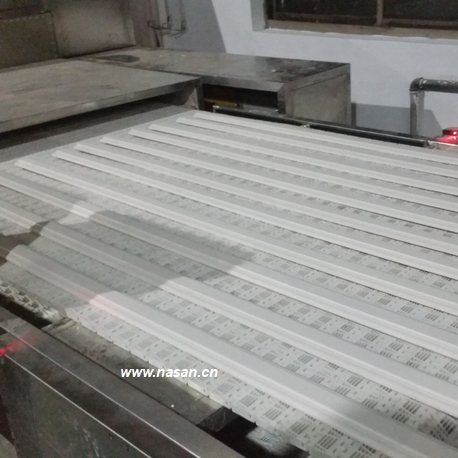


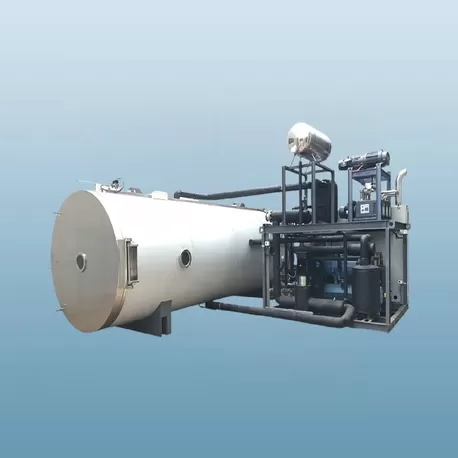

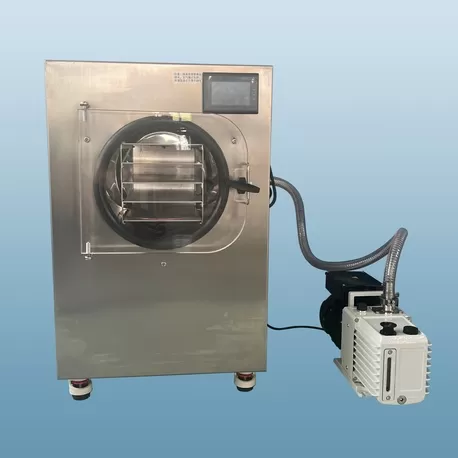
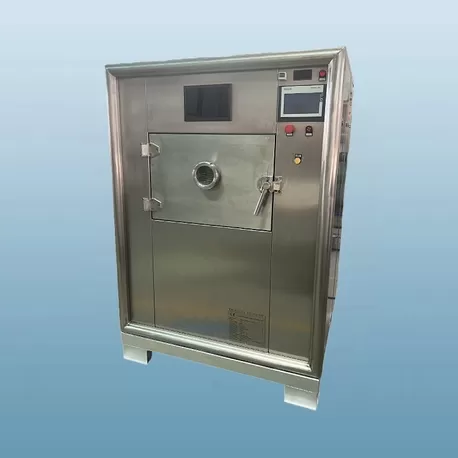
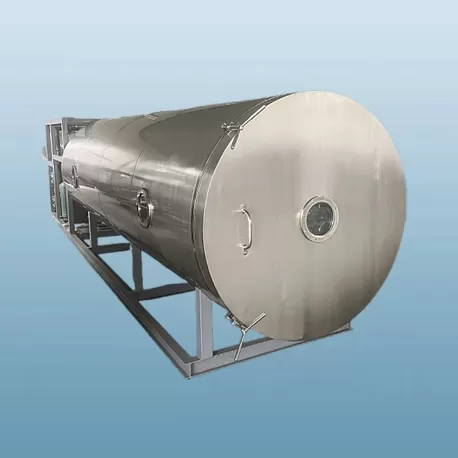
Industrial thermal processing requires a balance between evaporation efficiency and material integrity. Traditional drying methodologies, such as hot-air convection or contact conduction, rely on thermal gradients to drive heat from the outer surface to the wet core of a material. This mechanism is inherently limited by the thermal conductivity of the substance, often resulting in prolonged exposure to high temperatures, surface crusting, and degradation of heat-sensitive compounds. To overcome these thermodynamic limitations, utilizing microwave vacuum principles has become a standard approach for modern industrial drying. Industrial equipment manufactured by Nasan provides precise control over these parameters, offering a solution that addresses the physical limits of traditional systems.

The Physics of Volumetric Dielectric Heating
Understanding this process requires a close look at how electromagnetic energy interacts with matter. Unlike conventional methods where heat is applied externally, microwave energy heats volumetrically. This phenomenon relies on dielectric heating, which occurs when an electromagnetic field penetrates a polar substance.
Water molecules possess a permanent dipole moment due to the electronegativity difference between oxygen and hydrogen atoms. When subjected to high-frequency electromagnetic waves, typically at 2.45 GHz or 915 MHz, these polar molecules continuously realign themselves with the rapidly alternating electric field. This high-frequency rotation generates internal friction and subsequent heat throughout the entire volume of the wet material. The power absorbed per unit volume can be expressed by the following equation:
P = 2 π f ε0 ε″ E2
Where:
P is the power density (W/m³)
f is the frequency of the microwave field (Hz)
ε0 is the permittivity of free space
ε″ is the dielectric loss factor of the material
E is the electric field strength (V/m)
The dielectric loss factor is a key variable. Materials with high loss factors absorb energy rapidly, while dry substances with low loss factors remain unaffected. This characteristic allows for selective heating, where energy is directed specifically to the moisture pockets within the material rather than the surrounding dry matrix.
Thermodynamic Synergy of Low-Pressure Environments
The integration of a low-pressure environment with dielectric heating alters the thermodynamics of evaporation. In a standard atmospheric environment, water evaporates at 100°C. Many heat-sensitive pharmaceuticals, active botanical extracts, and organic polymers degrade at or below this temperature threshold.
By enclosing the drying chamber and reducing the absolute pressure, the boiling point of water is significantly lowered. For instance, at a vacuum level of 40 mbar, water evaporates at approximately 29°C. This pressure reduction allows for rapid moisture volatilization at temperatures that do not compromise the molecular structure of the product. Operating a system that integrates microwave vacuum physics ensures that the latent heat of vaporization is supplied directly by the internal microwave field, preventing the temperature drop that typically stalls conventional vacuum dryers.
Heat and Mass Transfer: Overcoming Case Hardening
In hot-air drying, moisture must migrate from the interior of a solid to the surface via capillary action or diffusion. As the surface dries faster than the core, it shrinks and forms a dense, impermeable outer layer. This phenomenon, known as case hardening, increases internal resistance to mass transfer and slows down the drying cycle.
Volumetric heating reverses the temperature and pressure gradients. Since the interior contains the highest concentration of water, it absorbs more microwave energy and reaches evaporation temperature first. This internal vaporization creates a positive vapor pressure gradient from the core to the outer surface. The vapor is pushed out through the pore structure of the material, preventing the collapse of the cellular matrix. Designing a continuous microwave vacuum system requires careful matching of this vapor discharge rate with the vacuum pump capacity to avoid pressure spikes that could cause structural damage to fragile materials.
Engineering Challenges in High-Vacuum Microwave Fields
While the thermodynamic benefits are clear, implementing these principles in industrial equipment requires precise engineering. A primary concern in low-pressure microwave systems is the occurrence of gas discharge, commonly referred to as plasma arcing.
Preventing Plasma Discharge
At reduced pressures, the mean free path of electrons increases. Under the influence of a strong electric field, these accelerated electrons can ionize residual gas molecules, creating a glowing plasma field. This discharge can damage the product, scorch the material, and erode the internal surfaces of the vacuum chamber. The vacuum design developed by Nasan utilizes advanced waveguide geometries and specialized field-modifying structures to suppress localized electric field concentrations, reducing the likelihood of ionization within the operating vacuum range (typically 20 to 150 mbar).
Achieving Field Uniformity
Microwave fields inside a metal cavity form standing wave patterns, which can lead to localized hot spots and cold spots. To ensure uniform moisture removal across the entire batch or belt width, engineering teams implement several design measures:
Mode Stirrers: Rotating metallic blades that continuously alter the boundary conditions of the cavity, shifting the electromagnetic wave patterns.
Rotary and Conveyor Systems: Moving the material through the electromagnetic field to average out exposure over time.
Multi-Port Feeding: Introducing microwave energy through multiple strategically placed waveguides to achieve a balanced spatial distribution of power.
Material Suitability and Processing Verticals
The physical characteristics of the target material dictate the design parameters of the drying system. For instance, viscous liquids, granular solids, and porous blocks behave differently under microwave radiation. Utilizing the microwave vacuum process allows for precise drying of several high-value material categories:
Active Pharmaceutical Ingredients (APIs) and Bioproducts
Many biochemical structures, such as proteins, enzymes, and specific API formulations, are unstable when exposed to prolonged thermal stress. Traditional freeze-drying (lyophilization) is a common preservation method, but it is energy-intensive and requires long cycle times. Microwave-assisted low-temperature drying offers a continuous, faster alternative by supplying the latent heat of sublimation or evaporation directly to the bound water molecules without raising the product temperature above its denaturation threshold.
Concentrated Botanicals and Phytochemicals
Herbal extracts, nutritional supplements, and natural colorants contain volatile organic compounds and thermally sensitive pigments. Conventional convection drying often leads to oxidation and loss of active ingredients. Low-temperature processing under vacuum minimizes oxidation due to the absence of atmospheric oxygen, while the rapid volumetric heating preserves the original chemical profile and color intensity of the botanical matrix.
System Instrumentation and Process Controls
Industrial drying equipment must provide repeatable, documented outcomes to meet stringent quality standards. This requires real-time monitoring of several interdependent variables:
Product Temperature: Since metal thermocouples cannot be placed directly in a high-frequency microwave field due to arcing hazards, non-contact infrared pyrometers or fiber-optic temperature sensors are integrated to monitor the product surface in real time.
Chamber Pressure: Capacitance manometers are utilized to measure absolute pressure independent of gas composition, ensuring stable vacuum control.
Reflected Power Monitoring: Magnetrons are protected by circulators that redirect reflected microwave energy away from the generator into a water load, protecting the hardware and allowing operators to monitor energy absorption efficiency.
Summary of Process Parameter Selection
Designing an effective industrial drying profile requires matching the physical properties of the wet material with the appropriate machine settings. Below is a general overview of parameter adjustments based on material states:
| Material State | Primary Dielectric Driver | Typical Pressure Range (mbar) | Power Density Strategy |
|---|---|---|---|
| Granular / Powders | Free water in interstitial spaces | 30 - 80 | Medium initial power, stepping down as moisture content drops. |
| High-Viscosity Slurries | Bound water and solvent mixes | 20 - 50 | High initial power to initiate boiling, followed by pulsing to prevent foaming. |
| Porous Solid Blocks | Internal capillary water | 40 - 100 | Low, steady power density to allow moisture migration without internal pressure buildup. |
Determining Feasibility for Commercial Scaling
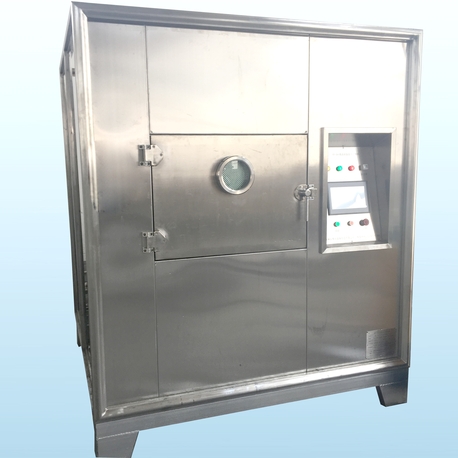
Transitioning from pilot-scale evaluation to continuous commercial processing requires a thorough understanding of the material's dielectric properties throughout the drying cycle. As moisture content decreases, the dielectric loss factor of the material also drops, which naturally reduces the rate of energy absorption. Modern system designs account for this variation by utilizing multi-zone heating chambers where microwave power densities are adjusted progressively along the length of the conveyor path.
For custom engineering and system sizing, Nasan works closely with process engineers to analyze material behavior under varying electromagnetic frequencies and vacuum levels. This analysis ensures the final equipment configuration matches the throughput and quality requirements of the specific production line.
Frequently Asked Questions
Q1: What is the main difference between freeze drying and microwave
vacuum drying?
A1: Freeze drying (lyophilization) relies on
sublimation, transitioning water from a solid ice phase directly to gas under
very low pressures and temperatures. While high in quality, it is slow and
requires significant energy. A microwave
vacuum system operates at slightly higher pressures where water
remains in a liquid state but boils at low temperatures (e.g., 30°C to 45°C). It
delivers energy directly to the water molecules, reducing processing times from
days to hours.
Q2: How is microwave leakage prevented in these industrial
systems?
A2: Microwave containment is managed through structural
design. The processing chambers are constructed of thick-walled stainless steel
that acts as a Faraday cage. At points of material entry and exit (especially in
continuous conveyor systems), specialized wave filters and quarter-wave choke
structures are installed. These components attenuate electromagnetic waves to
levels well below international safety limits, ensuring a safe working
environment.
Q3: Can these systems handle materials containing organic
solvents?
A3: Yes, but the system must be designed with
explosion-proof components and solvent recovery systems. Because solvents have
different dielectric properties and lower boiling points than water, the
condensation systems must be rated for the specific solvent vapors, and the
electrical enclosures must comply with local hazardous area classifications.
Q4: How do changing dielectric properties during drying affect
magnetron performance?
A4: As moisture is removed, the material
absorbs less microwave energy, causing more power to reflect back toward the
magnetrons. To prevent damage, industrial systems use isolators (circulators) to
redirect this reflected energy into water loads. Additionally, modern control
loops automatically decrease magnetron output power as the product reaches its
target dryness.
Q5: What maintenance is required for the vacuum chamber and microwave
components?
A5: Routine maintenance focuses on ensuring vacuum seals
remain airtight, cleaning the microwave-transparent windows that separate the
waveguides from the processing chamber, and monitoring magnetron filament
run-time. Because there are fewer moving parts inside the chamber compared to
conventional rotary drum dryers, mechanical wear is minimized.
Inquire for Custom Engineering Solutions
Selecting the correct industrial drying system requires detailed material characterization and process validation. If you are looking to replace slow thermal processing methods with efficient low-temperature volumetric drying, please submit your product specifications to our engineering team. We provide material testing services to determine dielectric profiles, drying curves, and scale-up parameters tailored to your processing facility. Contact us today to discuss your production requirements.