Drying heat-sensitive industrial materials presents a persistent challenge in
process engineering. Traditional thermal drying methods, such as hot air
convection, rely on conductive or convective heat transfer from the outer
surface of a material to its core. This pathway creates thermal gradients, often
leading to surface hardening, discoloration, and structural degradation of
active compounds. To address these issues, industrial processors deploy advanced
drying configurations that combine electromagnetic energy with reduced
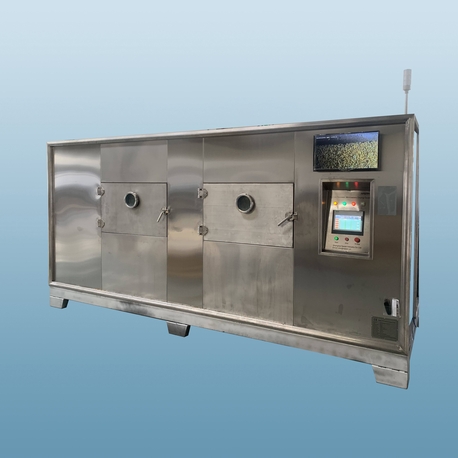
atmospheric pressure. Operating a vacuum microwave
oven changes the thermodynamic environment of the drying chamber,
allowing moisture removal at low temperatures while accelerating mass
transfer.
Fundamental Physics of Low-Pressure Dielectric Heating
The physics of this process rely on two simultaneous phenomena: volumetric
dielectric heating and vacuum-assisted boiling point depression.
The Mechanics of Dielectric Heating
In conventional systems, heat slowly migrates inward while moisture diffuses
outward. Electromagnetic radiation in the microwave spectrum, typically at
frequencies of 2450 MHz or 915 MHz, penetrates the product directly. Polar
molecules, primarily water, align themselves with the rapidly alternating
electric field. This rotational movement generates friction at the molecular
level, causing rapid heat generation throughout the entire volume of the wet
material.
The energy absorption capability of a material is governed by its dielectric
properties, specifically the dielectric constant (which measures the material's
ability to store electromagnetic energy) and the dielectric loss factor (which
measures its ability to dissipate that energy as heat). The penetration depth of
the radiation is mathematically defined to show how the energy decreases as it
travels deeper into the product. Because dry materials have a much lower loss
factor than liquid water, the electromagnetic energy naturally targets areas
with higher moisture concentration. This self-regulating behavior minimizes
localized thermal hotspots once moisture levels decline.
Vaporization and Boiling Point Depression under Vacuum
The thermal behavior of substances within a low-pressure environment is
described by thermodynamic state equations. Under standard atmospheric
conditions, water molecules require substantial thermal energy to overcome
cohesive forces and escape as vapor. By operating a vacuum system to maintain
chamber pressure between 10 mbar and 100 mbar, the boiling point of water drops
to a range of 7°C to 45°C. Consequently, moisture vaporizes at temperatures
close to ambient levels, protecting thermo-sensitive substances from heat
damage.
Overcoming Conventional Drying Limitations
Traditional vacuum shelf dryers require long processing cycles due to the
poor thermal conductivity of dry materials in a vacuum environment. Without air
to conduct heat, energy transfer from heated plates to the product is highly
inefficient. This limitation often causes uneven drying and thermal degradation
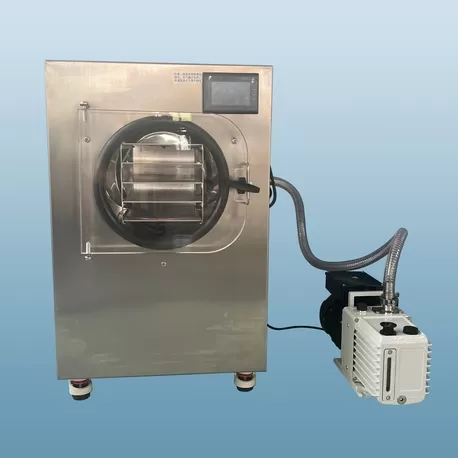
of the product layers closest to the heat source. Freeze drying (lyophilization)
avoids thermal degradation but requires long cycles and substantial electrical
input to maintain sublimation temperatures.
Electromagnetic energy does not rely on gas molecules or physical contact for
heat transfer. The radiation passes through the vacuum space and is absorbed
directly by the moisture remaining within the product. This targeted absorption
prevents case hardening, a common defect where the exterior of a product dries
into an impermeable crust, trapping moisture inside the core. Since the heating
is volumetric, an internal vapor pressure gradient is established, driving
moisture rapidly from the core to the surface.
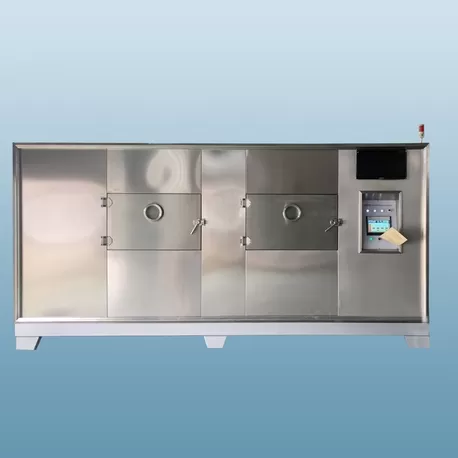
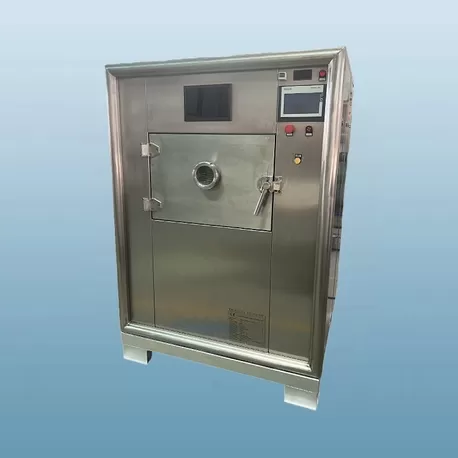
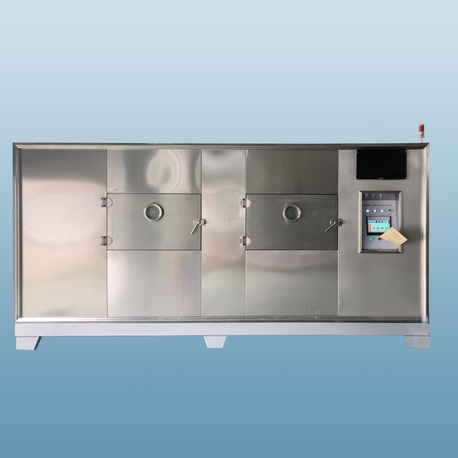
Industrial drying equipment manufactured by Nasan addresses these historical
challenges by coordinating microwave emission patterns with precise pressure
regulations. By maintaining a uniform electromagnetic field inside the chamber,
these systems prevent localized thermal variances and dry the product uniformly
from the inside out.
To maintain uniform performance under industrial conditions, several
subsystems must operate in synchronization:
Magnetron Arrays and Waveguides: Multiple microwave sources
are positioned to distribute electromagnetic fields evenly. Waveguides direct
this energy into the chamber, preventing localized energy concentrations.
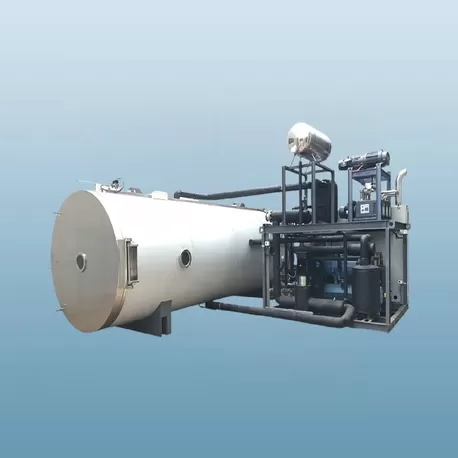
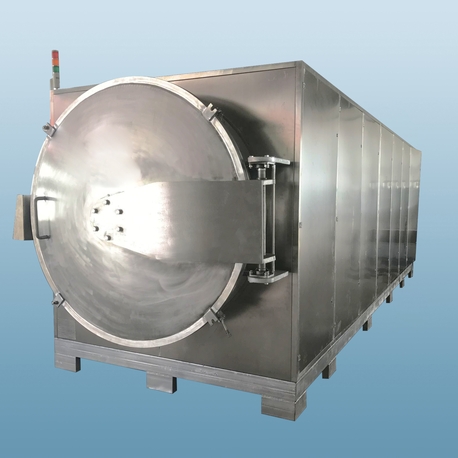
Vacuum Chamber Geometry: The chamber must withstand high
pressure differentials while preventing microwave leakage. Cylindrical or
reinforced rectangular chambers constructed from high-grade stainless steel are
standard.
Impedance Matching: As the moisture content of the material
drops, its dielectric properties change. The system must adapt to these changes
to prevent reflected microwave energy from returning to and damaging the
magnetrons.
Thermal Sensors: Non-contact infrared sensors monitor
surface temperatures in real-time. Because physical probes can act as antennas
in a microwave field, optical fiber sensors are utilized to provide accurate
temperature feedback without field distortion.
Process Parameters and Calibration Strategies
Operational success relies heavily on managing the balance between microwave
power input and vacuum levels. If the power input is too high relative to the
moisture content, localized thermal runaway can occur. Conversely, if the vacuum
level is not sufficient, the internal product temperature will rise above the
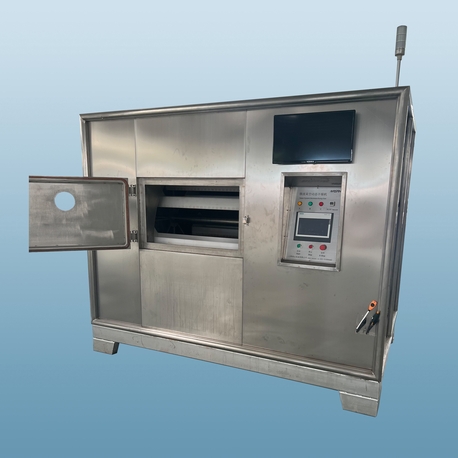
desired threshold. Integrating a vacuum microwave
oven into a production line requires precise calibration of several
key variables:
First, the specific power absorption (measured in kilowatts per kilogram of
wet material) must be adjusted throughout the drying cycle. During the initial
constant-rate drying phase, when moisture is abundant, high power density can be
applied because the energy is quickly consumed by vaporization. As the process
transitions to the falling-rate drying phase, the dielectric loss factor of the
material drops, and the power input must be throttled to prevent overheating the
dry solid matrix.
Second, managing the chamber pressure is vital to avoid plasma ionization.
Under low pressure, the air inside the chamber can ionize, creating a glow
discharge or electric arc. This phenomenon can scorch the product and damage
internal components. Control loops integrated by Nasan continuously adjust the
pressure and microwave pulse width to keep the environment outside the
ionization threshold while maximizing drying efficiency.
Application Profiles across Diversified Industries
Industrial processes across several sectors benefit from this technology:
Pharmaceutical Active Ingredients and Botanical Extractions
Active pharmaceutical ingredients (APIs) and botanical extracts often
decompose at elevated temperatures. Processing in a vacuum microwave
oven ensures that solvents are stripped rapidly without exposing
delicate molecular chains to destructive thermal levels. This is particularly
valuable for recovering high-purity phytomedicines, enzymes, and thermolabile
proteins, where maintaining molecular structure is directly linked to product
efficacy.
High-Value Food Products
Dehydrating fruits, vegetables, and protein-based ingredients using
convective heat often collapses the cellular structure, leading to poor
rehydration properties. Vacuum microwave processing preserves the porous
cellular matrix, resulting in superior texture, color, and nutritional
retention. The rapid vaporization creates a slight puffing effect, which
improves the solubility of powdered food products and the crunchiness of dried
snacks.
Materials Science and Advanced Ceramics
Synthesized polymers, catalysts, and ceramic precursors require uniform
moisture removal to prevent cracking, warping, or internal structural defects.
Volumetric drying ensures that no moisture gradients exist between the core and
the surface of molded components, reducing drying stresses and improving final
mechanical properties.
Frequently Asked Questions
Q1: How does a vacuum microwave
oven differ from a standard vacuum shelf dryer?
A1: A standard vacuum shelf dryer relies on heat conduction from heated
shelves, which is slow in a vacuum due to the absence of air molecules to assist
heat transfer. A vacuum microwave system bypasses this thermal barrier by using
electromagnetic waves to penetrate the material directly, generating volumetric
heat within the moisture itself, which shortens processing times.
Q2: What causes plasma ionization during vacuum microwave drying, and
how is it managed?
A2: Plasma ionization occurs when the electric field intensity exceeds the
dielectric breakdown strength of the rarefied gas inside the vacuum chamber. It
is managed by maintaining chamber pressure above the critical ionization
threshold, pulsing the microwave power, and using specialized waveguide
configurations to distribute electric field intensity more evenly.
Q3: Can these systems process materials containing metallic
particles?
A3: Processing materials with significant metallic content requires specific
chamber designs and specialized material handling systems to prevent electrical
arcing. For small trace elements or materials with low electrical conductivity,
modified electromagnetic profiles are used to ensure safe operation.
Q4: How is uniform heating maintained throughout a dense product
bed?
A4: Uniformity is achieved through a combination of physical product movement
(such as rotary drums or belt conveyor systems), multi-port microwave injection,
and the use of mode stirrers to continuously alter the electromagnetic field
patterns inside the chamber.
Q5: What parameters must be configured during product
testing?
A5: Initial testing focuses on identifying the material's drying curve,
dielectric properties, and temperature sensitivity. Key parameters to configure
include the initial-to-final power-to-mass ratio, the pressure profile, vapor
condensation rates, and material handling speeds.
Process Evaluation and Inquiries
Selecting the correct industrial drying configuration depends on the unique
physical and chemical characteristics of your product. Custom testing and
process calibration are standard steps in determining the optimal power density,
vacuum cycle, and chamber configuration for your production requirements. To
explore how electromagnetic low-pressure drying can be integrated into your
existing processing lines, please contact the engineering team at Nasan to submit a technical
inquiry and schedule a material trial.