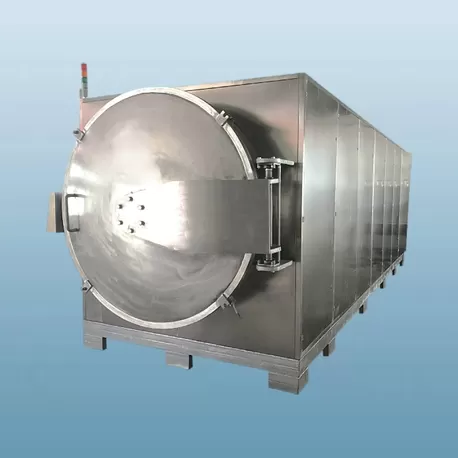
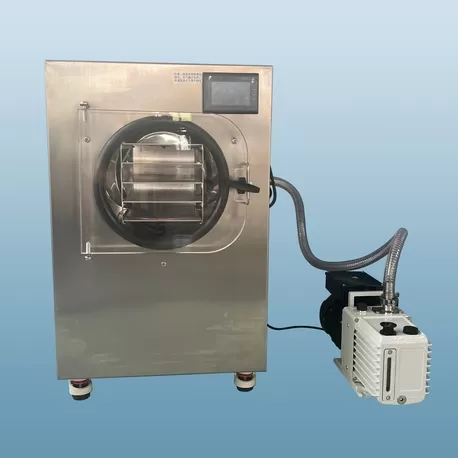
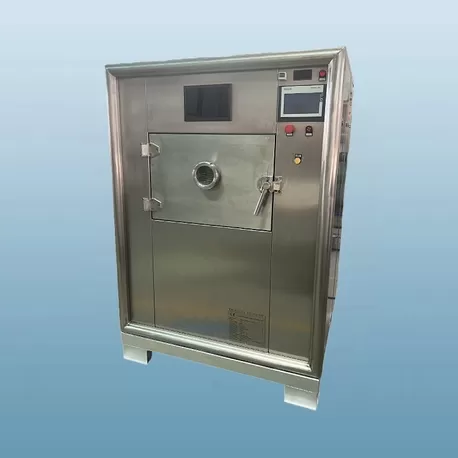
Industrial dehydration requires exact control over heat and mass transfer to preserve the molecular structures of sensitive biologicals, active ingredients, and food products. Traditional lyophilization, while highly effective at maintaining structural integrity, is limited by slow heat transfer rates. In conventional systems, heat must conduct through the dried product layer to reach the sublimation front, creating an operational bottleneck as the dry material acts as a thermal insulator. Integrating microwave radiation directly addresses this physical limitation. The technology of microwave freeze drying provides volumetric heating, generating thermal energy directly within the ice core of the product. This approach bypasses the conductive limitations of the dried layer, reducing sublimation cycles while maintaining low product temperatures. Equipment designs engineered by Nasan demonstrate how precise electromagnetic application under vacuum preserves structural and chemical characteristics in sensitive matrices.

The Physics of Microwave-Assisted Lyophilization
Understanding this process requires examining the interaction between electromagnetic fields and polar molecules under vacuum conditions. Below the triple point of water (611.65 Pa), moisture remains frozen, and sublimation occurs when thermal energy is supplied. Traditional heating relies on conduction from heated shelves or radiation from chamber walls. These methods depend on temperature gradients, which can overheat the outer surfaces of the product before the inner core sublimates.
Volumetric heating changes this dynamic. Microwave energy at industrial frequencies—typically 2.45 GHz or 915 MHz—penetrates the vacuum-frozen matrix. Water molecules, possessing a permanent dipole moment, continuously realign with the alternating electric field. This rotational movement generates friction at the molecular level, converting electromagnetic energy into thermal energy inside the frozen core. Because the heat is generated internally, the sublimation front does not rely on conduction through the dry outer boundary. The power dissipation per unit volume (P) of a material in a microwave field can be calculated using the equation:
P = 2 π f ε₀ ε″ E²
In this equation, f represents the frequency of the microwave radiation, ε₀ is the permittivity of free space, ε″ is the dielectric loss factor of the material, and E is the local electric field strength. Controlling these variables allows operators to match energy input precisely with the latent heat of sublimation.
Dielectric Properties of Frozen Materials
The dielectric properties of the material dictate how effectively it absorbs microwave energy. The dielectric constant (ε′) and the dielectric loss factor (ε″) are the primary parameters of interest. Ice has a much lower dielectric loss factor than liquid water. This difference is structurally significant: frozen water molecules are locked in a crystalline lattice, restricting their rotational mobility in response to high-frequency electromagnetic fields.
Ice absorbs microwave energy relatively slowly. However, as localized sublimation occurs and small amounts of unfrozen water or concentrated solute phases emerge, the dielectric loss factor of these regions increases. If the electric field is not controlled, this can lead to uneven heating, a phenomenon known as runaway heating. Managing the field strength and distribution ensures that energy input matches the sublimation rate, preventing localized melting and subsequent product collapse.
Mass Transfer Under Vacuum Conditions
While heat transfer is accelerated by volumetric heating, mass transfer remains governed by the pressure differential between the sublimation front and the condenser. In a typical freeze-drying chamber, the vacuum pressure must be maintained at a level that facilitates rapid vapor transport without initiating plasma discharge.
During microwave freeze drying, vapor generated within the ice core must escape through the porous dry layer. This creates an internal pressure gradient. If the sublimation rate is too high, the internal vapor pressure can exceed the mechanical strength of the product matrix, leading to structural micro-explosions or puffing. Precise balancing of the microwave power input against the chamber vacuum level is required to maintain a steady vapor flow. Controlling these parameters prevents structural damage while maintaining the sublimation rate.
Industry Challenges in Standard Freeze Drying Operations
Conventional lyophilization suffers from systematic bottlenecks that limit throughput in commercial processing. Understanding these challenges helps illustrate the necessity of alternative heating methods.
- Heat Transfer Resistance: As the drying front recedes, the thickness of the dry layer increases, raising the thermal resistance. To supply enough heat to the sublimation front, operators must raise shelf temperatures, which increases the likelihood of exceeding the collapse temperature of the formulation.
- Extended Cycle Times: Pharmaceutical and high-value food freeze-drying cycles frequently last between 24 and 72 hours. These prolonged operations require continuous utility support, including vacuum pumps and refrigeration systems, which impacts operational scheduling.
- Non-Uniform Drying Profiles: Differences in heat transfer across large shelves can lead to batch heterogeneity. Vials or trays situated near chamber walls may dry faster due to radiative effects, leading to variations in residual moisture content.
- Mass Transfer Limitations in Deep Beds: In bulk processing, thick layers of material present high resistance to vapor escape. This limits the depth of trays used in conventional dryers, restricting total throughput per cycle.
Resolving Processing Bottlenecks with Microwave Fields
Integrating microwave energy directly targets these operational limitations. Because electromagnetic waves propagate through the dried layer without resistance, energy is deposited directly where the sublimation occurs. This maintains a uniform heat distribution across the product volume, eliminating the temperature gradients that cause localized collapse.
By accelerating the sublimation phase, microwave freeze drying reduces drying times by up to 60% to 80% compared to traditional shelf freeze dryers. This reduction allows processing facilities to increase batch frequency and improve manufacturing schedules. Manufacturers like Nasan focus on designing systems that distribute microwave power uniformly across the vacuum chamber, addressing the historical challenge of hot spots and cold spots in electromagnetic drying.
Key Industrial Applications
The adoption of this technology spans several sectors where material structure and active ingredient preservation are paramount.
- Biotechnology and Pharmaceuticals: Proteins, vaccines, and monoclonal antibodies require stabilization for storage. Volumetric heating under vacuum minimizes the thermal stress experienced by these macromolecules during drying.
- High-Value Nutraceuticals: Bioactive compounds, such as probiotics, enzymes, and plant extracts, are sensitive to thermal degradation. Low-temperature sublimation preserves their viability and biological activity.
- Advanced Engineering Materials: Sol-gel synthesis and nanoparticle production utilize sublimation to remove solvents without causing pore collapse or particle agglomeration.
- Specialty Food Ingredients: Marine extracts, freeze-dried coffee concentrates, and functional ingredients benefit from rapid drying that preserves volatile flavor compounds and rehydration properties.
Design and Control Requirements for Microwave Vacuum Systems
Designing an industrial-scale microwave freeze drying system involves resolving several complex physical interactions. A primary concern is the prevention of electric arc discharge, or glow discharge, which occurs readily in low-pressure environments. When the pressure drops below certain thresholds, the ionization potential of the residual gas decreases. If the electric field strength exceeds the breakdown voltage of the gas, plasma is generated, which can damage the product and the equipment.
To avoid this, systems must operate with carefully calculated magnetron configurations, wave guides, and mode stirrers that distribute the electromagnetic field evenly throughout the chamber. The field strength must be kept below the ionization threshold at the operating vacuum pressure. This is achieved by using lower-density microwave inputs distributed across multiple sources rather than a single high-power source.
Temperature monitoring also requires specialized instruments. Traditional thermocouples cannot be used in a microwave field because the metal wires act as antennas, causing localized heating and field distortion. Industrial configurations utilize fiber-optic temperature sensors or infrared thermography to monitor product temperatures in real-time. These sensors provide the feedback data necessary to modulate magnetron power and maintain stable drying profiles throughout the primary and secondary drying phases.
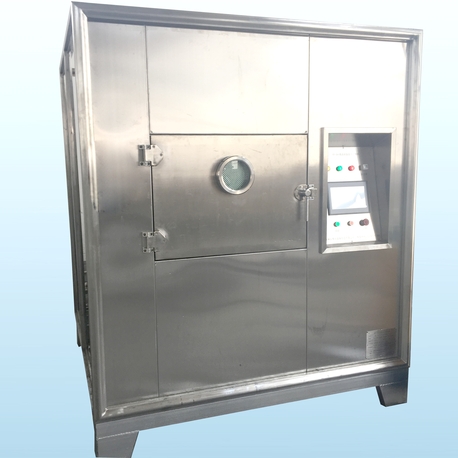
Industrial System Integration and Inquiry
Selecting the appropriate dehydration configuration requires a thorough analysis of product characteristics, dielectric behavior, and processing scale. Nasan designs and manufactures advanced thermal processing systems tailored to meet precise industrial requirements. If your facility seeks to evaluate the integration of microwave freeze drying systems for high-value materials, contact our application engineering team to discuss your process parameters, material specifications, and system sizing. Submit an inquiry today to initiate an engineering consultation.
Frequently Asked Questions
Q1: How does the processing time of microwave freeze drying compare to traditional freeze drying?
A1: Microwave-assisted systems generate thermal energy directly within the product's ice core, bypassing the thermal resistance of the dry layer. This volumetric heating can reduce total drying cycle times by 60% to 80% depending on the material formulation and system configuration.
Q2: What is the cause of plasma discharge in a vacuum microwave system, and how is it managed?
A2: In vacuum environments, low gas pressure reduces the ionization threshold, which can lead to electric arc or plasma discharge if the electromagnetic field is too intense. Systems manage this by distributing microwave field intensity, maintaining vacuum levels within precise operating windows, and utilizing advanced waveguide designs to keep local field strength below the ionization limit.
Q3: Why can conventional temperature sensors not be used in microwave freeze dryers?
A3: Metallic sensors, such as standard thermocouples, act as antennas in a microwave field, absorbing energy, causing localized overheating, and distorting the electromagnetic field. Instead, systems utilize non-metallic fiber-optic sensors or infrared pyrometers to measure product temperatures without interference.
Q4: How does microwave energy affect the biological activity of dried products?
A4: Because the energy is applied under deep vacuum, the sublimation of ice keeps the product temperature low, typically well below its collapse or glass transition temperature. This low-temperature operation preserves the structural integrity of proteins, enzymes, and active ingredients without thermal degradation.
Q5: Can bulk liquid materials be dried using microwave-assisted sublimation?
A5: Yes, bulk liquids can be frozen into cakes or slabs and processed. The volumetric nature of microwave heating is highly effective for thick material beds, as it does not rely on conductive heat transfer through the dried surface layers, which typically limits traditional tray dryers.