For production managers and process engineers working with heat-sensitive
pharmaceuticals, high-value food ingredients, or advanced chemical compounds,
drying represents a persistent quality bottleneck. Conventional hot-air
convection or tray drying often degrades product integrity through prolonged
exposure to elevated temperatures and oxygen. The microwave vacuum
dryer offers a fundamentally different approach—combining volumetric heating
with reduced-pressure environments to remove moisture while preserving molecular
structure. This article examines the operating principles, application
parameters, and selection criteria for this drying technology, drawing on
operational data from industrial installations.

How Microwave Vacuum Drying Differs from Conventional Methods
The distinction lies in the heat transfer mechanism. Traditional dryers rely
on conduction or convection: thermal energy moves from an external heat source
through the material surface inward. This creates temperature gradients, with
the surface drying first while the interior remains wet. Prolonged drying times
and elevated surface temperatures often lead to case hardening, thermal
degradation, or oxidative damage.
Microwave heating inverts this profile. Electromagnetic waves at 915 MHz or
2450 MHz penetrate the material volume, causing polar molecules—primarily
water—to oscillate and generate heat internally. Water evaporates from within
the product matrix, and the vacuum environment lowers the boiling point,
enabling moisture removal at temperatures between 30°C and 60°C. The combination
yields drying cycles that are typically 50–70% shorter than those of vacuum
ovens or fluidized-bed dryers, with substantially improved product
uniformity.
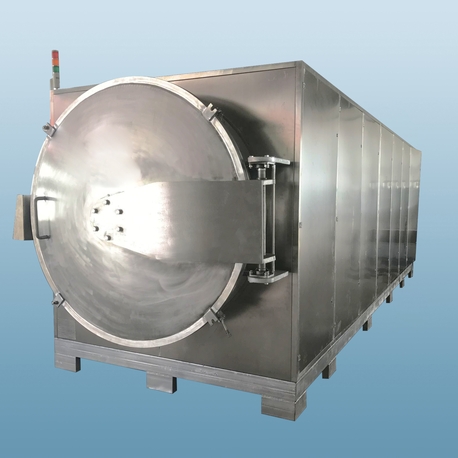
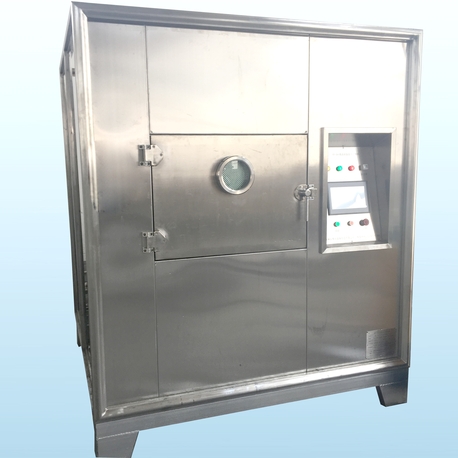
Industrial microwave vacuum
dryer systems integrate several subsystems: a microwave generator
(magnetron), a vacuum chamber with material handling mechanisms, a condenser to
capture evaporated moisture, and control instrumentation for pressure and power
regulation. The chamber design must suppress arcing and standing wave patterns,
which is achieved through mode stirrers and careful geometric configuration.
Primary Applications Across Processing Industries
Microwave vacuum drying finds adoption where product quality
attributes—color, potency, porosity, or bioactivity—are directly tied to drying
conditions. Three sectors account for the majority of industrial
installations.
Pharmaceutical and Nutraceutical Processing
Active pharmaceutical ingredients (APIs) that degrade above 40°C, including
many biologics and botanical extracts.
Probiotic cultures and enzyme preparations where viability depends on low
oxidative stress during drying.
Injectable powder formulations requiring sterile processing and precise
residual moisture specifications (typically <2% w/w).
Herbal extracts and traditional medicine concentrates where color and
volatile active components must be retained.
High-Value Food Ingredients
Fruit and vegetable powders for baby food, smoothie bases, and natural
colorants—where carotenoids and anthocyanins are susceptible to thermal
breakdown.
Instant coffee and tea extracts, where aroma retention directly correlates
with drying temperature and oxygen exposure.
Flavor and fragrance compounds encapsulated in starch or gum matrices,
requiring gentle dehydration to maintain release profiles.
Edible mushroom powders and seaweed derivatives for functional food
applications.
Advanced Materials and Chemicals
Zeolites, silica gels, and metal-organic frameworks (MOFs) where pore
structure determines adsorption performance.
Catalyst supports and ceramic precursors requiring uniform moisture removal
to prevent cracking during sintering.
Polymer beads and resin intermediates where residual solvent levels affect
downstream polymerization.
Nanomaterials and graphene oxide dispersions, where agglomeration during
drying compromises functional properties.
Addressing Industry Pain Points Through Controlled Drying Parameters
Process engineers face recurring challenges with traditional drying
equipment: non-uniform moisture distribution, prolonged cycle times that reduce
throughput, and material degradation that forces rework or grade reduction. The
microwave vacuum
dryer addresses these through precise control of three interdependent
variables.
Vacuum pressure determines the boiling point of water. At 50
mbar, water boils at approximately 33°C, allowing moisture removal at
temperatures that preserve thermolabile compounds. For materials with tightly
bound water, operation at 10–20 mbar reduces the boiling point to 20–25°C,
though pump capacity and seal integrity become more demanding. Pressure control
must respond to the evolving moisture profile—higher vapor loads early in the
cycle require rapid pressure recovery to maintain the target setpoint.
Microwave power density influences heating rate and
temperature distribution. Power levels typically range from 0.5 to 2.0 W/g of
material, with higher densities reducing drying time but increasing the risk of
thermal runaway if moisture removal does not keep pace with energy input.
Advanced systems employ pulsed power delivery or variable frequency operation to
match the dielectric properties of the material as it dries. Real-time
temperature monitoring via fiber-optic sensors provides feedback for closed-loop
control.
Material bed configuration affects the penetration depth and
uniformity of microwave energy. For granular materials, layer thickness should
not exceed two to three times the microwave penetration depth—typically 20–50 mm
for most organic materials at 2450 MHz. Rotary drum designs continuously turn
the material bed, exposing fresh surfaces and preventing localized overheating.
For pastes and viscous suspensions, a thin-film spread or extrusion mechanism
improves exposure.
These parameters are not set-and-forget. Optimal drying requires
understanding the material's dielectric constant and loss factor—properties that
change as moisture content decreases. Process development typically involves a
Design of Experiments (DoE) approach to map the response surface, identifying
the combination that yields the target final moisture with acceptable processing
time and product attributes. For manufacturers handling multiple product
families, equipment with programmable recipe management simplifies
changeovers.
Key Equipment Specifications and Selection Considerations
When evaluating microwave vacuum
dryer systems for a production line, several technical specifications demand
attention. These parameters directly affect throughput, product quality, and
operational reliability.
Chamber volume and material capacity: Laboratory-scale units
handle 5–50 liters, while production systems range from 200 to 2,000 liters. The
working volume should match batch size without excessive headspace, which
reduces energy efficiency. For continuous or semi-continuous operation, look for
systems with vacuum locks or rotary valves for material feeding and
discharge.
Microwave power output: Industrial magnetrons are available
in 6 kW, 10 kW, and 25 kW configurations. Higher power reduces drying time but
requires robust cooling systems (water-cooled magnetrons are preferred for
continuous duty). Total installed power should account for the heat of
vaporization and the material's specific heat capacity—over-sizing leads to
unnecessary capital expense and potential control instability at low loads.
Vacuum system performance: The combination of rotary vane
pumps and roots blowers determines evacuation time and ultimate pressure. For
production applications, a two-stage pumping system with a condenser ahead of
the vacuum pump is standard—this reduces pump oil contamination and recovers
solvents or volatile compounds. Pump displacement should be matched to the vapor
generation rate; under-sizing causes pressure rise that extends drying
cycles.
Control and data acquisition: Modern systems integrate
programmable logic controllers (PLCs) with supervisory control and data
acquisition (SCADA) interfaces. Key parameters—temperature, pressure, microwave
power, and product weight—are logged for batch documentation. For regulated
industries (pharmaceutical, food), 21 CFR Part 11 compliant data recording is
available on systems from established manufacturers. Nasan provides
integrated control platforms that include predefined drying protocols for common
materials, reducing development time for new products.
Construction materials and cleanability: Stainless steel
316L is standard for product-contact surfaces, with electropolished finishes to
prevent product adhesion and facilitate cleaning. For pharmaceutical
applications, sanitary design with radiused corners and CIP (clean-in-place)
capability is required. Vacuum seals and gaskets must withstand repeated thermal
cycling without degradation—fluorocarbon (FKM) and perfluoroelastomer (FFKM)
materials are preferred.
Beyond these technical parameters, manufacturers should consider service
accessibility. Magnetron replacement, vacuum pump maintenance, and seal
inspection should be straightforward without dismantling major assemblies. Nasan equipment
incorporates modular subassemblies to reduce downtime during routine
maintenance, with documented service intervals and spare parts availability.

Operational Considerations for Consistent Production
Transitioning from laboratory trials to full-scale production with a
microwave vacuum dryer requires attention to material handling, process
monitoring, and quality control procedures. Batch-to-batch variation in raw
material moisture content or particle size distribution affects drying
kinetics—implementing incoming material testing and adjusting process parameters
accordingly improves consistency.
Temperature measurement presents particular challenges under microwave and
vacuum conditions. Infrared pyrometers can be used for surface temperature
monitoring, but they do not reflect internal temperatures. Fiber-optic sensors
with gallium arsenide (GaAs) crystals provide accurate internal measurements
without microwave interference. Placing sensors at multiple positions within the
chamber—near the center and near the walls—detects non-uniform heating patterns
that may indicate mode distribution issues.
Moisture determination during drying can be performed by measuring the vapor
pressure in the vacuum line or by using near-infrared (NIR) reflectance probes,
though the latter requires careful calibration for each product matrix. For
critical applications, end-point determination is confirmed by weighing the
batch (if the system includes a load cell) or by in-line sampling for Karl
Fischer titration.
Safety systems are non-negotiable. Microwave leakage detectors, pressure
relief valves, and interlocks that prevent magnetron operation when the chamber
door is open are standard. In addition, oxygen monitoring is recommended for
solvent-containing materials to prevent flammable vapor accumulation. The vacuum
system must include a cold trap or scrubber to protect the pump from corrosive
vapors and prevent environmental release.
Frequently Asked Questions
Q1: What types of materials are unsuitable for microwave vacuum
drying?
A1: Materials with very high dielectric loss factors (e.g.,
certain metal oxides and carbon black) can absorb microwave energy too rapidly,
leading to localized overheating even under vacuum. Materials that produce
volatile corrosive byproducts (such as halogenated solvents) may damage the
chamber and vacuum pump unless specialized construction materials and effluent
treatment are employed. Electrically conductive materials also present arcing
risks.
Q2: How does batch size affect drying performance in a microwave
vacuum dryer?
A2: Batch size influences the ratio of material volume
to chamber volume and the bed depth. For a given microwave power, smaller
batches may dry faster but with less uniform energy distribution unless the load
is sufficient to absorb the available power. Most systems are designed for a
specific working load range—operating below 40% of rated capacity can result in
reflected power and magnetron inefficiency. Scaling should maintain the bed
depth within the specified range for the material's penetration depth.
Q3: Can a microwave vacuum dryer handle materials with high sugar or
fat content?
A3: High-sugar materials (e.g., fruit purees) can
experience localized melting and sticking if the temperature approaches the
glass transition point. This is managed through lower power density and lower
vacuum pressure to maintain temperature below the melting threshold. High-fat
materials have lower dielectric loss factors and may require longer drying
times; adding moisture or using a different frequency (915 MHz) can improve
heating efficiency for such materials.
Q4: What maintenance schedule is recommended for industrial microwave
vacuum dryer systems?
A4: Recommended intervals depend on usage
intensity, but a general schedule includes: daily inspection of door seals and
microwave leakage (<5 mW/cm²); weekly checking of magnetron cooling water
flow and temperature; monthly vacuum pump oil change and filter replacement; and
quarterly calibration of temperature and pressure sensors. Magnetrons typically
require replacement after 5,000–8,000 operating hours, depending on power level
and duty cycle.
Q5: How is the drying endpoint determined without over-drying the
product?
A5: Endpoint determination combines multiple approaches:
(1) monitoring the rate of pressure rise when vacuum pumping is briefly
stopped—a constant pressure indicates no further vapor release; (2) in-line
near-infrared (NIR) measurement of product moisture; (3) load cell weighing to
track mass loss; and (4) temperature profile stabilization. For production, a
combination of rate-of-pressure-rise and time-based overrides is commonly used,
with validation against off-line Karl Fischer measurement.
For processing specifications, equipment sizing, or technical consultation
regarding your specific material and production requirements, contact the
engineering team at Nasan to discuss your application in
detail. Our process development laboratory offers pilot-scale testing to
determine optimal drying parameters before equipment selection, ensuring that
the system configuration matches your throughput and quality targets. Submit your inquiry here to
receive a preliminary assessment and equipment proposal.