The combination of microwave energy with freeze-drying—often referred to as microwave freeze—alters the conventional heat-transfer paradigm. In traditional shelf-based lyophilization, heat conducts from the shelf through the container bottom and frozen layer, creating temperature gradients that limit sublimation rate. Microwave freeze drying applies volumetric heating directly to the frozen matrix, potentially shortening primary drying times by 40–60% while preserving the porous structure of sensitive biological or food materials.
However, the transition from conductive to dielectric heating introduces new process variables: non-uniform electromagnetic field distribution, localized melting risks, and the need for precise power modulation. Equipment designers and production managers must evaluate how microwave frequency, cavity geometry, and load placement affect drying uniformity. This article examines the physical principles, system components, and operational controls that define successful microwave freeze drying implementations.

1. Fundamental Heat Transfer in Microwave-Assisted Sublimation
Freeze drying occurs below the triple point of water, where ice sublimates directly to vapor. The latent heat required for sublimation (approximately 2837 kJ/kg at −40°C) must be supplied continuously to the sublimation front. In conventional freeze drying, heat flows from the heated shelf through the frozen layer to the interface, with the dried porous layer acting as an insulating barrier. As the sublimation front recedes, the dried layer thickness increases, reducing thermal conductivity and slowing the process.
Volumetric Heating Characteristics
Microwave freeze drying reverses this gradient. Microwaves (typically 915 MHz or 2450 MHz) penetrate the frozen product and interact with polar water molecules, generating heat throughout the ice matrix. The resulting temperature profile can be more uniform, provided the field distribution is controlled. Energy absorption depends on the dielectric loss factor of the frozen material, which varies with temperature and ice crystal morphology. For most aqueous solutions, the loss factor increases with temperature, creating a positive feedback loop that requires careful power regulation.
Sublimation Front Dynamics
The position of the sublimation front becomes less dependent on shelf temperature and more on the local electric field strength. This shift allows operators to maintain lower shelf temperatures, reducing the risk of product collapse. Yet, non-uniform field patterns—common in multi-mode cavities—can cause edge overheating or center underheating. Advanced systems employ mode stirrers, rotating turntables, or variable frequency generators to average the field over time.
- Penetration depth: Decreases with increasing frequency and moisture content; 915 MHz offers deeper penetration for larger loads.
- Power density: Recommended between 0.5–2 W/g to avoid exceeding the eutectic temperature.
- Pressure control: Chamber pressure typically maintained between 10–30 Pa to facilitate vapor flow without excessive gas conduction.
2. Equipment Architecture for Microwave Freeze Drying
A microwave freeze drying system integrates a vacuum chamber, microwave source, refrigeration circuit, and vapor condenser. The design must reconcile electromagnetic shielding with vacuum integrity and condensate removal. Each subsystem influences drying performance and product consistency.
Microwave Applicator and Cavity Design
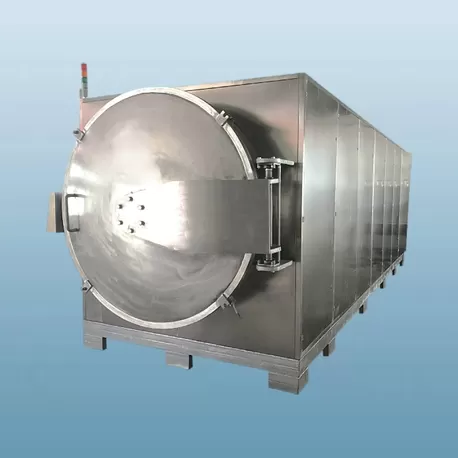
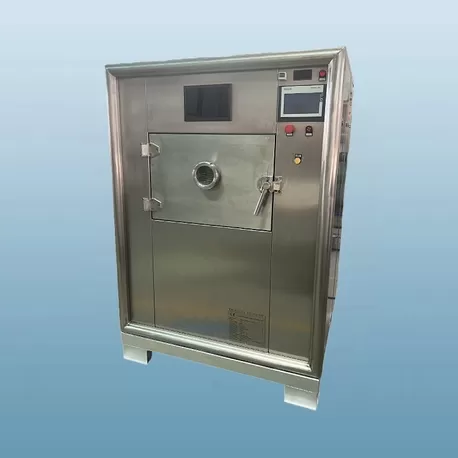
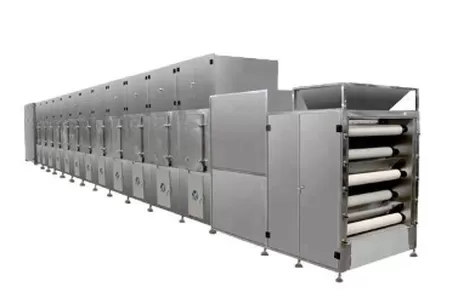
Two common configurations exist: batch cavity systems and continuous tunnel arrangements. Batch cavities, often rectangular or cylindrical, accommodate trays or vials on a rotating carousel. The rotation improves field uniformity by changing the orientation of the product relative to the standing wave pattern. Some manufacturers implement slotted-waveguide antennas or phased-array emitters to shape the field dynamically.
Vacuum and Condenser Integration
The vapor generated during sublimation must be captured by a cold trap (typically −60°C to −80°C) to prevent back-diffusion and maintain chamber pressure. The condenser's surface area and defrost cycle frequency directly affect the system's continuous run time. In microwave freeze drying, the vapor load is often higher per unit time compared to conventional systems, so condenser sizing becomes a critical parameter. Systems that incorporate dual condensers allow alternating defrost without process interruption.
- Microwave window: Quartz or ceramic plates that transmit microwaves while maintaining vacuum sealing.
- Temperature monitoring: Fiber-optic probes or infrared pyrometers that are immune to electromagnetic interference.
- Pressure measurement: Capacitance manometers preferred over thermal-conductivity gauges for accuracy in low-pressure ranges.
3. Product-Specific Behavior and Formulation Adjustments
The response to microwave freeze drying varies significantly with the product's dielectric properties, ice structure, and solute concentration. Materials with high ionic content—such as buffers or salt-containing formulations—absorb microwaves more strongly, increasing the risk of hot spots. Conversely, organic solvents like tert-butanol exhibit lower loss factors, requiring higher power input.
Ice Crystal Size and Sublimation Pathway
The freezing protocol determines the ice crystal network, which affects both the dielectric loss and the permeability of the dried layer. Slow freezing produces larger ice crystals, creating larger pores after sublimation and facilitating vapor escape. This generally improves the efficiency of microwave freeze drying because the dried layer offers less resistance to vapor flow. However, larger crystals may also cause localized variations in permittivity, so a balanced freeze rate is often recommended.
Glass Transition and Collapse Temperature
During microwave freeze drying, the product temperature must stay below the collapse temperature (Tg') of the maximally freeze-concentrated phase. Exceeding Tg' leads to structural collapse, loss of surface area, and poor reconstitution properties. Microwave power must be adjusted in real time to maintain the product temperature within a safe window—typically 2–5°C below Tg'. Some systems incorporate end-point detection using pressure-rise tests or dew-point sensors to automatically reduce power as the sublimation front nears completion.
4. Control Strategies for Uniform Energy Deposition
Uniformity remains the primary challenge in scaling up microwave freeze drying. Unlike small laboratory batches, industrial loads present variable geometry, packing density, and moisture distribution. Control strategies fall into three categories: field engineering, load manipulation, and feedback regulation.
Field Engineering Approaches
- Multi-port feeding with phase-shifted inputs to cancel standing wave nodes.
- Frequency sweeping across a narrow band (e.g., 2400–2500 MHz) to average the field pattern.
- Dielectric loading of cavity corners to absorb reflected power and reduce hotspots.
Load Manipulation
Arranging product containers in a circular pattern on a rotating platform helps each container experience similar average field exposure. For vial arrays, the spacing between vials affects coupling; dense packing increases inter-vial shielding. Some operators use metal ring inserts to modify the boundary conditions and redistribute the field.
Feedback Regulation
Real-time product temperature measurement enables closed-loop power control. A simple on-off controller can cause temperature oscillations, so proportional-integral-derivative (PID) algorithms with feedforward compensation based on chamber pressure are more stable. Advanced systems use model predictive control that anticipates the drying kinetics based on initial moisture and frozen layer thickness.
5. Process Monitoring and End-Point Determination
Determining the exact moment when primary drying concludes is essential to avoid excessive secondary drying or product overheating. In microwave freeze drying, the rate of pressure increase during a temporary isolation valve closure (the manometric temperature measurement method) changes as the sublimation front recedes. However, microwave interference can affect pressure transducer readings, so alternative methods are preferred.
Dielectric Property Tracking
The reflected power (return loss) and phase shift of the microwave signal change as the frozen ice converts to vapor. Monitoring these parameters provides a non-invasive indicator of remaining ice content. When the reflected power stabilizes to a baseline level, primary drying is essentially complete. This method requires calibrated baseline data for each product type.
Condenser Load Rate
The rate of ice accumulation on the condenser—measured by the temperature rise of the refrigerant or by weight sensors—declines sharply at the end of primary drying. Combined with pressure-rise tests, this gives a reliable end-point signal without additional probes inside the chamber.
6. Scale-Up Considerations from Pilot to Production
Translating a successful microwave freeze drying cycle from a 5-liter pilot unit to a 500-liter production system involves more than linear power scaling. The cavity volume increases, leading to more complex field distributions. The number of standing wave nodes grows, and the coupling between adjacent product zones becomes significant.
One practical approach is modular scaling—installing multiple smaller applicators that each handle a portion of the total load, rather than a single large cavity. Each module operates with independent power and vacuum control, allowing parallel processing with better uniformity. This modular design also simplifies maintenance and cleaning. Manufacturers like Nasan have developed modular microwave freeze drying platforms that maintain consistent field patterns across modules, enabling customers to start with one module and add others as throughput demands grow.
Load Density and Tray Configuration
For production trays, the depth of the frozen layer should not exceed 20–25 mm to allow adequate microwave penetration. Deeper layers cause excessive heating near the surface while leaving the center frozen. Multi-layer trays with spacers allow vertical stacking while maintaining uniform field exposure.
7. Integration with Upstream and Downstream Operations
Microwave freeze drying does not operate in isolation. The freezing step—either in a separate freezer or within the same chamber—determines ice morphology. Rapid freezing (at rates > 1°C/min) produces small crystals that may reduce microwave coupling but yield faster rehydration. Conversely, slow freezing improves sublimation efficiency but may cause solute redistribution.
Downstream, the dried product requires packaging under controlled humidity to prevent moisture pickup. The residual moisture content after microwave freeze drying typically ranges from 1–3%, comparable to conventional lyophilization. The shorter cycle time, however, reduces the overall exposure to oxidative degradation, which benefits oxygen-sensitive compounds.
Addressing Common Operational Challenges in Microwave Freeze Drying
Despite its advantages, operators face specific hurdles. Below are typical issues and their practical solutions:
Arcing and Discharge in the Cavity
Metallic particles or rough edges within the chamber can cause electrical arcing when exposed to high-power microwaves. Regular inspection, non-metallic fixturing, and maintaining clean surfaces prevent this. Using vacuum-grade seals that do not outgas also reduces the risk of plasma formation.
Non-uniform Drying Across Trays
As noted earlier, field non-uniformity is the main culprit. Combining rotation, frequency dithering, and variable power ramps often reduces inter-tray variability to within ±5% of the target moisture. Periodic verification with near-infrared (NIR) moisture sensors at multiple tray positions helps quantify the degree of uniformity.
Condenser Overloading
Higher sublimation rates produce a rapid vapor flux that can overwhelm the condenser. Increasing the condenser surface area or using a liquid nitrogen backup for peak loads ensures the pressure stays below the product's eutectic temperature. Some systems include a pre-condenser that catches the initial vapor burst.
Process Optimization Framework
Developing a robust microwave freeze drying cycle follows a structured sequence:
- Step 1 – Dielectric characterization: Measure the complex permittivity of the frozen formulation at the operating frequency over the temperature range of interest.
- Step 2 – Thermal mapping: Place fiber-optic sensors at multiple positions in a test load to record temperature versus time under different power schemes.
- Step 3 – Pressure curve analysis: Conduct runs with varying chamber pressures to find the optimum sublimation rate without exceeding the collapse temperature.
- Step 4 – Scale-up verification: Run full loads with moisture sampling at different tray locations to establish acceptance criteria.
- Step 5 – Cycle parameter documentation: Record power profiles, pressure setpoints, and end-point detection thresholds for batch release.
Nasan offers a comprehensive laboratory service that performs dielectric measurements and pilot-scale trials for customer-specific formulations. This data-driven approach reduces the number of trial runs needed during production scale-up.
Comparing Microwave Freeze Drying to Conventional Shelf Freeze Drying
The primary distinction lies in heat delivery. Shelf freeze drying relies on conduction through the dried layer, which becomes increasingly resistive. Microwave freeze drying bypasses this resistance, but demands more sophisticated power management. Below is a functional comparison based on key process indicators:
- Primary drying time: Microwave systems often achieve 50–70% reduction for materials with high moisture content (e.g., fruits, vegetables) and 30–50% for pharmaceuticals with low solid content.
- Product temperature uniformity: Conventional systems show gradients of 5–10°C across a tray, while microwave systems can achieve ±2°C with active stirring.
- Energy efficiency: Microwave energy converts directly to heat in the product, whereas shelf systems have thermal losses through the heating medium and chamber walls.
- Capital complexity: Microwave systems require additional magnetron cooling, shielding, and field-monitoring hardware, increasing initial investment but often offset by reduced cycle times.
The choice between the two depends on product sensitivity, batch size, and available facility infrastructure. For high-value biologics or heat-labile nutrients, the gentler and faster drying from microwave freeze drying can improve product quality metrics such as viability, potency, and rehydration ratio.
Frequently Asked Questions About Microwave Freeze Drying
Q1: Which products are most suitable for microwave freeze drying?
A1: Materials with moderate to high moisture content and relatively uniform dielectric properties—such as fruits, vegetables, coffee extracts, probiotics, vaccines, and certain therapeutic proteins—benefit the most. Products with high salt concentrations or conductive fillers require careful power profiling to avoid overheating.
Q2: How does microwave freeze drying affect the microstructure of the dried product?
A2: When properly controlled, microwave freeze drying preserves the porous, sponge-like structure characteristic of freeze-dried materials. The volumetric heating reduces the time the product spends in the primary drying phase, which can minimize pore collapse. However, excessive power can cause localized melting, which destroys the microporous network.
Q3: What are the main safety considerations for operating a microwave freeze dryer?
A3: Microwave leakage must be monitored with certified detectors, and interlocks prevent operation when the chamber door is open. Arcing risks require that all internal components are microwave-compatible (non-metallic or properly rounded edges). Personnel should be trained on vacuum system hazards and cryogenic handling if liquid nitrogen is used.
Q4: Can microwave freeze drying be used for continuous production?
A4: Continuous microwave freeze drying systems exist, typically as multi-stage tunnels with separate zones for loading, drying, and unloading. These are more common for food processing (e.g., instant coffee or vegetable pieces). For pharmaceuticals, batch processing remains predominant due to strict regulatory requirements for traceability and batch homogeneity.
Q5: How do you validate a microwave freeze drying cycle for pharmaceutical products?
A5: Validation follows regulatory guidelines (e.g., FDA's process validation guidance). It includes demonstrating temperature uniformity, moisture content consistency, and product stability across multiple batches. Temperature and pressure sensors must be calibrated, and the microwave field distribution must be mapped with a standardized load. Usually, a worst-case load scenario (e.g., full tray count, highest moisture) is tested.
Q6: What is the typical maintenance schedule for a microwave freeze dryer?
A6: Regular checks include magnetron health (output power measurement), waveguide condition, vacuum pump oil changes, and condenser defrost cycles. Microwave seals and window gaskets should be inspected for wear every 500–1000 operating hours. Nasan provides service contracts that include scheduled preventive maintenance and emergency support.
Q7: Can the same microwave freeze dryer process different product types?
A7: Yes, but each product requires its own validated cycle profile. The dryer's control system should store multiple recipes with distinct power ramps, pressure setpoints, and end-point detection thresholds. Changing products may require cleaning the chamber and replacing any product-specific fixtures.
For specific inquiries regarding equipment sizing, cycle development, or to arrange a dielectric evaluation of your product, please contact the engineering team at Nasan. Provide details of your product composition, batch weight, and desired residual moisture to receive a customized feasibility assessment and system recommendation.