


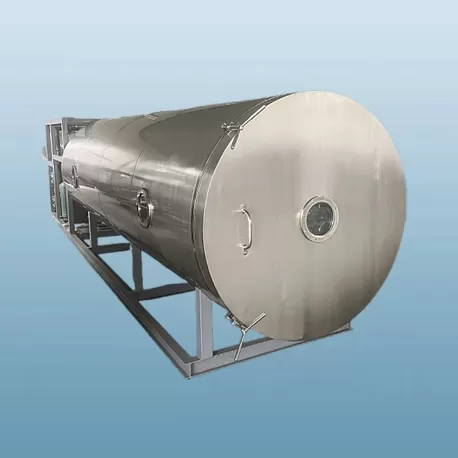
Conventional industrial drying equipment relies on conductive, convective, or radiant heat transfer methods. These traditional thermal techniques transfer energy exclusively from the surface of a material inward, governed by the natural thermal conductivity of the product. This structural mechanism creates distinct operational limits: internal moisture migration often lags far behind surface evaporation rates, causing surface hardening, thermal degradation, structural warping, and high primary energy losses. High-throughput manufacturing environments require thermal methods capable of bypassing external thermal boundary layers to achieve fast, uniform moisture removal throughout the entire bulk volume.
Electromagnetic dielectric heating solves these physics-based bottlenecks. By directly interacting with polar molecules and ionic particles inside the product, direct energy conversion converts high-frequency electromagnetic waves into heat instantly. Integrating a modern industrial microwave oven within a continuous processing line transforms the core thermodynamics of industrial drying, enabling plant operators to expand production capacity, reduce plant footprint requirements, and decrease operational energy inputs.
Electromagnetic Dynamics: Understanding Volumetric Heating Mechanics
The core operation of dielectric processing relies on the interaction between alternating high-frequency electromagnetic fields and the dielectric properties of the processing material. When non-conducting substrates containing polar molecules—primarily liquid water—are exposed to high-frequency electromagnetic fields, two primary mechanisms produce internal heat: dipole rotation and ionic conduction.
Water molecules feature a natural permanent electric dipole moment. Placed within an alternating electromagnetic field, these dipoles continuously attempt to realign with the rapidly reversing field directions. At designated operational frequencies like 2450 MHz or 915 MHz, this directional field flips hundreds of millions to billions of times per second. The phase delay between the rapid field reorientation and the physical movement of the polar molecules generates molecular friction, converting electromagnetic field energy directly into volumetric thermal energy.
At the same time, dissolved ions present within the moist product shift back and forth in response to the changing field polarity. This movement creates resistive electrical losses across the material bed, generating additional heat. The total power absorbed per unit volume ($P$) within the target substrate is governed by the fundamental dielectric equation:
P = 2 * π * f * ε0 * ε'' * |E|²
f represents the applied operating frequency of the electromagnetic field.
ε0 represents the vacuum permittivity constant.
ε'' represents the dielectric loss factor, defining the specific material ability to convert electromagnetic energy into heat.
|E| represents the local electric field intensity within the product volume.
Because thermal energy is generated directly where water is concentrated, the deep interior of the product heats rapidly. This internal vapor generation creates a positive internal pressure gradient, pushing liquid water and water vapor outward toward the surface. Unlike traditional hot-air ovens where surface crusting blocks moisture release, dielectric heating keeps surface pores open, accelerating drying speed without damaging product quality.
Frequency Selection Metrics: 915 MHz versus 2450 MHz System Architecture
System design engineers select operating frequencies based on material bed depth, total throughput specifications, and specific material dielectric characteristics. Industrial standards assign two main frequency bands for high-power processing: 915 MHz and 2450 MHz.
Operating frequency directly impacts field penetration depth ($d_p$), which defines the distance into a material where power density decreases to approximately 37% of its initial surface value. Lower electromagnetic frequencies produce longer wavelengths, allowing energy to penetrate much deeper into thick, dense product beds.
915 MHz Systems: Operating at a long wavelength of roughly 32.7 centimeters, 915 MHz provides deep power penetration. This frequency is ideal for high-density materials, bulk granulates, thick timber, large agrarian yields, and heavy continuous processing lines. Individual high-power magnetron generators operating at 915 MHz deliver outputs from 75 kW to 100 kW per unit, enabling massive processing scale.
2450 MHz Systems: Operating at a wavelength of approximately 12.2 centimeters, 2450 MHz yields shallower field penetration but offers higher localized power conversion rates in thin layers. This frequency excels in processing thin sheets, web materials, extruded snack matrices, small batch trays, and shallow product beds. Individual magnetrons at 2450 MHz typically deliver outputs between 1 kW and 15 kW, permitting granular multi-transmitter field placement.
Configuring a continuous unit to match the precise dielectric properties of a product prevents surface overheating while maintaining steady energy absorption throughout the material layer.
System Architecture: Conveyor Belts and Resonant Cavities
Incorporating electromagnetic processing into continuous production lines requires specialised mechanical engineering designed around material handling requirements and strict radio-frequency safety standards.
Continuous Tunnel Systems
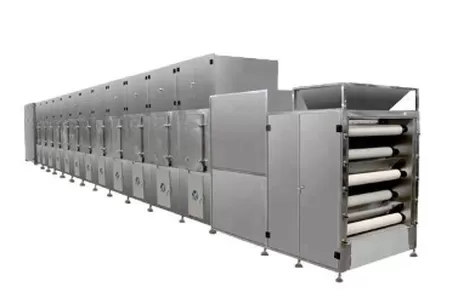
In high-volume manufacturing, continuous processing tunnels utilize a conveyored bed passing through tuned resonant applicator cavities or multi-slot waveguide launcher arrays. Key system components include:
Suppression Tunnels (Chokes): Entry and discharge portals feature tuned attenuation tunnels lined with microwave-absorbing materials and quarter-wave shorting geometry. These structures trap residual field energy, ensuring external emissions remain well below international safety standards (< 5 mW/cm² at 5 cm distance).
Conveyor Belting: Transport belts are constructed from low dielectric loss materials, such as PTFE-coated woven fiberglass, polypropylene, or specialized engineered polymers. These materials pass through high-intensity electric fields without absorbing field energy or heating up.
Air Transport Management: Integrated high-velocity, heated air systems sweep across the product bed inside the cavity. As electromagnetic energy drives moisture out of the material, the moving air evacuates the boundary layer humidity, preventing moisture from condensing on internal cavity walls.
Engineers at specialized equipment manufacturers like Nasan construct automated multi-zone continuous tunnels equipped with non-contact infrared sensors and field-balancing mode stirrers. These components ensure precise temperature control along the entire belt width while preventing damage to heat-sensitive materials.
Industrial Applications across Manufacturing Sectors
Direct volumetric heating provides clear mechanical and economic benefits across a broad range of raw materials and process industries.
1. Food Processing and Agritech
In industrial food processing, precise moisture management controls shelf stability, texture, and nutritional value. Conventional hot-air drying often over-cooks product surfaces while leaving high internal moisture levels. Implementing a heavy-duty industrial microwave oven enables controlled, low-temperature moisture reduction across several key operations:
Bulk Tempering: Raising the temperature of frozen meat, poultry, or butter blocks from -20°C to -2°C in minutes, enabling immediate slicing or grinding without drip loss or microbial growth.
Post-Bake Drying: Removing excess moisture from the center of baked goods without causing over-browning or darkening of the crust.
Pasteurization and Disinfestation: Achieving complete thermal eradication of pathogens, insects, and fungal spores at low thermal exposures, preserving natural flavor and color profiles.
2. Chemical and Pharmaceutical Manufacturing
Chemical powders, granular compounds, and active ingredients require uniform moisture content and strict structural integrity. Volumetric heating eliminates hot-spots that trigger chemical decomposition or altering crystalline structures. Because energy generation stops instantly when power is cut, line operators can freeze thermal processing immediately, avoiding damage during downstream line pauses.
3. Advanced Ceramics and Engineered Materials
Drying dense ceramic greenware, honeycomb filter substrates, and technical catalysts presents severe processing challenges. Conventional external heating generates steep thermal gradients that cause differential shrinkage, structural cracking, and warping. Volumetric drying creates uniform internal steam pressure that drives moisture out without creating structural strain inside the body. Advanced processing lines built by Nasan utilize real-time power adjustment routines that lower output power as moisture levels drop, protecting the material matrix during final drying stages.
Energy Balance and Operational Cost Metrics
Evaluating thermal equipment requires analyzing total system efficiency, energy conversion metrics, and facility floor space requirements. Traditional gas or steam convection dryers operate with low total thermal efficiency—often between 25% and 40%—because vast amounts of energy are lost through stack exhaust, warm-up cycles, and structural radiant heat.
Modern electrical-to-microwave energy conversion efficiency in 915 MHz magnetron generators reaches 85% to 90%, while 2450 MHz generators average 70% to 75%. Because electromagnetic energy acts directly upon the moisture inside the product rather than heating structural air masses or heavy steel walls, effective energy efficiency regularly exceeds 70%.
Key operational performance advantages include:
Compact Footprint: Increasing heat transfer rates by 4x to 10x drastically shortens the required processing length, saving high-value factory floor space.
Zero Warm-Up Delay: Traditional industrial kilns require hours of pre-heating and controlled cooling cycles. Electromagnetic systems deliver full power instantly upon activation, eliminating non-productive energy usage.
Automated Energy Tracking: System power output links directly to line speeds and incoming moisture sensor data via industrial programmable logic controllers (PLCs).
When properly integrated, a commercial industrial microwave oven operates as a highly responsive energy system, modulating power usage in real time based on mass flow changes and incoming moisture variations.
Overcoming Processing Bottlenecks: Field Uniformity and Hybrid Drying
While volumetric heating provides rapid processing, high-intensity electromagnetic fields require careful system design to prevent operational issues such as localized overheating.
Hot Spot Mitigation
Reflective standing waves within metallic processing cavities can cause non-uniform field distributions, leading to uneven drying or local hot spots. Machine designers eliminate standing wave risks using targeted strategies:
Mode Stirrers: High-speed rotating metal blades inside the cavity continuously reflect incoming wave patterns, spreading energy evenly across the processing belt.
Phased Waveguide Port Arrays: Positioning multiple staggered energy ports along the tunnel ensures uniform field distribution across the width of moving product beds.
Variable Power Density Control: Solid-state power supplies adjust operational parameters on the fly, tailoring power levels to localized moisture content.
Hybrid Processing Configurations
Relying exclusively on electromagnetic energy to evaporate high volumes of free surface moisture is not always cost-effective. The most efficient processing systems combine traditional convective hot-air with volumetric dielectric heating. In these hybrid configurations, inexpensive hot air rapidly strips surface moisture, while the electromagnetic system targets stubborn bound moisture deep within the material core where traditional heat conduction slows down.
Parameters for Scaling Production Systems
Scaling a material process from pilot evaluation to a full-scale continuous line requires measuring specific physical and dielectric parameters under controlled conditions:
Dielectric Permittivity and Loss Factor ($\epsilon'$ and $\epsilon''$): Tracking these values across various temperature and moisture points shows how effectively a material absorbs electromagnetic energy throughout the drying cycle.
Specific Heat Capacity and Latent Heat of Vaporization: These thermodynamic metrics dictate total power calculations for raising product temperatures and driving phase changes in target solvents.
Internal Moisture Diffusivity: Measuring moisture movement rates prevents structural blistering or steam-induced defects caused by over-powering dense materials.
Through pilot lab evaluation, Nasan assists plant engineering teams in defining exact kilowatt requirements, residence times, belt speeds, and air balance configurations required for reliable performance at full industrial scale.
Frequently Asked Questions
Q1: How does an industrial microwave oven differ from standard
industrial hot-air dryers?
A1: Traditional hot-air dryers transfer
heat slowly from the surface inward through thermal conduction, creating surface
crusting and steep temperature gradients. An electromagnetic processing system
generates thermal energy directly inside the product by exciting moisture
molecules throughout the bulk volume, delivering much faster drying times and
higher thermal efficiency.
Q2: What safety systems protect operators from high-frequency
electromagnetic exposure?
A2: Industrial systems feature fully
enclosed metallic cavities, interlocked safety doors, and tuned quarter-wave
suppression chokes at tunnel openings. These integrated traps reflect stray wave
energy back into the cavity, keeping external field levels far below
international exposure limits (< 5 mW/cm² at a 5 cm distance).
Q3: Can continuous dielectric drying systems process
temperature-sensitive chemicals or food ingredients?
A3: Yes.
Because internal water vapor generation creates an outward pressure gradient,
moisture evaporates quickly at lower bulk product temperatures. Furthermore,
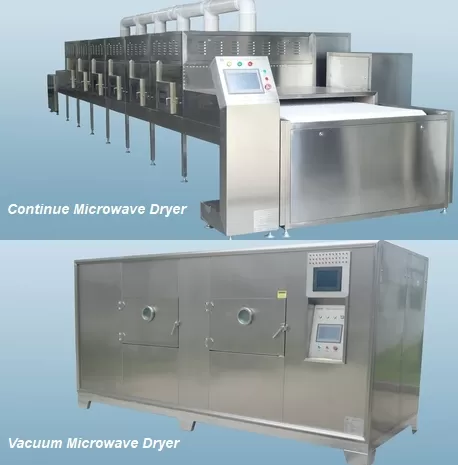
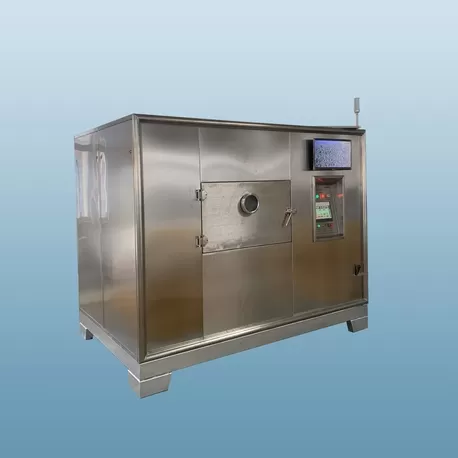
combining microwave power with vacuum conditions allows continuous drying at
reduced temperatures (35°C to 50°C), protecting active compounds and sensitive
ingredients from heat damage.
Q4: What is the typical operational lifespan of industrial magnetron
tubes?
A4: Industrial-grade magnetrons feature heavy-duty filaments,
liquid cooling systems, and robust ceramic seals built for continuous operation.
Standard 915 MHz industrial magnetrons offer operational lifespans between 8,000
and 15,000 hours, and modular generator configurations permit fast replacement
without halting the main production line.
Q5: What routine maintenance is required for continuous processing
systems?
A5: Primary maintenance tasks include keeping internal
cavity walls clean, inspecting transport belts for physical wear, cleaning
intake air filters, verifying cooling water loop purity, and conducting routine
emission checks using field survey meters to ensure safe, long-term
operation.
Request an Engineering Assessment for Your Production Line
Upgrading to continuous dielectric drying requires specialized process evaluation, precise power matching, and custom cavity design tailored to your specific material. If your manufacturing facility needs to expand production throughput, reduce energy costs, or solve moisture uniform issues, consult with our process design engineering team.
Contact our application engineers today to request a technical inquiry, arrange laboratory testing for your raw materials, or receive a comprehensive system proposal designed for your production specifications.