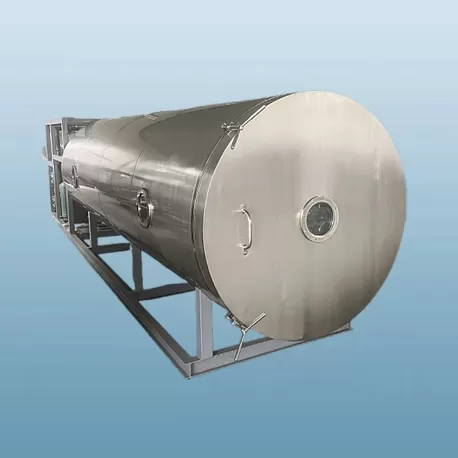
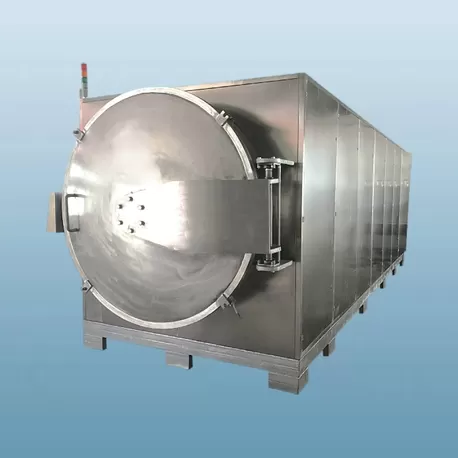
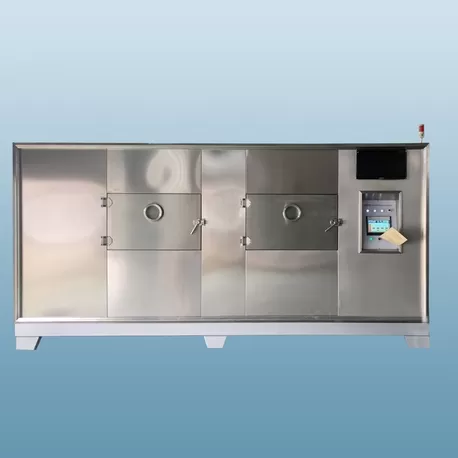
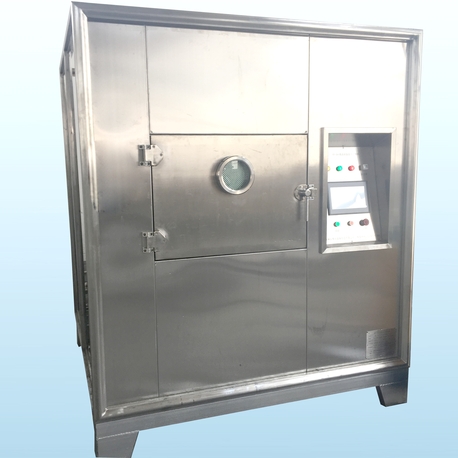
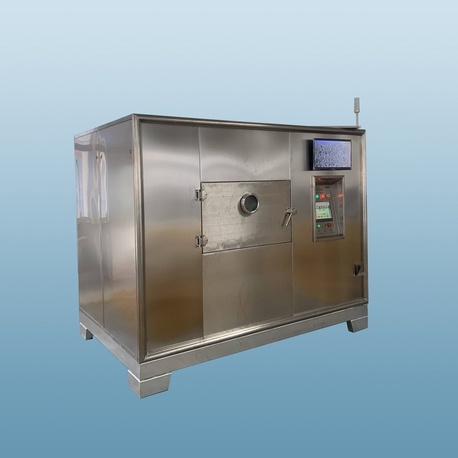
In industrial lumber processing, the wood dryer transforms green timber into usable stock
by reducing bound and free water below fiber saturation point. Unlike air
drying, a controlled drying system eliminates surface checks, honeycombing, and
warpage through precise temperature and relative humidity staging. This guide
covers heat transfer mechanisms, kiln configurations (conventional,
dehumidification, vacuum), and process optimization for mills producing
furniture blanks, flooring, or construction lumber.
A well-specified wood dryer accommodates species-specific drying
curves: slow for oak and maple, faster for pine and poplar. Nasan engineers drying systems with embedded moisture
sensing and PLC-controlled venting, reducing degrade from 12% to under 3% in
high-value applications.
1. Core Physics: How a Wood Dryer Removes Moisture
Wood contains two types of moisture: free water (cell lumens) and bound water
(cell walls). The drying process moves through three phases:
Warming-up stage: Heat raises core temperature, equalizing
gradients without evaporation.
Constant rate period: Free water migrates to surface;
evaporation depends on air velocity and vapor pressure difference.
Falling rate period: Bound water desorbs from cell walls;
slower diffusion controlled by relative humidity (RH) and temperature.
Critical parameters monitored inside a wood dryer include
dry-bulb temperature, wet-bulb depression (or RH), and air speed across
sticker-spaced loads. Improper control during the falling rate stage generates
drying stresses—casehardening or surface tension cracks.
2. Main Configurations of Industrial Wood Dryers
Selecting between conventional steam kilns, dehumidification dryers, and
vacuum systems depends on throughput, species, and energy source. Each design
has distinct airflow and heat recovery characteristics.
2.1 Conventional Steam or Hot Water Kiln
Most common for high-volume softwood mills. Coils heat recirculated air,
while vents release saturated vapor. Reversible fans
(clockwise/counterclockwise) equalize moisture across the charge. A conventional
wood dryer uses direct or indirect steam injection to increase
RH for equalization and conditioning treatments.
2.2 Dehumidification (Heat Pump) Dryer
Closed-loop system passes moist air over evaporator coils, condensing water
out. Latent heat is recovered to reheat dried air. Lower operating temperature
(40–60°C) reduces surface checking for species prone to collapse. Ideal for
hardwoods where gentle drying improves color retention.
2.3 Vacuum Wood Dryer
Lowers boiling point of water under vacuum (150–200 mbar), allowing fast
drying at 50–70°C without casehardening. Thick sections (10–15 cm) dry in 5–8
days instead of weeks. Energy efficiency is high, but batch size limited per
chamber.
Nasan integrates RF (radio frequency) assist for
large cross-sections, reducing drying gradients further. For producers of hard
maple flooring or ash tool handles, this hybrid approach eliminates reject due
to internal checking.
3. Critical Performance Metrics for Wood Dryer Evaluation
Industry standards (NHLA, ASTM D245) define quality classes. Measure these
indices when specifying or auditing a wood drying system:
Final moisture content (MC) uniformity: Target average 6–8%
for interior furniture, 12–15% for construction timber. Variation across load ≤
±1.5%.
Drying gradient (shell-to-core MC difference): At end of
process, difference ≤ 2%. Larger gradients cause post-drying distortion.
Air velocity uniformity: 1.5–3 m/s across all stickers.
Dead zones (below 0.8 m/s) create slower drying pockets and color
variation.
Condensate removal rate: For dehumidification models,
liters per kWh measures efficiency. Typical values: 2.5–3.5 L/kWh.
Stress relief capability: Conditioning cycle (high RH at
final stage) should equalize MC and relax residual stresses.
4. Heat Sources and Air Distribution Engineering
Modern wood dryer designs use indirect gas burners, electric resistance,
waste wood boilers, or recovered heat from cogeneration. The thermal delivery
method affects ramping speed and risk of scorching.
4.1 Direct-Fired Gas with Heat Exchanger
Fast response; combustion products isolated from drying chamber. Burner
modulation of 10:1 prevents overshoot near final setpoint. Requires fresh air
intake and flue gas exhaust management.
4.2 Steam Coil Arrays
Preferred for large kilns (over 80 m³). Steam from central boiler offers
stable temperature (±2°C). Condensate return improves efficiency. Coil fins must
resist corrosion from acidic wood extractives (oak, cedar).
4.3 Hydronic (Hot Water) Systems
Suitable for low-temperature dehumidification or solar-assisted dryers.
Slower thermal response but lower surface drying stress.
Air distribution inside a wood dryer relies on axial fans
placed in plenum chambers. Half the fans rotate clockwise, others
counter-clockwise; direction reversal every 6–8 hours equalizes moisture across
the stack. Nozzle plates or baffles prevent jet impingement directly on board
edges, which would over-dry end grain.
5. Species-Specific Drying Schedules
Each wood group requires customized dry-bulb and wet-bulb depression curves.
Common examples:
Red Oak (Quercus rubra)
Prone to honeycombing. Schedule starts at 40°C/38°C (dry bulb/wet bulb) for 3
days, then increases to 65°C/60°C. Final equalization: 71°C/68°C. Total time
28–35 days for 25mm thickness. Avoiding steep wet-bulb depression prevents
surface checking.
Southern Yellow Pine (Pinus spp.)
Fast drying tolerant. Initial 60°C/55°C, then raise to 80°C/75°C after free
water removal. Condition to relieve residual stress at 75°C/70°C. Total cycle
12–15 days for 25mm. Resin exudation control requires gradual venting.
European Beech (Fagus sylvatica)
High collapse sensitivity. Vacuum wood dryer or low-temperature
dehumidification (45°C maximum) recommended. Steam conditioning at the end for
12 hours prevents internal checks.
6. Industry Pain Points and Engineered Solutions
Even with proper equipment, operators face specific drying defects. Below are
root causes and fixes applied in professional wood dryer operations:
Pain point: Surface checks on thick walnut
slabs.
Solution: Reduce initial dry-bulb depression;
increase wet-bulb temperature to slow surface evaporation. Apply end-coating
sealer on log ends before stacking. Use gradual ramp of 5°C per day during first
72 hours.
Pain point: Collapse in red oak (hollow honeycomb
interior).
Solution: Introduce a pre-steaming cycle (80°C /
98% RH for 6 hours) to plasticize cell walls before drying. Then apply vacuum or
low-temperature dehumidification below 50°C until MC reaches 25%.
Pain point: Core remains wet while shell is over-dried
(casehardening).
Solution: Insert a conditioning hold:
raise RH to 85–90% for 8–12 hours before final drying. This equalizes shell-core
moisture and releases locked-in tensile stresses.
Pain point: Color degradation (darkening) in clear
pine.
Solution: Switch from steam to indirect electric
heating, reducing phenolic oxidation. Keep maximum temperature below 55°C and
eliminate exposure to combustion fumes.
7. Instrumentation and Control Strategies
Modern wood dryer systems integrate in-line moisture probes (resistance or
dielectric type) placed inside representative boards. Real-time data adjusts
vent positions or refrigeration capacity. Key sensors:
Resistance pin meters – measure MC between 7–25% range.
Good for final stage verification.
Dielectric (capacitance) sensors – non-intrusive, measure
MC 0–30% continuously.
Load cells – weigh entire kiln charge; weight loss
correlates to moisture removal.
Wet-bulb thermistors – need distilled water wick cleaning
weekly to avoid scale errors.
Programmable logic controllers (PLC) store up to 30 drying recipes. For
producers drying multiple species, Nasan offers cloud-based
monitoring with remote drying curve adjustment, reducing operator intervention.
Data logging supports certification for export (heat treatment compliance ISPM
15).
8. Maintenance Protocols for Long-Term Reliability
Regular inspection ensures consistent drying quality and energy
efficiency:
Fan reversal check: Verify that half the fans switch
direction every 6 hours. Stuck reversing relays create one-sided
over-drying.
Steam trap inspection (conventional kilns): Failed traps
allow live steam into return lines, increasing energy use by 15%.
Dehumidifier coil cleaning: Wood dust and resin accumulate
on evaporator fins, reducing heat transfer. Clean monthly with alkaline
foam.
Gasket and door seal integrity: Leaks cause moisture
infiltration and temperature stratification. Replace silicone seals every 24
months.
Calibration of moisture meters: Use certified moisture
standards (e.g., 12% maple block) each quarter. Field recalibrate if variance
exceeds ±0.5%.
9. Integration with Sorting and Planing Lines
After exiting the wood dryer, boards should be conditioned
in a holding area for 24–48 hours to relax residual gradients before planing.
In-line moisture scanning (continuous capacitance or NIR) triggers automatic
sorting into dry/acceptable/reject bins. For kiln-dried timber intended for
glued laminated products, a post-dryer equalization chamber (20–22°C, 55–60% RH)
stabilizes MC before finger-jointing. This step prevents glue-line failure from
moisture movement.
Nasan provides complete drying lines from green chain to
stacking, including heat recovery systems that capture exhaust energy to preheat
fresh air, lowering fuel consumption. For tropical hardwoods (iroko, meranti),
vacuum-assisted wood dryers reduce drying time from 45 days to 12 days while
preserving natural color.
Frequently Asked Questions (FAQ)
Q1: What is the ideal final moisture content range for
furniture-grade lumber from a wood dryer?
A1: For interior furniture (tables, chairs, cabinets) in temperate climates,
target 6–8% MC. This range matches equilibrium moisture content (EMC) of heated
buildings. For exterior furniture or decking, aim for 10–12% MC to prevent
movement with seasonal humidity changes. Always measure with a calibrated
pin-type meter at ¼ depth.
Q2: How to diagnose if a wood dryer is causing
casehardening?
A2: Cut a 25mm thick sample from dried board, then cut a prong shape (two
tines) from it. If the tines warp inward (closing), casehardening compression
stresses exist. The fix involves reconditioning: increase RH to 85% at 70°C for
8 hours, then slow cooling. Modern wood dryers with conditioning cycles prevent
this.
Q3: Can a dehumidification wood dryer handle 100mm thick oak
beams?
A3: Yes, but cycle extends to 40–50 days. To reduce risk of internal
checking, use vacuum-assisted dehumidification or a conventional kiln with steam
spray. For thickness above 80mm, a vacuum wood dryer is more efficient (dries in
12–18 days) because boiling point reduction prevents collapse. Always pre-steam
oak beams for 8 hours before drying.
Q4: What air velocity across the stack is needed for uniform
drying?
A4: Minimum 1.5 m/s at the driest (furthest from fan) position; 2.0–2.5 m/s
average is optimal. Velocities below 1.0 m/s create stagnant layers where
moisture remains, promoting mold or uneven color. Above 3.5 m/s causes end-grain
over-drying and raised grain. Use baffles to redirect flow where air
short-circuits.
Q5: How to reduce energy consumption without sacrificing
drying quality?
A5: Install heat recovery coils that capture exhaust enthalpy to preheat
incoming fresh air. For dehumidification dryers, add a pre-dry shed with forced
air (no heat) to remove free water from green lumber for 2–3 weeks before kiln
loading. Also, automate vent control: modulate dampers based on actual RH rather
than fixed timers. Nasan systems include a
smart purge routine that reduces vent cycles by 35% while maintaining gradient
control.
Q6: Why does my wood dryer show uneven MC across the same
species batch?
A6: Common causes: 1) Inconsistent sticker thickness (use uniform 19–25mm
stickers). 2) Fan reversal timer not alternating, creating one-sided drying. 3)
blocked return-air grilles by overhang. Map MC with a moisture meter every 2
meters along each row. Adjust vent positions or add internal baffles to
rebalance airflow. Schedule a kiln mapping test with nine sample boards placed
at different heights.
Request a process-optimized wood dryer
for your sawmill or joinery facility
Share your annual volume (m³), species mix, initial and target moisture
content, and thickness range. Nasan engineers provide
full drying schedules, ventilation layout, and energy recovery calculation.
Submit your inquiry to receive a technical proposal and kiln layout drawing
within 72 hours.
Inquiry form – Click here to contact our drying systems group (attach your
lumber photos for initial assessment).
Include preferred control automation level (basic PLC or cloud-based
monitoring) and available power (gas/steam/electric).