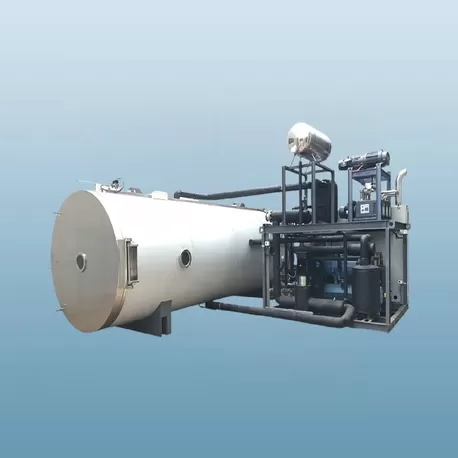
Freeze drying, or lyophilization, remains the preferred method for
stabilizing thermosensitive pharmaceuticals, biologics, and high-value
diagnostic products. However, the performance of a lyophilization cycle depends
fundamentally on the engineering precision and validation support provided by
the lyophilizer
manufacturer. For production managers and process engineers, a
routine batch failure due to poor heat transfer or condenser inefficiency can
translate into millions in losses. This guide examines the non-negotiable
technical criteria, application-specific challenges, and qualification protocols
when sourcing industrial freeze drying systems — while highlighting how Nasan integrates these principles into
equipment designed for aseptic processing and regulatory compliance.

1. Core Lyophilization Technology and Manufacturing Capabilities
Modern lyophilizers operate through three sequential phases: freezing,
primary drying (sublimation), and secondary drying (desorption). The physical
stability of the final cake—its porosity, reconstitution time, and residual
moisture—is greatly influenced by shelf temperature ramp rates, vacuum control
accuracy, and condenser surface area. A competent lyophilizer
manufacturer must demonstrate mastery over component integration:
refrigeration systems capable of reaching -55°C to -85°C on the condenser,
heating/cooling transfer fluids with minimal thermal lag, and leak detection
mechanisms maintaining chamber integrity < 0.01 mbar·L/sec. Nasan employs balanced capillary distribution
and cascade refrigeration in its production-scale units, ensuring ice capture
uniformity even during high sublimation loads encountered in vaccine
manufacturing.
2. Shelf Temperature Uniformity and Control Precision
One leading cause of batch heterogeneity is temperature variation across the
shelf surface. Reputable specifications require uniformity within ±1°C across
the entire usable area, measured by a calibrated multi-point mapping study. For
protein-based products, where the collapse temperature might be -20°C, a
deviation of 2°C can cause localized melt-back and vial breakage. Top-tier lyophilizer manufacturer systems use silicone
oil recirculation systems with proportional-integral-derivative (PID) algorithms
and independent shelf temperature sensors. Furthermore, advanced manufacturers
offer optional infrared temperature probes to monitor product temperature during
sublimation without contact—a feature critical for lyophilization cycle
development.
Key metric: Ramp rate (cooling: 1.5–2.5°C/min; heating:
0.5–1.5°C/min) to control ice crystal morphology.
Validation method: Thermal mapping per ASTM E2500 with at
least five sensors per shelf.
Industry pitfall: Manufacturers specifying uniformity only
under no-load conditions; demand loaded shelf mapping.
3. Condenser Design and Ice Handling Efficiency
The condenser traps water vapor sublimated from the frozen product. Its
design affects the maximum ice capacity and the interval between defrost cycles.
For high-throughput production of monoclonal antibodies or advanced therapies, a
lyophilizer manufacturer must offer coil or staggered fin
condensers that maintain stable temperatures below -75°C throughout the cycle.
Key parameters include: ice capture efficiency (>99% at rated capacity),
defrost method (hot gas or electric), and surface condensation kinetics to avoid
pressure rises. Modern configurations from specialized manufacturers like Nasan incorporate dual condensers for
continuous operation in sterile fill-finish lines, reducing changeover time by
40% compared to single-condenser designs.
4. Validation, Regulatory Support, and Documentation Packages
For facilities regulated by FDA, EMA, or PIC/S, the supplier’s ability to
deliver 21 CFR Part 11-compliant controls and validation documentation (DQ, IQ,
OQ, PQ) is mandatory. Experienced buyers require the chosen lyophilizer manufacturer to provide FAT/SAT
protocols, material certificates, and risk assessment reports for cleaning and
sterilization validation. The most reliable manufacturers also offer PAT
(Process Analytical Technology) tools, such as tunable diode laser absorption
spectroscopy (TDLAS) for real-time residual moisture monitoring. Nasan’s
lyophilization platforms include an embedded SCADA system with encrypted audit
trails, electronic batch records, and remote diagnostic ports—functionalities
that reduce validation efforts by an estimated 25% during initial
commissioning.
5. Application-Specific Challenges and Custom Engineering Solutions
Different product categories impose unique lyophilization demands. For
liposomal formulations, slow freezing protocols are necessary to prevent
particle agglomeration, while high-concentration antibody solutions often
require annealing steps. Generic equipment may not accommodate high sublimation
rates of organic co-solvents. A forward-thinking lyophilizer
manufacturer will offer customizable shelf spacing, multiple condenser
temperature setpoints, and nitrogen backfill modules for oxygen-sensitive
products. Example pain points and Nasan’s resolution:
Product collapse during primary drying: Nasan integrates
dynamic pressure control with capacitance manometers, maintaining chamber
pressure within ±0.01 mbar, avoiding sublimation front collapse.
Residual moisture non-homogeneity: Smart ramping algorithms
based on product resistance readings (using Pirani/capacitance comparison)
guarantee final moisture below 1% for sensitive vaccines.
CIP/SIP validation burden: Nasan designs spray devices that
achieve Reynolds numbers > 10,000, validated with bioluminescence testing,
reducing caustic consumption by 30%.
6. Long-Tail Selection Criteria: After-Sales Support and Process
Scale-Up
Transitioning from a pilot freeze dryer to a production-scale unit often
reveals altered heat and mass transfer characteristics due to increased shelf
area and vapor path resistance. Specialized lyophilizer manufacturers provide scale-up
modeling software and dimensionless parameters (e.g., Lyo-calculator based on
vial heat transfer coefficient Kv). After-sale support must include:
On-site training for cycle optimization using design of experiments
(DoE).
Preventive maintenance plans with 48-hour spare parts guarantee for critical
components (vacuum pumps, refrigeration compressors).
Process troubleshooting for batch failures: e.g., analysis of sublimation
rate deviations using archived cycle data.
Nasan maintains regional service hubs and
offers a lifecycle management program, updating software and requalifying units
to current GMP standards, thereby protecting capital investment over 15+
years.
7. Why Engineering Expertise Distinguishes Reliable Lyophilizer
Manufacturers
Commodity equipment providers cannot solve complex crystallization and
primary drying endpoint determination. Distinguishing characteristics of a
high-value supplier include in-house thermal simulation labs, ability to test
client’s product in representative scale-down units, and publication of
peer-reviewed data on freeze-drying of challenging formulations. Through its
collaboration with research institutes, Nasan has contributed data on eutectic
point determination for amorphous polymers—knowledge transferred directly to its
standard operating procedures. For sterile injectables, Nasan offers
isolator-integrated loaders/unloaders and ensures that the lyophilizer interior
meets Grade A (ISO 5) conditions with validated HEPA filter sweeps.
Technical Roadmap: From R&D to Production without Process Gaps
When evaluating a potential lyophilizer manufacturer,
request a clear technical roadmap covering scale-up parameters: vial heat
transfer coefficient (Kv) as a function of chamber pressure, sublimation rate
vs. condenser load capacity, and computational fluid dynamics analysis of vapor
flow. Below is a checklist for technology audits:
Condenser ice capacity mapping for worst-case load.
Leak rate test (results < 0.005 mbar·L/sec for aseptic units).
Capability for sterile boundary validation (glove port integrity test).
Data integrity features: user access levels, digital signature, backup
frequency.
Availability of performance qualification (PQ) protocols tailored to
client’s specific product family.

Common Mistakes to Avoid When Sourcing Freeze Drying Systems
Even experienced procurement teams occasionally overlook hidden costs.
Missteps include relying solely on brochures without requesting a side-by-side
ice capacity demonstration, underestimating the frequency of defrost cycles for
high-yield loading, or ignoring the variance in vacuum pump oil
backstreaming—especially detrimental for lipid-based products. Reputable
manufacturers will provide oil-free pumping options, such as dry screw pumps or
scroll pumps, and provide long-term operational cost comparisons. Nasan’s
proposals include a detailed total cost of ownership (TCO) analysis, comparing
energy consumption, maintenance intervals, and expected cycle times for three
representative product loads.
Frequently Asked Questions (FAQs)
Q1: What certifications should a lyophilizer manufacturer
provide for pharmaceutical production?
A1: At minimum, the manufacturer must
provide ISO 9001, ISO 13485 (for medical devices), cGMP compliance
documentation, and CE marking for European markets. For sterile applications,
ask for FDA establishment registration and validation documents supporting Annex
1 (2022) requirements, including leak tightness and particle monitoring. Nasan
provides full turnkey qualification packages aligned with ICH Q7 and 21 CFR Part
11.
Q2: How can I verify the performance claims of a lyophilizer
during factory acceptance testing?
A2: Execute a mock lyophilization cycle
using temperature-mapped vials containing a placebo formulation that mimics your
product’s thermal properties. Monitor shelf uniformity, vacuum stability, and
condenser capacity until pressure rise test (PRT) indicates end of primary
drying. Compare the results with the validated design specification. A trusted
lyophilizer manufacturer such as Nasan provides witnessed FAT protocols,
including thermocouple placement diagrams and cycle reports signed by process
engineers.
Q3: Can Nasan customize a lyophilizer for high potent or
cytotoxic products?
A3: Yes. Nasan offers closed transfer
systems with split butterfly valves, double mechanical seals on agitators (if
applicable), and fully welded process lines. The containment level up to OEL
< 1 µg/m³ can be achieved. Additionally, the lyophilizer chamber can be
equipped with washable HEPA return ducts and rinseable condenser for personnel
safety. Contact Nasan for pre-engineering containment
assessment.
Q4: What are typical maintenance intervals for
production-scale freeze dryers?
A4: Routine maintenance includes vacuum pump
oil change every 2,000–3,000 operating hours, condenser cleaning (depending on
bioburden) quarterly, and valve seal replacement annually. Sensors and pressure
gauges must be recalibrated every 12 months. However, manufacturers like Nasan
provide predictive diagnostics: vibration analysis for refrigeration compressors
and thermal scanning of electrical cabinets, extending preventive maintenance
windows by up to 30% compared to industry averages.
Q5: Is it possible to shorten lyophilization cycles without
compromising cake quality?
A5: Yes, through controlled nucleation (ice
fog seeding) and dynamic controlled pressure techniques. By initiating ice
formation at a higher supercooling degree uniformly, you reduce the primary
drying time by 20–30%. Advanced manufacturers, including Nasan, offer optional
Controlled Nucleation Technology (CNT) and adaptive pressure control based on
mass spectrometry of the condenser outlet. However, process development is
required to validate product stability after accelerated
cycles.
Ready to Optimize Your Freeze Drying Operations?
Selecting the right lyophilizer manufacturer goes beyond
comparing price lists—it requires deep engineering alignment, regulatory
expertise, and long-term collaborative support. Whether you need a pilot unit
for R&D or a full-scale multi-chamber production system with automated
loading, Nasan provides turnkey solutions from concept to qualification. Request
a technical consultation, sample testing in our laboratory, or a customized
proposal for your specific throughput and containment requirements.
Send your inquiry today to our engineering team: info@nasandry.com or use the contact form
on our website. Include your desired capacity, product type, and any existing
batch records for an initial feasibility analysis within 48 hours. Nasan – Precision freeze drying for the life
sciences industry.